 HYGO News
 House PASSED rescissions; Trump at Congressional Picnic; RFK: Health Savings gym member/concierge dc
House PASSED rescissions; Trump at Congressional Picnic; RFK: Health Savings gym member/concierge dc
A quietly consequential evening at the White House delivered four separate political stories of real significance. The House of Representatives passed the first rescissions package of the Trump second term, clawing back billions in federal funding for NPR, PBS, and foreign aid programs the administration characterized as subsidizing “Radical Left lunacy abroad.” Trump, hosting the annual Congressional Picnic, delivered an economic monologue that compressed the administration’s entire argument into a single paragraph. Health and Human Services Secretary Robert F. Kennedy Jr. unveiled the specific Health Savings Account provisions of the One Big Beautiful Bill that will, in his framing, make ordinary Americans healthier. And U.S. Attorney Bill Essayli delivered one of the sharpest prosecutorial warnings in recent federal practice: Californians conditioned to expect no consequences for criminal activity against federal agents would find the federal government operates on different rules.
The Rescissions Pass
The rescissions package is the legislative instrument through which Congress can claw back previously appropriated funds. It had been the subject of weeks of political combat, with Democrats pledging to “work hard to kill” it and Republican leaders pressing for passage. The House vote sent the bill to the Senate, where its prospects are uncertain but where the administration has been actively working members.
What the rescissions does, in practical terms, is redirect or rescind funding that had been appropriated for programs including public broadcasting and various foreign aid line items. The administration’s framing of these line items — “Sesame Street in Iraq,” “Radical Left lunacy abroad” — is rhetorical. The Democratic framing — “First Amendment support,” “critical diplomatic assistance” — is also rhetorical. What matters substantively is that the House has now voted to end these funding streams, which means the debate has shifted from whether to end them to how many survive Senate negotiation.
”Incomes Are Soaring, Grocery Prices Are Way Down”
At the Congressional Picnic, Trump delivered what may be the most compressed articulation of the administration’s economic case to date. “The U.S.A. is now really on a path that’s, I believe, unparalleled. Trillions of dollars of investment are pouring in, incomes are soaring, grocery prices are way down, gasoline prices are way down, energy prices are down, mortgage rates are down, and inflation is down.”
That paragraph contains, in a single breath, the administration’s six-point economic argument. Investment is flowing into the country. Wages are rising. Grocery costs are falling. Fuel costs are falling. Energy costs are falling. Housing finance is easing. Inflation is decelerating.
Each claim is empirically debatable at the margins, but directionally the May CPI, the trade deficit release, and the administration’s investment announcements support the overall framing. The political effect of the paragraph is cumulative. Any one claim, heard in isolation, might be questioned. The six-point list, delivered rapid-fire, is harder to dismiss because it triangulates across metrics that are not normally correlated.
”Every Single One Of Them”
Trump then framed the list as delivery against explicit commitment. “They’ve been talking to me, do you think you can get prices down? We did it every single one of them.”
The “every single one” formulation is the rhetorical closing of a political promise. Voters had asked Trump, across the 2024 campaign, whether he could get specific prices down. His answer is that he has done so — not on some of the categories, but on all of them.
The Trade Deficit Halved
The president then delivered a specific statistic. “Last month we cut the trade deficit. You saw that two days ago, it was just announced. The trade deficit was cut in exactly half. And that was all done in a period of four months.”
Cutting the trade deficit in half in four months is a statement that demands context. Trade deficits fluctuate with exchange rates, import prices, and consumer demand. A 50% cut in four months is unusual and, if sustained, would be historic. The administration’s theory is that the combination of tariffs, reshoring incentives, and domestic energy production has rebalanced the trade flows in favor of U.S. producers.
The caveat is that a single month of trade data can be affected by timing factors — inventory buildup, shipment delays, or one-time commodity transactions. The question for the administration is whether the trade deficit decline persists across subsequent months. If it does, Trump will have a talking point that almost no modern president has been able to claim.
”99.999 Percent” — The Border Numbers
Trump pivoted to the border. “So we’ve reduced the number of illegal border crosses, and you know that because you look at the numbers, and 99.999 percent. Last month it was three people got across, three.”
The “three” figure for monthly unauthorized crossings is so low that it prompts immediate skepticism, but the administration has been reporting similar numbers for several months. The methodology matters — “got across” likely refers to encounters that resulted in successful evasion, not total encounter volume. What Trump is asserting is that the combination of border enforcement, Mexican cooperation, and deterrence messaging has reduced successful unauthorized crossings to near zero.
That claim, even with methodology caveats, is an extraordinary shift from the multi-hundred-thousand-per-month figures reported in earlier years. The political implication is enormous. If the border is genuinely functioning, the immigration debate shifts from flow to stock — from “how do we stop new crossings” to “what do we do about the people who are already here."
"I Did A Good Job In 2016, But We Did An Even Better Job”
Trump’s self-comparison to his first term was direct. “So I did a good job in 2016, but we did an even better job right now, and it’s been amazing.”
The claim is that the second term is delivering more, faster, than the first term. The argument rests partly on the experience of the personnel around him — many of whom served in the first term and returned to the second — and partly on the clearer policy priorities going in. The first term, in this telling, was a learning curve. The second term is execution.
”A Lot Of Bad People Were Led Into Our Country”
Trump’s framing of the deportation operation was that the prior administration had actively admitted criminal elements. “We have to get a little cooperation for some people, but a lot of bad people were led into our country, and we’re getting them out fast, and I think you know that.”
The word “led” is deliberate. Trump is not saying bad people entered the country. He is saying they were led into the country — a framing that assigns agency to prior administration policies rather than to the individuals themselves. The implication is that correcting the policies requires reversing the admissions, which is what the current deportation operation is doing.
RFK Jr.: HSAs As The Health Access Lever
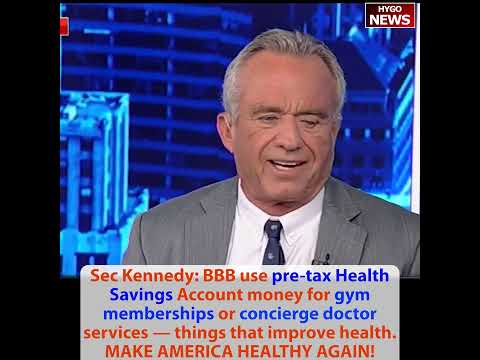
Health and Human Services Secretary Robert F. Kennedy Jr. then pivoted to the specific provisions of the One Big Beautiful Bill that affect his department. “I know that you feel strongly about the big, beautiful bill. Tell us what the impact is on HHS for you. And give Americans more choice. One of the things that it does, it allows health savings accounts, which are very popular with American people, that you can put pre-tax money aside to pay for certain things that are relevant to healthcare.”
Health Savings Accounts are a tax-advantaged vehicle that allows individuals to set aside pre-tax dollars for medical expenses. The accounts have existed for years, but the list of “qualified medical expenses” has been tightly defined — prescriptions, doctor visits, specific equipment. What the One Big Beautiful Bill expands, in Kennedy’s explanation, is what counts as qualified.
”Gym Memberships Will Be Paid For”
Kennedy’s first expansion was striking. “For example, gym memberships will be paid for.”
The rationale is straightforward. If the country is serious about preventive health, exercise is the single most cost-effective intervention available. Allowing Americans to use pre-tax HSA dollars on gym memberships converts what had been an after-tax discretionary expense into a tax-advantaged health investment. For many households, that turns gym membership from a luxury into an affordable health practice.
”$75 A Month…Concierge Doctor”
Kennedy’s second expansion was arguably more consequential. “For $75 a month, you can, under this bill, you’ll be able to get a concierge doctor who is available 24 hours a day, every day of the week, every day of the year. And you won’t get a bill for it. You won’t have to file insurance claims. It’s just like old-style healthcare, but it’s for $75 a month.”
The concierge medicine model — direct-pay primary care — is one of the fastest-growing segments of American healthcare. At $75/month, the product sits at an accessible price point. What the bill enables is paying for it through HSA funds, which converts the expense to pre-tax dollars and eliminates the insurance-paperwork friction that has made conventional primary care increasingly unpleasant for both doctors and patients.
The long-term implication is interesting. If millions of Americans begin using HSA dollars for direct-pay primary care, the traditional insurance-intermediated primary care market may face meaningful competitive pressure. That competitive pressure could, in turn, produce reform in how insurance-based primary care is delivered.
On-Site Medical Centers At Workplaces
Kennedy’s third provision addressed the workplace. “We’re also going to allow the creation of on-site medical centers by employers at factories, at workplaces where workers can get treated for free. Somebody won’t have to leave work for four or five hours to get a medical checkup. They’ll be able to do that on-site.”
On-site medical care has been a feature of some large employers for years — companies like Boeing and Google have had workplace clinics for decades. What the bill does is extend and incentivize the model across a broader swath of employers. The practical effect for workers is enormous: a routine physical that might otherwise require a half-day off work becomes a 30-minute visit during a break.
Essayli: “You Will Go To Federal Prison”
The video closed with U.S. Attorney Bill Essayli’s remarks on the Los Angeles federal enforcement operation. The operational context: Essayli’s team had been conducting federal arrests across Los Angeles County, and they had been met with what he described as organized resistance.
“We had judicial warrants to do what we did on both Friday and Saturday. The amount of resistance and organized agitators that showed up to try to impede us was overwhelming. And we’re really grateful to the president for deploying the guard, which allowed us to continue our mission undeterred, to enforce the law, and to keep our people and our buildings safe."
"We Will Bring Charges, And You Will Go To Federal Prison”
Essayli then delivered the prosecutorial warning that defines the article’s title. “My office has been aggressive in bringing charges. We charge several people over the weekend. And some people in the state of California have been conditioned to think that there is no consequences for criminal activity. And you know, that might be true for the state of California, but it’s not true with the federal government. And we will bring charges and you will go to federal prison.”
The “conditioned to think” framing is a direct indictment of California’s prosecutorial environment. Essayli is arguing that years of progressive prosecutors declining to bring charges for certain offenses have left some Californians with the mistaken impression that federal law works the same way. His message is that the federal system does not operate by the same priorities, and that interference with federal operations carries federal consequences.
”If You Spit, We Hit”
Essayli’s closing line echoed one the president had used. “This is the federal government. This is not the state government. As the president said, if you spit, we hit and we’ll hit you with a felony.”
The phrase — “if you spit, we hit” — is meant to convey the federal threshold. Minor-seeming misconduct against federal personnel, which in California might not result in charges at all, will result in federal felony charges. The warning is specific and credible because Essayli’s office has already demonstrated the willingness to file those charges.
Key Takeaways
- House passed the rescissions package clawing back billions in federal funding for NPR, PBS, and foreign aid; now heads to the Senate.
- Trump’s compressed economic case: “Trillions of dollars of investment are pouring in, incomes are soaring, grocery prices are way down, gasoline prices are way down, energy prices are down, mortgage rates are down, and inflation is down.”
- Trade deficit “cut in exactly half” over four months; monthly unauthorized crossings reported at “three people got across, three.”
- RFK Jr. on the One Big Beautiful Bill: Health Savings Accounts will pay for “gym memberships” and “$75 a month” concierge doctor subscriptions.
- U.S. Attorney Essayli to LA agitators: “some people in the state of California have been conditioned to think that there is no consequences for criminal activity…we will bring charges and you will go to federal prison.”