 HYGO News
 Hillary Clinton nominate Trump Nobel Peace Prize Russia Deal; Dem Crockett, Ayanna Pressley, Mamdani
Hillary Clinton nominate Trump Nobel Peace Prize Russia Deal; Dem Crockett, Ayanna Pressley, Mamdani
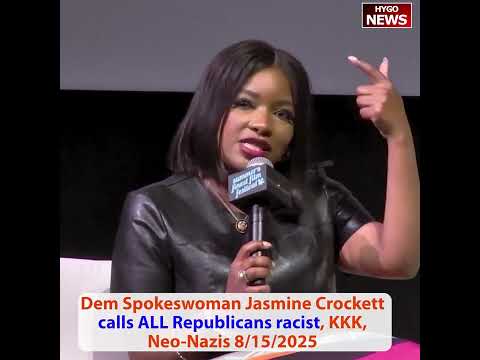
An unusual composite segment. Hillary Clinton declared she would nominate Trump for the Nobel Peace Prize if he ends the Russia-Ukraine war. AG Pam Bondi provided an operational update on DC arrests. Rep. Jasmine Crockett accused Republicans broadly of being KKK/Neo-Nazis. Rep. Ayanna Pressley called Trump a “wannabe dictator.” Virginia’s Abigail Spanberger declined a CNN debate invitation despite earlier saying “don’t vote for someone who won’t do a debate.” And Zohran Mamdani’s “free buses” proposal — costing $650 million annually. Clinton: “If President Trump were the architect of that, I’d nominate him for a Nobel Peace Prize. To make it clear, there must be a ceasefire. There will be no exchange of territory. And that over a period of time, Putin should be actually withdrawing from the territory he seized.” Bondi on 156 DC arrests: “Citizens are coming out of their homes, and they’re going up to these law enforcement officers, and they’re thanking them for keeping them safe.” Crockett: “Most black people are not Republicans simply because we just as like y’all racist. I can’t hang out with the KKK in them.” Pressley on Trump: “What this wannabe dictator wants is a citizenry that is ignorant and uninformed.”
Hillary Clinton’s Nobel Peace Prize Offer
Hillary Clinton’s specific statement. “If President Trump were the architect of that, I’d nominate him for a Nobel Peace Prize. To make it clear, there must be a ceasefire. There will be no exchange of territory. And that over a period of time, Putin should be actually withdrawing from the territory he seized in order to demonstrate good faith efforts, let us say, not to threaten European security. If President Trump were the architect of that, I’d nominate him for a Nobel Peace Prize.”
That is the unexpected acknowledgment from Clinton — one of Trump’s most persistent political opponents over the past decade. The 2016 Democratic presidential nominee. A central figure in the Russia-collusion narrative that dominated Trump’s first term. Clinton publicly stating she would nominate Trump for the Nobel Peace Prize is a notable political moment.
Clinton’s conditions are specific:
- Ceasefire as the starting point
- No territorial exchange (Russia does not get to keep occupied territory)
- Russian withdrawal over time from seized territory
- Demonstration of good faith on European security
Those conditions track closely with Zelensky’s and European leaders’ positions. Whether Putin would accept those conditions is the negotiation question.
”If Trump Were the Architect”
The phrase “if Trump were the architect” matters. Clinton is not merely saying she would support any Russia-Ukraine peace. She is specifically acknowledging that Trump’s diplomatic architecture — if it produces her described outcome — would warrant the Peace Prize.
The Nobel Peace Prize has been awarded to previous U.S. presidents (Roosevelt, Wilson, Carter, Obama — the last of whom received it for essentially aspirational reasons during his first months in office). Trump would earn it for specific operational success — ending a major war that has killed hundreds of thousands.
Whether Clinton’s statement is tactical (acknowledging Trump cannot be prevented from achieving the outcome and accepting some credit for it), sincere (genuine recognition that ending the war is more important than partisan opposition), or both, is a political question. The statement itself is significant regardless of motivation.
Bondi: “DC Will Not Remain a Sanctuary City”
Attorney General Pam Bondi’s continuing DC framework. “DC will not remain a sanctuary city, actively shielding criminal aliens. Will not happen. Under Donald Trump’s directive, DC will become safe again, and it will become clean again.”
That reaffirms the end of DC’s sanctuary policies documented in the previous segment. “Will not happen” — no exceptions. DC officials will cooperate with ICE. Criminal aliens will not be shielded from federal enforcement.
“Safe again, and it will become clean again.” Two distinct objectives. Safety (crime reduction). Cleanliness (encampment clearance, infrastructure restoration, graffiti removal, general aesthetic improvement).
”Extremely Divisive City Council”
“And I think what’s happening is it’s a combination of an extremely divisive city council. You have liberal judges, you have no cash bail, as you said. You have juveniles running rampant over this city, and you have a Metro Police Department. They want to do their jobs.”
The specific causal analysis. Multiple factors contributing to DC’s crime problem:
- Divisive city council (political leadership failure)
- Liberal judges (light sentencing, bail decisions favoring defendants)
- No cash bail (defendants released pre-trial)
- Juveniles “running rampant” (juvenile crime, weak enforcement)
“A Metro Police Department. They want to do their jobs.” That framing distinguishes DC MPD officers from the system they operate within. Officers want to enforce law. The system (judicial, political, operational) has constrained their ability to do so. Federal intervention removes some of those constraints.
156 DC Arrests
“And we have been out there for the last few nights with all of our federal agencies. Sean, they have been working so hard working together. We’ve made 156 arrests, and we are going to protect DC and make it safe again.”
156 arrests in “the last few nights” — specific operational output. Multiple federal agencies coordinating with MPD. Active nightly enforcement. Specific arrest numbers demonstrate the federalization is producing measurable law enforcement activity.
”Citizens Are Coming Out of Their Homes”
“But you know, I think the most impactful thing that’s happened, despite what we’ve seen with these crazy protesters out there, citizens are coming out of their homes, and they’re going up to these law enforcement officers, and they’re thanking them for keeping them safe and making the streets safe again.”
That is the specific operational feedback. DC residents are thanking federal law enforcement officers. Despite “crazy protesters” framing federalization as authoritarian overreach, ordinary DC residents are grateful for the increased safety.
“And elderly woman walks up to law enforcement and thanks them so she can go to the market again.”
A specific anecdote. An elderly woman can go to the market. That simple activity — buying groceries safely — has been restricted for many DC residents because of crime. The federalization restores that basic daily function.
That kind of specific testimony is more persuasive than statistical framings. An elderly woman thanking an officer because she can shop safely is a specific human story that resonates with voters who understand the underlying fear.
Crockett: “Y’all Racist”
Rep. Jasmine Crockett’s framing of Black political alignment. “Most black people are not Republicans simply because we just as like y’all racist. I can’t hang out with the KKK in them. That’s really what it is.”
That is extraordinary framing from a sitting member of Congress. All Republicans characterized as “racist.” Republicans equated with KKK members. Association with Republicans treated as equivalent to “hanging out with the KKK.”
“But when we think about who we are as black people and we think about where we come from, most black people have very conservative values, right?”
Crockett acknowledging the policy overlap. Most Black Americans hold culturally conservative values on many issues — faith, family, small business, crime, education. Those are generally aligned with Republican positions rather than progressive Democratic positions.
“But the reality is that like we just came side with like the neo-nazis in them.”
Despite policy alignment, Crockett’s framing: Black Americans cannot ally with Republicans because Republicans are “neo-nazis.” The identity-politics framing overrides the policy alignment.
The political effect of that framing is specific. Black voters who held conservative values but had been reliable Democratic voters have begun shifting toward Republicans — particularly Black men, who gave Trump substantially more support in 2024 than in prior elections. Crockett’s framing — calling those voters “neo-nazi”-adjacent — does not persuade them to return. It further alienates them from the Democratic Party.
Pressley: “Wannabe Dictator”
Rep. Ayanna Pressley on Trump. “What this wannabe dictator wants is a citizenry that is ignorant and uninformed. He wants a citizenry that is indifferent to the suffering of its neighbors.”
“Wannabe dictator.” That is the specific Democratic framing — used by Pressley, Beto O’Rourke (with Hitler comparisons), Newsom, and many others. The consistency of the framing across multiple figures suggests coordinated messaging.
The factual basis for “dictator” is absent. Trump governs under the same constitutional constraints as previous presidents. Congress meets. Courts rule. Elections occur. None of the structural dictatorship indicators are present. The framing relies on aggressive executive action (executive orders, firings of federal officials, operational choices) being equivalent to dictatorship — which they are not.
“A citizenry that is ignorant and uninformed.” That is Pressley’s implicit characterization of Trump voters. Voters who support Trump are, per this framing, ignorant and uninformed. Educated, informed voters would oppose Trump.
The political effect is similar to Crockett’s. Calling Trump voters ignorant does not persuade them to change positions. It confirms their sense that Democratic elites look down on them.
”Woman on the BX33”
Pressley’s New York reference (Pressley represents Massachusetts, but her reference is to Mamdani’s New York mayoral campaign). “I think of a woman I met on the BX33 a few years ago who said, I used to love New York. Now it’s just where I live. There are too many New Yorkers who feel that pain.”
The BX33 is a Bronx bus route. An anecdote from an ordinary New Yorker expressing disillusionment with the city. “I used to love New York. Now it’s just where I live.” That captures the specific post-pandemic New York decline many residents have felt.
“It is our job to bring that love back to their lives, to bring it back as we freeze the rent for more than two million rent stabilized tenants, to bring it back as we make the slowest buses in the country fast and free.”
Mamdani’s proposed policies. Rent freeze on 2 million rent-stabilized apartments. Fast and free buses. Those are the specific proposals Pressley is endorsing for New York.
Mamdani’s Free Buses: $650 Million Annually
The segment notes the fiscal cost. “Democrat leader & communist Zohran Mamdani’s ‘free’ buses ALONE will cost New Yorkers $650 million a year. And that’s just ONE of his radical policies.”
$650 million annually for free buses. That is the specific fiscal cost — subsidy covering what currently paying passengers contribute to MTA revenue. That cost must be paid from somewhere — new taxes on New York City residents (city-level taxes) or state funding (from other New York residents).
And “that’s just ONE of his radical policies.” Mamdani’s platform includes:
- Rent freeze on 2 million apartments
- Free buses
- City-owned grocery stores
- Significant tax increases on high earners
- Various other progressive proposals
The cumulative fiscal impact would be substantially greater than $650 million. Implementation would require either substantial new revenue or substantial new debt.
Spanberger Refusing Debate
Virginia Democrat Abigail Spanberger’s debate history. “We were talking about debates earlier. Like people don’t want to debate anymore as a voter. Like don’t vote for someone who won’t do a debate. Right?”
Spanberger’s own prior statement: voters should not vote for candidates who refuse debates. That was her campaign-level principle.
“Like debates are, they can be very fun, I’ll be honest. But they’re nerve-wracking because you’re on display and it’s the contrast of ideas. And yet, you know, I have had three elections and only in two of them did I have the chance to debate my opponent. That’s not fair to the voters. Right? You’re relying on a 30-second television ad.”
Spanberger’s recognition that debates are important for voters. Her own experience: had debates in two of three elections. Third election’s lack of debate was “not fair to the voters.”
And yet: Spanberger herself declined a CNN debate invitation in her current Virginia governor’s race. “She can’t defend her radical record — like voting to keep men in girls’ sports and locker rooms.”
The political contradiction is specific. Spanberger previously said debates were essential. She now refuses to debate. Presumably because her specific record includes votes (transgender athlete participation, etc.) that would be difficult to defend in direct debate format.
That is what Subramanyam called the “future of the Democratic Party” — Spanberger as the Mamdani-charismatic pragmatist. Whether voters find refusal to debate to be “pragmatism” or opportunism is the political question.
Six Distinct Stories
Clinton’s Nobel Peace Prize offer (surprising political moment). DC operational updates (156 arrests). Crockett’s Republicans-as-KKK framing (alienating moderate voters). Pressley’s wannabe-dictator framing (also alienating). Spanberger’s debate refusal (concealing her record). Mamdani’s $650 million free buses (fiscal indicator of broader radical platform).
The composite shows the specific Democratic political situation. Even Clinton acknowledges Trump may earn Nobel Peace Prize. Democratic politicians continue rhetorical framings (KKK, dictator) that alienate moderate voters. Democratic candidates avoid direct defense of their records. Progressive policies (Mamdani’s) carry fiscal costs that voters will eventually have to pay.
The cumulative trajectory — on current evidence — favors continued Republican electoral momentum through 2026.
Key Takeaways
- Hillary Clinton’s unexpected Nobel offer: “If President Trump were the architect of that, I’d nominate him for a Nobel Peace Prize. To make it clear, there must be a ceasefire … Putin should be actually withdrawing from the territory he seized.”
- AG Pam Bondi on DC operational results: “We’ve made 156 arrests … citizens are coming out of their homes, and they’re going up to these law enforcement officers, and they’re thanking them for keeping them safe.”
- Rep. Jasmine Crockett on Republicans: “Most black people are not Republicans simply because we just as like y’all racist. I can’t hang out with the KKK in them … like we just came side with like the neo-nazis in them.”
- Rep. Ayanna Pressley on Trump: “What this wannabe dictator wants is a citizenry that is ignorant and uninformed. He wants a citizenry that is indifferent to the suffering of its neighbors.”
- Abigail Spanberger’s debate contradiction: “People don’t want to debate anymore as a voter. Like don’t vote for someone who won’t do a debate” — while herself declining a CNN debate invitation.