 HYGO News
 Trump Roasts Biden at White House Summer Soiree: 'Don't Fall, Please. We Had an Administration That Fell a Lot -- We Don't Want to Have That'; NYC Mayoral Candidates Compete to Protect Illegals -- Mamdani Would Use Tax Dollars, Adams Sues Trump; OMB's Vought on OBBB: 'First Time Since 1990s Talking About Trillions in Mandatory Savers'
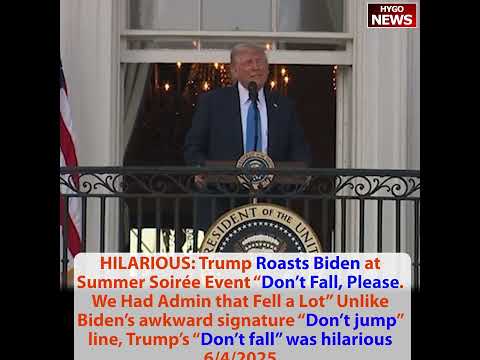
Trump Roasts Biden at White House Summer Soiree: “Don’t Fall, Please. We Had an Administration That Fell a Lot — We Don’t Want to Have That”; NYC Mayoral Candidates Compete to Protect Illegals — Mamdani Would Use Tax Dollars, Adams Sues Trump; OMB’s Vought on OBBB: “First Time Since 1990s Talking About Trillions in Mandatory Savers”
At a White House Summer Soiree in early June 2025, President Trump delivered a classic Biden-era callback. “Don’t fall, please, nobody. We had an administration that fell a lot, and we don’t want to have that.” The whole crowd erupted in laughter. The rest of his speech captured electoral victory: “We won every swing state. We won the popular vote by millions. We won everything you can win. And now we have a successful country. Doesn’t it feel different?” In NYC mayoral race news, Democrat candidate Zohran Mamdani committed to using NYC taxpayer dollars for illegal immigrant healthcare. Candidate Adrienne Adams bragged about suing Trump: “I will always be a mayor that will stand up for our immigrants. Donald Trump’s ICE has no place on Rikers Island… not in my New York.” OMB Director Russ Vought on OBBB: “One of the reasons we’re so excited about it is that for the first time since the 1990s, we are talking about trillions of dollars with regard to mandatory savers. $1.7 trillion now is an enormous opportunity and first step along the lines of what you’re talking about.” He noted: “For those saying ‘where are the DOGE cuts?’ — that’s not a reconciliation thing. For those saying ‘where are mandatory reforms?’ — that IS in that bill.”
The Summer Soiree
The White House hosted a large event on the South Lawn.
“USA! USA! USA! USA!” the crowd chanted.
Trump arrived to enthusiastic welcome: “What a nice group. Look at them all coming back now. They were way out at that fence, and they’re coming back. They’re running.”
Then came the memorable joke: “Don’t fall. Please, nobody. We had an administration that fell a lot, and we don’t want to have that. We don’t want to have any of that.”
The Biden Fall References
Trump’s “fall a lot” joke had specific content.
Biden’s physical falls had been extensively documented throughout his presidency:
- Multiple falls on Air Force One stairs
- Falling from his bicycle in Delaware
- Various stumbles at public events
- Visible difficulty walking and navigating stairs
- Fall during West Point graduation ceremony
Each fall had been:
- Captured on video
- Widely shared on social media
- Metaphorically representative of decline
- Symbolic of broader administration failures
- Politically significant
Trump’s joke captured all of this in four words. “Don’t fall, please, nobody” wasn’t just physical humor — it was a specific reference to Biden’s documented pattern of falls. The crowd understood the reference and laughed appropriately.
The Electoral Celebration
Trump used the event to celebrate 2024 victory.
“Well, I’m delighted to welcome to the White House the thousands of proud American patriots. And that’s what you are, your patriots,” Trump said.
He noted the event’s uniqueness: “You know, we’ve never done this before. You know that, right? This is the first. They didn’t do it. The previous administration wouldn’t have thought of doing it.”
He looked forward: “But we’re going to do it for four more years. I don’t know, maybe eight more years. I don’t know.”
He praised the attendees: “But we love you all. You’re really amazing, successful people all.”
He cited their contributions: “And you just gave your heart and your soul and we won every swing state. We won the popular vote by millions. We won everything you can win.”
He delivered the satisfying observation: “And now we have a successful country. Doesn’t it feel different?”
The Electoral Reality
Trump’s claims about 2024 were factually accurate.
“Every swing state”: Trump had won:
- Pennsylvania (20 electoral votes)
- Georgia (16 electoral votes)
- Michigan (15 electoral votes)
- North Carolina (16 electoral votes)
- Arizona (11 electoral votes)
- Nevada (6 electoral votes)
- Wisconsin (10 electoral votes)
All seven major swing states had gone Republican. This was the first time since 2000 that one party had swept the swing states.
“Popular vote by millions”: Trump had:
- Won the popular vote by approximately 2.5 million votes
- First Republican popular vote win since 2004
- Largest Republican popular vote margin since 2004
- Substantial improvement over 2016 and 2020
- Genuine mandate beyond electoral college
“Won everything you can win”: Republicans had also won:
- House of Representatives majority
- Senate majority
- Governor elections in multiple states
- Various state-level races
- Cultural and political momentum
”Doesn’t It Feel Different?”
Trump’s observation was genuine and widely shared.
The objective reality in June 2025:
- Consumer confidence surging
- Jobs numbers strong
- Border effectively secured
- Energy prices falling
- Inflation declining
- Cultural shifts occurring
- Institutional reform proceeding
- International deals being made
- Historical agreements being reached
The subjective feeling:
- Americans experiencing actual improvement
- Confidence in national direction rising
- Fear about future declining
- Hope about opportunities increasing
- Satisfaction with governance growing
The “doesn’t it feel different” was rhetorical rather than literal. It was inviting agreement with a shared observation that most supporters already felt.
Mamdani’s NYC Vision
Socialist Democrat NYC mayoral candidate Zohran Mamdani’s position was stark.
“We have sued him and New York will win,” Mamdani-like speaker said.
The framing: “I will always be a mayor that will stand up for our immigrants.”
The specific positions:
- “Donald Trump’s ICE has no place on Rikers Island”
- “Donald Trump’s ICE has no place pulling our people that are taking their court, their legal court dates now”
- “No right.”
The speaker closed: “Thank you. Not in my New York.”
The NYC Mayoral Context
NYC’s Democratic mayoral primary had produced radical candidates:
Zohran Kwame Mamdani:
- Young socialist Queens Assembly member
- Son of Ugandan-Indian parents
- Muslim (Shia) background
- Palestinian advocacy record
- Free public transit, rent freeze, millionaires tax platform
- Views on illegal immigration firmly on the permissive end
- Major labor union support
Adrienne Adams:
- NYC Speaker (not mayor)
- More moderate than Mamdani
- Still substantially progressive
- Opposition to ICE cooperation
- Support for sanctuary city policies
- Suing the Trump administration over immigration
Eric Adams:
- Current NYC Mayor (not relation to Adrienne)
- More moderate position
- Recognized immigration crisis was real
- Had been critical of Biden administration on migration
- Had been indicted (since dismissed) by Biden DOJ
The Democratic primary contest in NYC was substantially about how far left the party would move on immigration and related issues. Mamdani’s vision was:
- Unlimited sanctuary
- Tax-funded services for illegal immigrants
- No cooperation with federal enforcement
- Opposition to any deportation
- NYC as refuge from federal policy
The “Taxing the 1%” Framework
The Mamdani-style response to federal policy was standard progressive strategy.
“Ultimately, what we need to do is tell those same institutions, we will provide them that funding and we’ll get that funding by taxing the 1% and the wealthiest corporations right here in New York State,” the speaker said.
This framework assumed:
- Wealthy New Yorkers would stay despite higher taxes
- Corporations would remain despite higher taxes
- Tax base would support expanded benefits
- Progressive policies would attract rather than repel capital
- Services would improve rather than deteriorate with expanded scope
What actually happens with aggressive progressive taxation:
- Wealthy residents relocate to lower-tax states
- Businesses relocate operations
- Tax base contracts rather than expands
- Benefits become unaffordable
- Services deteriorate
- Middle-class residents leave
- City decline accelerates
California and New York had both demonstrated this pattern:
- Highest-earning residents leaving
- Businesses relocating to Texas, Florida, Tennessee
- State government budgets straining
- Services deteriorating despite higher spending
- Population decline or stagnation
- Economic competitors gaining
Mamdani’s “tax the wealthy” framework was politically popular but economically unsustainable. New York City could not afford comprehensive services for illegal immigrants while also providing services to American citizens. The math didn’t work.
The 7% Budget Leverage
The speaker made a specific comment about federal leverage.
“Here’s the thing. The Donald Trump administration will use the fact that they fund 7% of our city budget as leverage over us to try and give up whichever category of New Yorkers they are pursuing in that day.”
This was a revealing admission. The federal government did fund approximately 7% of NYC’s budget (varied by year). This represented:
- Medicaid reimbursements
- Various grants
- Specific program funding
- Infrastructure support
- Other federal contributions
If federal funding was used as leverage:
- Federal-funded programs could be restricted
- Sanctuary jurisdictions could lose federal funds
- Specific federal programs could require cooperation
- State and local resistance had federal consequences
The speaker was framing this as inappropriate “leverage.” But federalism had always included this reality: federal funding came with conditions. Local jurisdictions could:
- Accept federal funds with conditions
- Reject federal funds and maintain independence
- Negotiate specific terms within constitutional bounds
- Accept legal obligations that accompanied federal money
Using federal funding to encourage immigration enforcement cooperation was:
- Constitutionally permitted
- Historically standard
- Politically strategic
- Practically necessary
- Fundamentally just
Vought on OBBB
OMB Director Russ Vought addressed mandatory spending reform.
“At what point in time will we see a plan and a strategy which we really go after and fix largest share of the federal spending that is the crux of the national deficit that we have today?” a reporter asked.
Vought’s response was confident: “You know, we believe that we’re doing that with this bill that has you have passed out of the House.”
He made the historical framing: “And one of the reasons we’re so excited about is that for the first time since 1990s, we are talking about trillions of dollars with regard to mandatory savers.”
He cited the specific number: “$1.7 trillion now is an enormous operation and opportunity and first step along the lines of what you’re talking about and what we’ve proposed in budgets before.”
The Mandatory Spending Challenge
Vought’s framing captured a critical budget reality.
Federal budget composition:
- Mandatory spending (entitlements): ~65% of total
- Discretionary spending: ~28% of total
- Interest on debt: ~7% of total
Where the budget growth is:
- Social Security (growing with retirees)
- Medicare (growing with aging population)
- Medicaid (growing with various factors)
- Interest on debt (growing with debt and rates)
Why mandatory spending matters most:
- Largest share of budget
- Growing faster than revenue
- Discretionary cuts can’t solve the problem
- Need structural reforms to programs
- Politically most difficult
Why OBBB’s mandatory reforms matter:
- Medicaid work requirements
- Eligibility verification
- Program integrity
- Targeting ineligible beneficiaries
- First systematic reform since 1990s
Vought’s specific reference to the 1990s meant the Clinton-era welfare reform. Since 1996, there had been no major systematic mandatory spending reform. The Trump administration’s OBBB represented the first comprehensive effort in nearly 30 years.
”Where Are the DOGE Cuts?”
Vought addressed the procedural question.
“You know, for those that are saying, where are the doge cuts? That’s not a reconciliation thing.”
He explained the procedural framework.
Reconciliation rules:
- Budget reconciliation has specific rules
- Only certain types of spending can be changed
- DOGE cuts to discretionary spending are different legal process
- Most reconciliation focus is on mandatory spending
- DOGE work continues separately through appropriations and executive actions
How DOGE cuts happen:
- Executive branch spending reductions
- Personnel attrition and restructuring
- Program eliminations through administrative action
- Contract cancellations
- Various administrative efficiency efforts
How OBBB mandatory reforms happen:
- Specific changes to federal law
- Medicaid eligibility requirements
- Work requirements
- Benefit calculation changes
- Program integrity enhancements
These were parallel efforts:
- DOGE focused on discretionary waste
- OBBB focused on mandatory reform
- Each used appropriate legal mechanisms
- Together they represented comprehensive approach
- Their work complementary rather than competitive
”For Those Saying Where Are Mandatory Reforms?”
Vought’s explanation continued.
“For those that are saying, where are the mandatory reforms? That is in that bill. And we believe it’s the first major conversation length that we’ve had since the 1990s.”
He looked forward: “We will have more proposals as we go forward.”
He referenced Trump’s goal: “You know, the president wants to have a balanced budget. Three out of our four budgets in the first term were aimed at budget, had that as a goal.”
He described specific context: “And we had large mandatory savers in those budgets that were consistent with the president’s promises to protect social security and Medicare.”
He finished: “And we will continue to have reforms along those lines.”
The Balanced Budget Goal
Trump’s first-term budget approach had consistently included balanced-budget proposals.
Trump’s first term budgets:
- FY 2018: Aimed toward balance
- FY 2019: Aimed toward balance
- FY 2020: Aimed toward balance
- FY 2021: Modified by COVID response
Democratic opposition had been the primary obstacle:
- Senate Democrats blocked appropriations bills
- Reconciliation had been used repeatedly
- Negotiated compromises diluted savings
- Final budgets often had larger deficits than proposed
- Political realities shaped outcomes
The mandatory reform pattern:
- Medicare: “Protect and strengthen” — not cut
- Social Security: “Protect and strengthen” — not cut
- Medicaid: Eliminate fraud and waste — not cut
- SNAP: Eliminate fraud and waste — not cut
- Other programs: Reform to match purpose
The OBBB continued this pattern but with broader scope and stronger political position. Trump’s second-term Republican majority made reform more feasible than his first-term narrow margins had allowed.
The Historical Significance
The OBBB’s $1.7 trillion in mandatory savings was indeed historic.
Historical context:
- 1990s: Welfare reform under Clinton (approximately $50-100 billion savings)
- 1997: Balanced Budget Act ($127 billion in mandatory reductions)
- 2011: Budget Control Act (discretionary caps, minimal mandatory changes)
- 2013: Sequestration (discretionary impact primarily)
- 2017: TCJA (revenue changes, limited mandatory reform)
- 2021: ARA (net increase in mandatory spending)
- 2022: IRA (selective mandatory increases)
- 2025: OBBB ($1.7 trillion in mandatory savings)
Why the 1990s were different:
- Welfare reform genuinely restructured program
- Work requirements were unprecedented
- State experimentation was enabled
- Federal role was reduced
- Long-term effects were positive
OBBB replicates and extends the approach:
- Medicaid work requirements (parallel to TANF)
- State flexibility enhanced
- Federal role adjusted
- Long-term sustainability improved
- Genuine structural reform
Key Takeaways
- Trump’s Biden roast: “Don’t fall, please, nobody. We had an administration that fell a lot — we don’t want to have that.”
- Trump electoral celebration: “We won every swing state. We won the popular vote by millions. Doesn’t it feel different?”
- NYC Democratic mayoral race features candidates competing to protect illegal immigrants against federal enforcement.
- Mamdani-style framework: Tax wealthy New Yorkers to fund services for illegal immigrants; has historically led to capital flight.
- Vought on OBBB: “First time since 1990s talking trillions in mandatory savers. $1.7T first step.”