 HYGO News
 Trump to RFK: 'You Stopped One of My Jobs, Then Depression Came and I Saved a Hell of a Lot of Money'; 'Thank You for Stopping That Big Job' -- RFK: 'You're Welcome'; Dr. Oz 'Very Tough Hombre' Leading Prescription Drug Fight
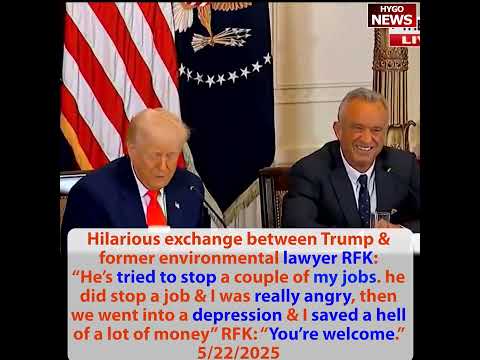
Trump to RFK: “You Stopped One of My Jobs, Then Depression Came and I Saved a Hell of a Lot of Money”; “Thank You for Stopping That Big Job” — RFK: “You’re Welcome”; Dr. Oz “Very Tough Hombre” Leading Prescription Drug Fight
In a memorable May 2025 exchange during the MAHA Commission event, President Trump delivered a classic improvised story about HHS Secretary RFK Jr.’s past life as an environmental lawyer. Trump: “He’s a friend of Bobby and he’s been a foe too. He tried to stop a couple of my jobs. In one case he did stop a job and I was really angry. And then about four months later we went into like a depression and I saved a hell of a lot of money by the fact. So never mind, thank you very much for stopping that big job I was going to do.” RFK responded: “You’re welcome.” RFK then described the movement’s market impact: “You’re watching companies now that are changing their ingredients because of this movement — big fast food conglomerates switching from seed oils to beef tallow. Chobani yogurt changing its ingredients.” Trump called Dr. Mehmet Oz “a very tough hombre” and assigned him to lead prescription drug price reduction: “If you do it, you can have within a period of weeks drug costs that drop like a rock… If you don’t do it, I am firing every single one.” Dr. Oz advised on MAHA: “Get those kids outside and playing. One hour a day of activity. 70% of food is ultra-processed.”
The Environmental Lawyer Joke
Trump’s opening was a classic improvised comedy moment.
“A friend of Bobby and he’s been a foe too, you know, he’s tried to stop a couple of my jobs,” Trump said. “In one case he did stop a job and I was really angry.”
He described the unexpected result: “And then about four months later, we went into like a depression and I saved a hell of a lot of money by the fact.”
He delivered the comedic resolution: “So I never mind. Thank you very much for stopping that big job I was going to do.”
RFK Jr. played along: “You’re welcome.”
The exchange worked on multiple levels. First, it referenced RFK’s decades as an environmental lawyer, during which he had indeed filed lawsuits against various Trump development projects. The adversarial relationship between Trump the developer and Kennedy the environmental litigator was real history.
Second, Trump’s spin on the outcome was characteristic. Rather than holding a grudge about Kennedy blocking his projects, Trump framed the blocked job as fortuitous — he had avoided a bad investment because Kennedy’s lawsuit had delayed the project until market conditions turned against it.
Third, the “you’re welcome” response showed RFK’s willingness to play along with Trump’s humor. The former adversaries had become cabinet colleagues, and their rapport was genuine enough to support spontaneous comedic exchanges.
The likely specific reference was to Kennedy’s environmental litigation in the 1990s and 2000s, which had sometimes affected Trump development projects in New York or New Jersey. The “depression” Trump referenced was likely a specific market downturn (possibly the post-2001 recession or the 2008 financial crisis) during which real estate values had declined substantially.
Companies Changing Ingredients
Kennedy described the MAHA movement’s market impact.
“You’re watching watching companies now that are changing their ingredients because of this movement,” Kennedy said. “That are making good food more available to Americans because they’re demanding it. There was no demand for it before.”
He described the mechanism: “This report is about getting every American to demand the accessibility to good whole food in their neighborhoods.”
He acknowledged the gradual nature: “Oh, it’s gonna be a process, but it’s already happening.”
He cited specific examples: “You see these big fast food conglomerates that are switching from seed oils to beef tallow.”
He mentioned another example: “And then reducing the ingredients you see Chobani yogurt changing its ingredients because of the demand that has happened because of the MAHA movement.”
The beef tallow transition was particularly significant. For approximately 50 years, most fast food chains had cooked French fries and other products in seed oils (soybean, corn, canola, sunflower). The original McDonald’s French fries had been cooked in beef tallow, producing their iconic taste, before the chain switched to vegetable oils in the 1990s under pressure from anti-saturated-fat advocates.
The MAHA movement had been pushing for:
- Return to traditional fats (beef tallow, butter, lard, coconut oil)
- Elimination of highly processed seed oils (which contain high omega-6 fats, industrial processing residues, and potentially inflammatory compounds)
- Reduced reliance on ultra-processed ingredients generally
- Simpler ingredient lists with recognizable whole food components
Several fast food chains (Steak ‘n Shake, some regional chains, some Florida McDonald’s franchises) had begun switching back to beef tallow in late 2024 and 2025. The switch was driven partly by consumer demand and partly by accumulating evidence about seed oil health impacts.
Chobani had reduced added sugar and eliminated certain preservatives in response to consumer demand. Other major food companies had similarly begun reformulating products to appeal to health-conscious consumers.
The HHS App Project
Kennedy described technology-enabled consumer empowerment.
“We are going to make sure they have apps that mothers who go into the grocery store have an app that they can show on the Senate Flash on the barcode of every product and get a green light red light or yellow light,” Kennedy said.
He described the HHS role: “HHS is creating that we’re working with industry to do it and they’re already doing it.”
He cited existing examples: “You know that Mark Hyman’s company has done it. Patrick’s on seems a company has done it. Many many apps out there.”
He cited his personal use: “I use one called Yucca my wife and I considered invaluable. You can go into any grocery store flashing at any product and you can get a go or no on it.”
He described the theory: “As that happens, the market… We’re not trying to create an anti-state here. We’re trying to create mark drive market forces that will drive change and the kind of food Americans get.”
The app concept was market-based rather than regulatory. Rather than banning ingredients or products, the MAHA approach was to empower consumers with information. If mothers could instantly evaluate any grocery product against health criteria, they would:
- Reject products with problematic ingredients
- Prefer products with clean ingredients
- Drive market demand toward healthier options
- Create competitive pressure on manufacturers to reformulate
This approach was philosophically libertarian. Rather than government dictating what people could eat, government would provide information infrastructure that allowed informed consumer choice. The market would then respond to aggregate consumer preferences.
The specific apps Kennedy mentioned — Mark Hyman’s company (Function Health), Yucca, and others — represented entrepreneurial responses to the information gap. Parents, particularly mothers, wanted to make healthier choices but lacked the information to evaluate products quickly at the point of purchase. The apps filled this gap.
Dr. Oz: “Very Tough Hombre”
Trump pivoted to prescription drug pricing.
“I’d like to ask us In particular because you and I know each other,” Trump said to Dr. Mehmet Oz, who had been appointed CMS Administrator.
He characterized Oz: “He’s a very tough hombre this one. He’s tough as hell.”
He gave the assignment: “And so if you can lead the group and it’s not going to be easy. You’re gonna have to get in and you’re gonna have to fight.”
He promised the reward: “If you do it, you can have within a period of weeks you can have drug costs that drop like a rock, okay?”
He expressed confidence: “So you as a group, I have great confidence.”
He delivered the threat: “And if you don’t do it, I am firing every single one.”
The Oz assignment was significant. Mehmet Oz had been a cardiothoracic surgeon and celebrity TV doctor for over 20 years before Trump appointed him to lead the Centers for Medicare and Medicaid Services (CMS). CMS controlled approximately $1.5 trillion in annual federal healthcare spending, making Oz one of the most powerful healthcare officials in the world.
The “very tough hombre” characterization was genuine. Oz’s public persona was friendly and folksy, but his private reputation was as a demanding, driven executive. He had built his TV empire through aggressive business practices, had managed complex commercial relationships, and had navigated significant political controversies (including a failed Senate run in 2022). He was not a figurehead; he was a serious executive.
The drug pricing assignment was one of Trump’s signature second-term initiatives. The Most Favored Nation pricing framework — requiring American prices to match lowest prices in other developed countries — was complex and politically contentious. Pharmaceutical companies opposed it vigorously. Some conservative Republicans had concerns about price controls. International allies opposed what they saw as American extraction of their cheaper drug prices.
Oz’s CMS leadership gave him the regulatory authority to implement significant drug pricing reforms. His combination of medical credibility, business experience, and political skill was the profile Trump wanted for this difficult task.
The “firing every single one” threat was characteristic Trump management. By publicly threatening to fire the team if they didn’t deliver, Trump created accountability and urgency. Whether he would actually follow through was less important than the signal of priority and seriousness.
Dr. Oz on MAHA
Dr. Oz gave specific recommendations based on the MAHA report.
“Number one, get those kids outside and playing and they need an hour a day of some activity,” Oz said.
He cited the current statistics: “Only about 15 percent of kids — that’s one in seven children — get an hour of activity a day.”
He made the evolutionary argument: “That’s standard to any human species survival is your young kids can go run around and learn how to do things while they’re playing with each other.”
He gave the second recommendation: “Get them out. And the second is give them real food.”
He referenced Kennedy’s framing: “You heard Secretary Kennedy talk about 70% of the food being ultra processed.”
He described “real food”: “Just give them food that comes out of the ground looking the way it looks when you eat it. Real food that you can recognize.”
He stated the conclusion: “Those two things alone will make a dramatic difference and help the country.”
The “one in seven children get an hour of activity a day” statistic was from federal physical activity guidelines research. The 85% of American children who did not meet basic physical activity standards represented a dramatic deterioration from historical norms. Previous generations of children had spent most of their non-school time outdoors in unstructured play. Modern children spent most of their non-school time indoors, often with screens.
The “real food” framing was deliberately simple. Rather than providing complex nutritional science, Oz was offering a rule parents could apply: if the food “comes out of the ground looking the way it looks when you eat it,” it’s real food. If it requires factory processing, industrial ingredients, or laboratory formulation to produce, it’s not real food.
By this criterion:
- Fresh apple = real food
- Apple juice with preservatives = not real food
- Grass-fed beef = real food
- Chicken nuggets = not real food
- Boiled egg = real food
- Packaged “breakfast” cereals = not real food
This was a drastic simplification but was also actionable. Parents did not need to become nutrition scientists; they needed to recognize recognizable food and feed it to their children.
”Patriotic Duty”
Oz invoked national security framing.
“It’s also your patriotic duty because you’re less than a quarter of kids are eligible for the military because they’ve got underlying health issues,” Oz said.
He described the MAHA approach: “Now that stated what we’re really going to do with this my report is begin to study the underlying principles are so much that we’re doing. All the recommendations are given. We’re going to challenge the status quo on toxins in the environment, the medicalization of young people so they end up in the health care system and the sick care system where they shouldn’t be there.”
He cited the institutional timeline: “There are lots of moving parts, but my agency’s said Medicare and Medicaid were created in 1965. That’s 60 years ago. We haven’t done something like this in this entire time period.”
The military readiness argument was genuinely concerning. The Department of Defense had been reporting for years that the American youth population was increasingly ineligible for military service. Reasons included:
- Obesity (approximately 40% of military-age Americans)
- Chronic health conditions
- Mental health conditions
- Substance abuse
- Criminal records
- Inadequate education
- Physical fitness failures
If the eligible recruitment pool kept shrinking, American military capacity would be constrained regardless of technology or equipment. A nation whose youth were too sick to serve would have to increasingly rely on automation, contractors, or allied forces.
Oz’s “sick care system” framing captured a distinction the MAHA movement emphasized. American medicine had evolved to treat sickness — responding to diseases after they occurred — rather than preventing sickness by addressing root causes. The result was an expensive system that was very good at responding to acute conditions but inadequate at preventing chronic disease.
The 1965 reference was significant. Medicare and Medicaid had been created during the Johnson administration as part of the Great Society. Over 60 years, these programs had grown dramatically in scope and cost, but their fundamental structure had remained largely unchanged. The Trump administration’s MAHA approach was the first systematic reconsideration of this structure in a generation.
Key Takeaways
- Trump-RFK exchange on environmental lawsuit: “Thank you for stopping that big job I was going to do.” RFK: “You’re welcome.”
- Market shifts: “Fast food conglomerates switching from seed oils to beef tallow. Chobani changing ingredients. MAHA movement driving demand.”
- HHS barcode app concept: Green/red/yellow light on any grocery product — empowering consumers through information.
- Dr. Oz as “very tough hombre” leading prescription drug pricing: “If you don’t do it, I am firing every single one.”
- MAHA basics: “Hour a day of activity (only 15% of kids do this). Real food that comes out of ground looking same as when eaten.”