 HYGO News
 High Gas Price, Sullivan 'foreign policy advisor', worker shortage, inflation & infrastructure 11/9
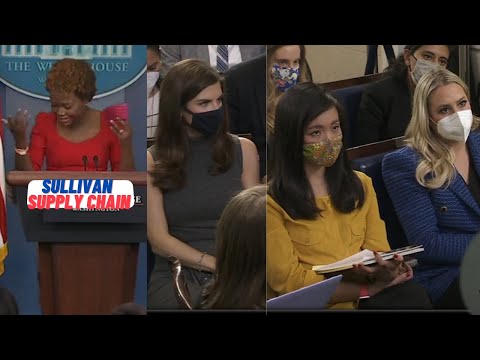
White House Has No Gas Price Plan, No Comment on Sullivan-Durham Link, No Infrastructure Timeline
On November 9, 2021, White House Deputy Press Secretary Karine Jean-Pierre faced a barrage of questions on multiple fronts and came up short on all of them. She could not name a single specific action the administration was considering to lower gas prices beyond “monitoring the situation.” She said she had no comment on reports that National Security Advisor Jake Sullivan was the “foreign policy advisor” referenced in the Durham investigation’s indictment of former Clinton campaign lawyer Michael Sussmann. She could not explain how infrastructure bill funding would be allocated or provide a timeline for projects. And she acknowledged that the administration’s answer to worker shortages was to pay “competitive wages” — while simultaneously arguing that the Build Back Better spending bill would ease inflation.
No Plan to Lower Gas Prices
Senate Democrats had sent the president a letter urging him to consider banning crude oil exports as a measure to combat surging gasoline prices. A reporter asked Jean-Pierre directly whether the president was considering the ban.
Jean-Pierre’s response was noncommittal: “The administration is closely and directly monitoring the situation. We’re looking at all the tools in our arsenal. We’re very concerned about the impact of high energy prices on consumers, especially as we enter the colder months.”
When pressed for specifics beyond the Strategic Petroleum Reserve, Jean-Pierre could not provide any. “I can just tell you what we’ve been doing here, which is calling on OPEC to increase their supply. We’ve been looking at, you know, monitoring the situation,” she said.
A reporter noted that the only concrete tool the administration had mentioned was the SPR release. “Does that mean he feels that his hands are tied when it comes to what he can actually do to try to combat high gas prices?” the reporter asked.
“No, I wouldn’t read it that way. We just don’t have anything right now to announce,” Jean-Pierre replied.
The exchange revealed a White House that had been talking about gas prices for weeks but had developed no actionable policy response beyond diplomatic pressure on OPEC — which had already been publicly rebuffed — and the possibility of a Strategic Petroleum Reserve release that had not been executed.
Sullivan Named as “Foreign Policy Advisor” in Durham Probe
The briefing’s most politically charged moment came when a reporter informed Jean-Pierre that two sources had identified National Security Advisor Jake Sullivan as the “foreign policy advisor” referenced in Special Counsel John Durham’s indictment of Michael Sussmann.
Sussmann, a former Clinton campaign lawyer, had been indicted for allegedly lying to then-FBI General Counsel James Baker when he claimed he was not working “for any client” during a September 2016 meeting where he presented evidence of a purported secret communications channel between the Trump campaign and a Russian bank. Durham’s indictment alleged Sussmann had in fact billed the Clinton campaign for the meeting. The FBI investigated the alleged Trump-Russia bank link and determined it was “bogus.”
The connection to Sullivan was significant: it was, as the video description noted, “the closest Special Counsel John Durham’s investigation into the origins of the Russia investigation has come to anyone directly associated with the Biden White House.”
Jean-Pierre had no answer. “I’m just now hearing this. So I don’t have a comment for you at this moment,” she said. “I don’t know anything about what you’re just mentioning. So I have to talk to our team.”
When the reporter followed up asking whether the revelations about the dossier created any concern that there had been “too much focus” on the Russia narrative during Biden’s campaign, Jean-Pierre deflected entirely: “I refer you to the Department of Justice. I’m not going to comment on that from here.”
The refusal to engage on whether Sullivan’s identification created any conflict of interest for a sitting national security advisor raised questions about the White House’s willingness to address the Durham investigation’s growing proximity to the current administration.
No Infrastructure Details or Timeline
Despite the bipartisan infrastructure bill having been signed into law, Jean-Pierre could not provide basic implementation details when pressed by reporters. A reporter pointed out that the administration had “months” while the bill worked through Congress to prepare and asked why there was no concrete list of projects that would be pursued first.
“We’ll have something soon,” Jean-Pierre said.
The reporter pressed: “I still don’t really understand how all the money is going to be allocated.”
Jean-Pierre acknowledged she did not have specifics: “I don’t have the specifics for you right now, but I can tell you the agencies that will be involved.” She could not provide timelines for when Americans would see projects begin.
When asked how much the infrastructure bill would reduce inflation over the next 12 months, Jean-Pierre again had no specifics: “I don’t have a specific number for you. I’m happy to talk to our economics team and get something more granular there.” She fell back on the now-standard talking point: “The 17 Nobel Laureate economists have said that this bill, the Build Back Better Act and bipartisan infrastructure will ease inflation.”
Worker Shortages and the Wage Argument
A reporter asked how the administration planned to address the worker shortages that were plaguing the economy even as it was promising to create millions of new jobs through the infrastructure bill.
Jean-Pierre’s answer was circular: “When we talk about the labor shortage, I think the President has talked about this, the importance of making sure that we’re paying people wages that are competitive so that they’re able to come back into the workforce.”
The argument that the solution to worker shortages was higher wages sat uncomfortably alongside the administration’s insistence that inflation was temporary and that more government spending would ease rather than exacerbate price pressures. Higher wages without corresponding productivity gains are a classic inflationary mechanism, and critics argued the administration was simultaneously advocating for both higher wages and lower inflation without acknowledging the tension between the two goals.
Line 5 Pipeline Clarification
Jean-Pierre also used the briefing to attempt a clarification on the Line 5 pipeline controversy that had erupted the previous day when she initially called reporting about an administration study “inaccurate” before admitting the study was underway.
She explained that the Army Corps of Engineers had announced an environmental impact study in June about a “potential replacement for a portion of Line 5,” and that this was distinct from the current operating pipeline. “Nothing new to share on the current line,” she said. “We expect the U.S. and Canada to engage constructively on it.”
When asked whether a possible outcome of the study could be a decision that limits oil output, Jean-Pierre declined to speculate. She also could not provide a timeline for when the study would be completed.
Democrats Want Biden More Visible
Reporters pressed Jean-Pierre on why the president was not doing more public events to sell and explain the infrastructure bill and Build Back Better. Some Democratic members of Congress had publicly said they wanted Biden to be “more vocal” and more visible in communities across the country.
Jean-Pierre said Biden was “doing local media” and would be traveling to Baltimore the next day. “He’ll continue to do more,” she said. “I would actually argue that he has been out there anytime that, you know…” She trailed off without completing the sentence.
The exchange underscored a broader concern within the Democratic Party that the administration was failing to communicate the benefits of its legislative achievements to voters who were focused on rising prices and supply chain disruptions rather than the long-term promise of infrastructure spending.
Key Takeaways
- Jean-Pierre could not name a single specific action to lower gas prices beyond “monitoring the situation” and calling on OPEC, even after Senate Democrats sent the president a letter urging a ban on crude oil exports.
- She said she had no comment on reports that National Security Advisor Jake Sullivan was identified as the “foreign policy advisor” in Durham’s indictment of Clinton campaign lawyer Sussmann, the closest the probe had come to anyone in the Biden White House.
- The administration could not provide a list of infrastructure projects, a timeline for implementation, or a specific estimate of how much the bill would reduce inflation, while arguing that the solution to worker shortages was higher wages and the solution to inflation was more government spending.