 HYGO News
 Hiding Info communication strategy: protect Biden from political damage, A: that's your version
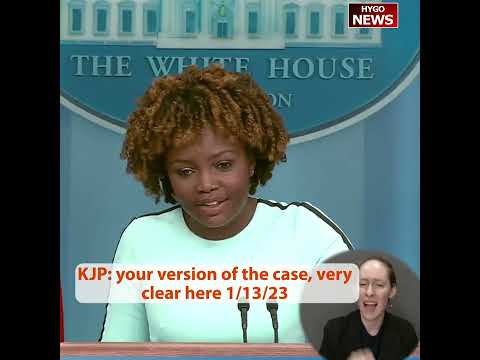
Reporter: Was It a Communication Strategy to Hide Docs From Public? KJP: “That’s Your Version of the Case”
On 1/13/2023, a reporter named Steven pressed White House Press Secretary Karine Jean-Pierre on whether the delayed disclosure was a deliberate communication strategy. “It sort of feels like a strategy, a communication strategy, to protect the president from political damage. Was it the hope and expectation here that this would have remained a private matter and not have been subject to public disclosure?” the reporter asked. KJP rejected the characterization: “Look, Steven, that’s your version of the case. I’ve been very clear here, and I’ve answered that question multiple times in different versions.” Another reporter invoked a historic framing: “In the careers of White House press secretaries, there comes a time where they are asked what they knew, and when they knew it. Were you or any member of your staff involved in the crafting of a strategy as to when this disclosure should be made in advance of CBS News breaking the story on Monday?” KJP answered: “No.”
The Strategy Question
The reporter posed a specific question. “It sort of feels like a strategy, a communication strategy, to protect the president from political damage,” the reporter said.
The “communication strategy” framing:
Strategic framing — Of disclosure timing.
Political protection — Motive identified.
Professional assessment — By reporter.
Reasonable interpretation — Of evidence.
Accountability demand — For honesty.
The strategy concern:
Deliberate concealment — Alleged.
Political motive — Rather than accidental.
Systematic approach — Suggested.
Professional communication work — Identified.
Standard political practice — But worth exposing.
”Was It the Hope That This Remained Private?”
The reporter’s specific question. “Was it the hope and expectation here that this would have remained a private matter and not have been subject to public disclosure?” the reporter asked.
The “private matter” question:
Directly addressing — Motivation.
Wishful thinking — About concealment.
Expectation — Of non-disclosure.
Private vs. public — Distinction.
Strategic calculation — Examination.
If the answer was yes:
Concealment was intentional — Not accidental.
Public interest disregarded — By administration.
Political calculations primary — Over accountability.
Transparency claims false — Substantively.
Credibility damage — Confirmed.
”That’s Your Version of the Case”
KJP’s response was dismissive. “Look, Steven, that’s your version of the case,” KJP said.
“Your version”:
Dismissive language — Rejecting framing.
Subjective characterization — Suggested.
Not my narrative — Implied.
Reporter interpretation — Rather than fact.
Pushback technique — Standard.
“The case”:
Legal-sounding — Framing.
As if contested facts — Existed.
Reporter presenting — One view.
Administration had — Another.
Question settled — Not.
The dismissive framing:
Didn’t answer question — Directly.
Rejected characterization — Without refutation.
Moved past inquiry — Procedurally.
Standard technique — For hard questions.
Substantive avoidance — Through dismissal.
”Been Very Clear”
KJP claimed prior clarity. “I’ve been very clear here, and I’ve answered that question multiple times in different versions,” KJP said.
The “been very clear”:
Self-assertion — Of clarity.
Not accepted — By reporter.
Standard claim — Across briefings.
Repetition without specifics — Pattern.
Subjective judgment — Of clarity.
“Multiple times in different versions”:
Previous briefings — Referenced.
Multiple questions — Asked.
Administration answers — Given.
Still pressing — Because inadequate.
Accountability continuing — Required.
”There’s a Process”
KJP invoked process. “Look, I want to be very clear, there’s a process, colleagues there,” KJP said.
“A process”:
Standard framing — For administrative.
Legal procedures — Referenced.
Deflection technique — Common.
Substitute for substance — In briefings.
Avoids direct answer — To strategy question.
The process framing:
Legal requirements — Followed.
Administrative steps — Completed.
But strategy question — Different.
Process neutrality claimed — Despite political.
Standard non-answer — Technique.
The “What They Knew” Framing
A different reporter invoked historic framing. “In the careers of White House press secretaries, there comes a time where they are asked, you know, what they knew, and when they knew it,” the reporter said.
The “what they knew” reference:
Watergate framing — Iconic political phrase.
Howard Baker — Originated during Watergate.
Political accountability — Traditional standard.
Cover-up investigation — Framework.
Historical gravity — Invoked.
The framing:
Elevated stakes — Of questioning.
Historical comparison — With major scandals.
Accountability standard — Traditional.
Press Secretary responsibility — For knowledge.
Watergate echoes — Deliberately.
The Specific Strategy Question
The reporter’s specific question. “Were you or any member of your staff involved in the crafting of a strategy as to when this disclosure should be made in advance of CBS News breaking the story on Monday?” the reporter asked.
The specific question:
Staff involvement — In strategy.
Crafting disclosure timing — Deliberate.
CBS News breaking story — Referenced.
Monday disclosure — Contextualized.
Proactive vs. reactive — Distinction.
The CBS News reference:
Monday January 9 — First public disclosure.
CBS News reporting — First broke story.
Media forcing disclosure — Rather than administration initiative.
Reactive rather than proactive — Transparency.
Political calculation — About timing.
”No”
KJP’s brief answer. “No,” KJP said.
The single-word denial:
Direct response — To specific question.
Categorical denial — Of staff involvement.
Binary answer — Yes/no format.
Limits follow-up — Somewhat.
Protection — Of administration.
The “no” denial:
Denied strategic crafting — Of disclosure timing.
Protected administration — From cover-up accusation.
May have been accurate — Narrowly defined.
Or strategic denial — Of broader process.
Standard defense — For such questions.
The CBS Timing Issue
The CBS News report timing:
January 9, 2023 — Monday.
Broke the story — First publicly.
Before administration — Announcement.
Not coordinated — Apparently.
Administration caught — Somewhat.
The timing suggested:
Administration planned different schedule — For disclosure.
CBS forced their hand — Somewhat.
Or administration released — To CBS first.
Various interpretations — Possible.
Specific facts — Unclear publicly.
The Reactive Disclosure Pattern
The disclosure pattern was reactive:
Initial discovery — November 2.
Silence for 2+ months — Administration.
CBS breaks story — January 9.
Administration announces — Same day.
Rolling additional disclosures — Following.
This pattern suggested:
Administration preferred silence — Strategically.
Media forced disclosure — Ultimately.
Timing wasn’t proactive — Clearly.
Damage control mode — Throughout.
Accountability avoided — Where possible.
The Strategic Communication Reality
Strategic communication is:
Standard practice — In White Houses.
Legitimate function — Mostly.
Includes timing — Of disclosures.
Affects public trust — Sometimes.
Professional skill — Generally.
But:
Transparency claims — Limit strategy.
Public interest — Conflicts with strategy sometimes.
Accountability requires — Full disclosure.
Political calculations — Can undermine transparency.
Democratic expectations — Require openness.
The Watergate Invocation
The “what they knew” framing:
Watergate-era reference — Explicit.
Cover-up implications — Suggested.
Serious accountability — Standard invoked.
Historical significance — Added.
Media gravity — Established.
Watergate parallels:
Limited in reality — To classified docs.
But framework useful — For accountability.
Reporters invoking — Standards.
Administration attention — Required.
Historical context — Provides weight.
The Press Secretary’s Responsibility
The role of Press Secretary:
Public information — About administration.
Journalist engagement — On behalf of president.
Questions answering — Professionally.
Knowledge about events — Required.
Accountability to media — And through them to public.
KJP’s position:
Should know about disclosure strategy — If it existed.
Responsible to report — Accurately.
Accountable to press — For honesty.
Cannot hide — Strategic decisions.
Must engage substantively — Ideally.
The “Crafting” Specificity
“Crafting of a strategy”:
Specific construction — Of plan.
Staff involvement — In planning.
Deliberate timing — Of disclosure.
Communication planning — Professional.
Strategic thinking — About release.
The specificity:
Made denial pointed — “No.”
Difficult to evade — If true.
Legal implications — If false.
Public accountability — Through specificity.
Standard investigative questioning — Technique.
The Legal vs. Political Dimension
The legal-political distinction:
Legal requirements — For classified disclosure.
Political decisions — About timing.
DOJ coordination — With administration.
White House strategy — About public.
Separate considerations — Technically.
In practice:
Legal and political intertwined — Often.
Timing decisions — Political.
Legal basis — For some decisions.
Cover often both — Simultaneously.
Investigation would reveal — Specific dynamics.
The Special Counsel Context
January 12, 2023:
Robert Hur appointed — Special Counsel.
Biden classified documents — Focus.
Investigation begin — Year-long.
Independent review — Of handling.
Political insulation — From DOJ.
The Special Counsel:
Would investigate — Handling.
Timeline examined — In detail.
Strategic decisions — Reviewed.
Intent determined — Eventually.
Report produced — February 2024.
The Hur Report Outcomes
The eventual Hur report:
No charges recommended — For Biden.
Characterized Biden — Memorably.
“Well-meaning, elderly man” — Phrase.
Memory concerns — Highlighted.
Political damage — Significant.
The report would:
Not charge Biden — Legally.
Damage politically — Memorably.
Affect 2024 — Substantially.
Age concerns — Reinforced.
Biden angered — By characterization.
The Press-Administration Dynamic
The dynamic showed:
Persistent press inquiry — Appropriate.
Administration deflection — Standard.
Historical framing — By reporters.
Specific denials — By administration.
Continuing investigation — Beyond briefings.
The professional press:
Asked serious questions — Consistently.
Invoked appropriate standards — Watergate.
Pressed for specifics — Beyond deflections.
Generated coverage — Of accountability.
Built case — Through questioning.
The “Strategic” Nature of Disclosure
Whether strategic or not:
Timing was delayed — 2+ months.
Public learned from media — Not administration.
Rolling disclosures followed — Reactive pattern.
Mid-midterm calculations — Obvious.
Political elements — Clear.
The strategic question:
Served accountability — To ask.
Complicated by nature — Of communication.
Legal constraints — Acknowledged.
Political considerations — Inevitable.
Transparency commitments — Compromised.
The Media Response Pattern
Media responses:
Conservative outlets — Extensive coverage.
Mainstream outlets — Growing coverage.
Liberal outlets — Cautious coverage.
Social media — Active discussion.
Political analysis — Continued.
The coverage patterns:
Reflected framework — Across outlets.
Built sustained narrative — Over weeks.
Political implications — Noted.
Administration damage — Measured.
2024 effects — Speculated.
The Administration Limits
KJP’s position:
Limited by legal advice — From lawyers.
Coordinated with DOJ — On messaging.
Political considerations — Primary.
Personal role limits — Acknowledged.
Standard techniques deployed — Consistently.
Within constraints:
Substantive engagement — Limited.
Direct answers — Rare.
Pattern recognition — Universal.
Media frustration — Growing.
Political damage — Accumulating.
Key Takeaways
- A reporter pressed KJP on whether the delayed disclosure was a “communication strategy to protect the president from political damage.”
- KJP dismissed the characterization: “That’s your version of the case.”
- Another reporter invoked the historic “what they knew and when they knew it” framing from Watergate.
- The specific question: “Were you or any member of your staff involved in the crafting of a strategy as to when this disclosure should be made in advance of CBS News breaking the story on Monday?”
- KJP answered: “No.”
- The CBS News reference highlighted that media, not administration, forced the disclosure.
- The rolling disclosure pattern supported the strategic communication interpretation.
- The Special Counsel investigation would eventually examine these dynamics in detail.
Transcript Highlights
The following is transcribed from the video audio (unverified — AI-generated from audio).
- I just want to press you on that point about the idea of disclosures when it’s appropriate.
- It sort of feels like a strategy, a communication strategy, to protect the president from political damage.
- Was it the hope and expectation here that this would have remained a private matter and not have been subject to public disclosure?
- Look, Steven, that’s your version of the case.
- In the careers of White House press secretaries, there comes a time where they are asked, you know, what they knew, and when they knew it.
- Were you or any member of your staff involved in the crafting of a strategy as to when this disclosure should be made in advance of CBS News breaking the story on Monday? — No.
Full transcript: 178 words transcribed via Whisper AI.