 HYGO News
 Hassett: Our modeling used last time, BETTER 3% growth $4T; Smith BBB: 40M, 91% benefit No Tax
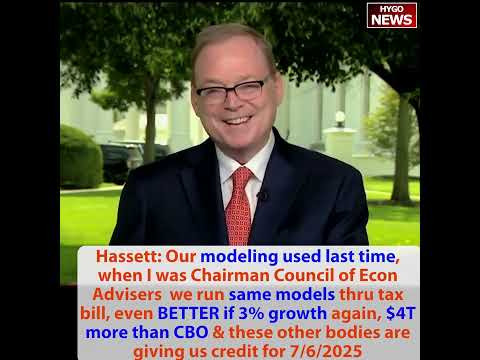
Hassett: Our modeling used last time, BETTER 3% growth $4T; Smith BBB: 40M, 91% benefit No Tax
National Economic Council Director Kevin Hassett delivered the administration’s most thorough defense of its alternative economic modeling against the CBO’s fiscal projections. Hassett, who served as Chairman of the Council of Economic Advisers during Trump’s first term, explained that the same models that predicted 3% growth from the 2017 tax cuts — and were ultimately vindicated by actual outcomes — are being applied to the current bill and producing even better projections. Ways and Means Chairman Jason Smith then laid out the specific beneficiary breakdown: 40 million families benefiting from expanded child tax credit, 91% of Americans benefiting from increased standard deduction. Speaker Mike Johnson added that the 2017 cuts made permanent by the new bill produced “the bottom 20% of earners saw their lowest federal tax rate in forty years.” Hassett’s projections: 3% GDP growth, 4 million additional jobs, $13,000 in additional average household take-home pay, and a 2026 midterm environment with voters “riding an economic high."
"Science Is Not Democracy”
Hassett opened with his methodological framing. “Well, well, first of all, let’s remember that science is not democracy. Truth is not democracy.”
The framing is philosophically important. Truth claims about economic outcomes are not settled by majority opinion. If one analyst projects one outcome and 10 analysts project another, the majority view is not necessarily correct. What matters is which analysis is methodologically sound and which predictions ultimately match observed outcomes.
Hassett is preempting the framing that because CBO is the official scoring body and because most commentary accepts CBO’s numbers, the CBO projection must be correct. His counter is that methodology and track record matter more than institutional endorsement.
The Last-Time Model
Hassett then described his specific credentials. “Our estimates are based on modeling that we used last time when I was chairman of the council of economic advisors to say what would happen if we had a bill, how much growth we would get. And we said, and we were criticized soundly, that we would get 3% growth.”
The specific history matters. During the 2017 debate over the Tax Cuts and Jobs Act, Hassett (as CEA Chairman) predicted 3% growth. Mainstream economic commentary predicted much lower growth. Hassett was “criticized soundly” for what his critics viewed as an implausibly optimistic projection.
“We even had the really technical, macroeconomic models that said that we would get 3% growth” captures the methodological basis. Hassett’s projection was not a political assertion — it was the output of specific macroeconomic models applied to the specific bill provisions.
”We Got It Right Last Time”
Hassett’s track record claim is important. The 2017 tax cuts did produce growth that exceeded the CBO’s projections. Actual GDP growth in 2018 and 2019 approached or reached the 3% target Hassett had predicted. The COVID-19 disruption of 2020 interrupted the trajectory, but the underlying growth performance before the pandemic vindicated Hassett’s prediction.
Critics will contest the specific interpretation. They will point to various factors that contributed to the elevated growth — cyclical dynamics, global conditions, pre-existing trajectory. But the specific prediction Hassett made — 3% growth from the 2017 cuts — was closer to reality than the predictions of his critics.
”Even Better” Models
Hassett extended the framework. “We run the same models through this tax bill. It’s even better. And what we’re seeing is that if you get 3% growth again, then that’s 4 trillion more in revenue than the CBO and these other bodies are giving us credit for.”
The same models that produced the 2017 projection are now producing projections for the 2025 bill. The 2025 bill, according to those models, should produce “even better” outcomes — because the bill combines the 2017 tax cuts (now permanent) with additional new provisions (no tax on tips, overtime, Social Security) that further enhance growth incentives.
“$4 trillion more in revenue than the CBO” is the specific deficit implication. If growth reaches 3%, the revenue projection shifts by $4 trillion over the 10-year budget window. That shift changes the bill from a $3.3 trillion deficit increaser (CBO projection) to a significantly smaller deficit impact or even a deficit reducer.
”They Have Been Wrong In The Past”
Hassett’s methodological critique of CBO. “They have been wrong in the past, and they’re being wrong again in our belief.”
CBO has been wrong in specific ways. The agency’s 10-year projections often diverge substantially from actual outcomes. Growth rates, revenue levels, spending categories — each has, in various years, differed from CBO projections.
The divergence is not random. CBO’s methodology includes specific assumptions about economic dynamics that may or may not match reality. When those assumptions prove wrong, CBO’s projections prove wrong. Hassett is arguing that the current CBO assumptions are incorrect in ways that will be visible when actual outcomes emerge.
”I Find Disappointing”
Hassett offered his professional critique of the scoring organizations. “The thing that disappoints me is that if I put out a model and I say, hey, here’s what’s going to happen. We’re going to get 3% growth. And then it turns out it’s 1.5% growth. Then as an academic economist, as a scientist, then it’s my duty to say, what did I get wrong? What did my model miss? These people aren’t doing that.”
The critique is procedural. Academic economists whose predictions fail are expected to analyze why. The analysis improves their models for future predictions. That methodological self-examination is what separates genuine science from ideological advocacy.
Hassett is claiming that CBO and similar bodies do not engage in the same methodological self-examination. When their predictions fail, they do not publicly analyze why. They continue issuing similar predictions that presumably contain similar errors.
”Peer-Reviewed Academic Stuff”
Hassett emphasized the peer-reviewed basis. “We put peer reviewed academic stuff on the table, said we’re going to get that 3% growth. And then we got it right last time.”
Peer-reviewed academic research is the gold standard for methodological rigor in economics. Peer review means that other academic economists have evaluated the methodology, the assumptions, and the conclusions. That review process filters out obvious errors and methodological shortcuts.
Hassett’s claim is that his 2017 projections were based on peer-reviewed methodology and proved accurate. The 2025 projections are based on the same methodology applied to updated inputs. Those projections should be credited accordingly.
The Biggest Tax Hike Alternative
Hassett then addressed the other side of the fiscal question. “There’s another part of the CBO number that you need to worry about. And that is that if we don’t pass the bill, then it’s the biggest tax hike in history.”
The argument is important. The 2017 Tax Cuts and Jobs Act included temporary provisions that would expire at the end of 2025 absent action. Those expirations, if allowed to occur, would produce automatic tax increases across income brackets. The cumulative tax increase would be, in Hassett’s characterization, the “biggest tax hike in history.”
The bill’s extension of the 2017 cuts prevents those automatic tax increases. The alternative to passing the bill is not maintaining the status quo — it is allowing scheduled tax increases to take effect.
”4% Drop In GDP And Lose 9 Million Jobs”
Hassett specified the alternative’s consequences. “And with that big tax hike, then of course we would have a recession. The CEA says that we’d have about a 4% drop in GDP and lose 9 million jobs.”
A 4% GDP decline and 9 million job loss is recession-scale damage. Those outcomes would be catastrophic for American households. Unemployment would spike. Business investment would collapse. Consumer spending would contract.
The Council of Economic Advisers has modeled this alternative scenario. Their specific numbers — 4% GDP drop, 9 million jobs lost — are the projections Hassett is citing. Whether those projections match what would actually happen if the bill were not passed is debatable, but the direction is clear: not passing the bill would produce substantial economic damage.
”What Would Happen To The Deficit?”
Hassett delivered the fiscal punchline. “If we had a 4% drop in GDP and we lost 9 million jobs, what would happen to the deficit?”
The rhetorical question has an obvious answer. A 4% GDP drop and 9 million job loss would produce massive revenue collapse and substantial spending increases (unemployment benefits, safety net costs, automatic stabilizers). The deficit would explode.
The CBO’s framing — that the bill increases the deficit by $3.3 trillion — assumes the alternative is a stable baseline. But the alternative, Hassett argues, is recession. The deficit impact of recession would be far larger than the deficit impact of the bill’s tax provisions.
”Go Back And Read Jim Stock”
Hassett closed his critique with a specific methodological recommendation. “What they need to do is get back to the basics of looking at macroeconomic models. There’s a really famous macroeconomist and Harvard named Jim Stock. They should go back and read everything Jim Stock has written for the last 15 years and fold those into their models and then maybe we could talk.”
Jim Stock is a prominent Harvard macroeconomist whose work on dynamic stochastic general equilibrium models and time-series econometrics has been influential in academic macroeconomics. Hassett’s reference to Stock’s work is a specific methodological reference — the CBO’s models, in Hassett’s view, do not adequately incorporate the dynamic effects Stock’s research has demonstrated.
Whether CBO analysts would agree with Hassett’s assessment is a separate question. But the specific academic reference captures that Hassett’s critique is methodologically grounded, not merely political.
Jason Smith On The Benefits
Ways and Means Chairman Jason Smith then walked through the specific beneficiary breakdown. “40 million families are going to benefit from an increased child tax credit. 91% of Americans will benefit from an increased standard deduction for a family up to $31,500.”
40 million families benefiting from expanded child tax credit captures a substantial portion of American households with children. Most families with children will see larger refundable credits that reduce their tax bills or increase their refunds.
91% of Americans benefiting from increased standard deduction — up to $31,500 for families — is a remarkable distributional reach. Nearly everyone who files a tax return benefits from the standard deduction. Increasing it automatically reduces tax liability for virtually all taxpayers.
”Waitresses, No Tax On Tips”
Smith ran through specific examples. “This is how the majority of people will receive tax cuts. Waitresses, no tax on tips. Linemen working overtime, no tax on overtime. Seniors, no tax on social security.”
The specific examples personalize the benefits. Waitresses — the specific constituency most directly affected by tip tax elimination. Linemen — the specific working-class overtime-earning category. Seniors — the specific retirement-age category affected by Social Security taxation.
Each category represents millions of Americans. Service workers who rely on tips. Skilled trades workers whose overtime significantly increases annual earnings. Retirees whose Social Security benefits had been subject to taxation at higher income levels.
”Promises Kept”
Smith closed with the political framing. “These are all items that we’re delivering for the American people that the president campaigned on and I am thrilled that this Congress, the House and the Senate finally delivered and didn’t wait till the last minute. And we did it by our timeline of July 4th.”
“Promises kept” is the consistent administration framing. The campaign commitments that Trump made in 2024 have been delivered through the bill. Voters who supported Trump on the basis of those commitments now have specific evidence that their support produced the intended outcomes.
“Our timeline of July 4th” is the specific date achievement. The administration had set a July 4 target months earlier. The bill was delivered on that target. That delivery capability demonstrates operational effectiveness.
Speaker Johnson On The 2017 Cuts
Speaker Mike Johnson then addressed the broader tax architecture. “So all that is nonsense, Shannon. What we did in this bill is we made permanent the 2017 Trump’s tax cuts and that was geared for lower and middle class Americans in spite of everything they said. The bottom 20% of earners saw their lowest federal tax rate in 40 years.”
“The bottom 20% saw their lowest federal tax rate in 40 years” is a specific historical claim about the 2017 TCJA. Critics had characterized the 2017 cuts as benefiting primarily the wealthy. Johnson is arguing that the actual distributional effect — measured in effective tax rates by income bracket — produced unprecedented tax relief for the lowest-income Americans.
That claim is empirically testable. If the bottom 20% of earners actually paid lower effective federal tax rates than at any point in 40 years following the 2017 cuts, Johnson’s characterization is validated. If the cuts actually produced different distributional effects, his characterization fails.
”Building Upon That”
Johnson extended the framework. “Now we’re building upon that. We just made that permanent and we’re building upon it because now we cut tax on overtime and tips and had more tax relief for seniors.”
The 2017 cuts, made permanent, are the foundation. The new provisions — tip taxation elimination, overtime taxation elimination, Social Security taxation reduction — are the additions. Each addition increases the distributional reach of the tax relief.
“We’re giving everybody a tax cut and that’s going to help the economy” is Johnson’s framing. The bill provides tax relief broadly across American taxpayers. The broad relief produces economic stimulus through increased consumer spending and reduced tax burden on economic activity.
”Jet Fuel”
Johnson used the specific economic metaphor. “It’s going to be jet fuel. All business owners, entrepreneurs, risk takers, the people that provide the jobs, manufacturers, farmers get assistance here and that will lift the economy.”
“Jet fuel” captures the administration’s growth projection. The bill accelerates economic growth in ways that exceed what incremental policy adjustments would produce. Business owners, entrepreneurs, and specific productive categories receive incentives to invest, hire, and expand.
The mechanism is supply-side. Reducing marginal tax rates on productive activity increases the return to that activity. Higher returns produce more activity. More activity produces more growth.
”$13,000 More In Take-Home Pay”
Johnson specified the household-level benefit. “The average American, the typical American household will have $13,000 more in take home pay.”
$13,000 in additional annual take-home pay for the typical household is substantial. For a median household making approximately $74,000 annually, $13,000 represents approximately 17.5% of pre-bill income. That magnitude of increase would transform household financial planning, consumer spending capacity, and savings potential.
Whether the actual household-level effect reaches $13,000 will be measured in implementation. If it does, the political benefit to the administration will be enormous. If it falls substantially short, the administration will face political backlash.
”Riding An Economic High” In 2026
Johnson closed with the political projection. “This time it’s on steroids. We’re excited about the upcoming election cycle in 26. Because people will be riding an economic high just as we did after the first two years of the first Trump administration.”
The 2026 midterm cycle is the first major electoral test of the second Trump administration. Historically, midterm elections often disadvantage the party holding the presidency. The “thermostatic” reaction — voters adjusting toward the party out of power — has produced many midterm losses for incumbent presidents.
Johnson’s projection is that the economic conditions in 2026 will be favorable enough to override the thermostatic reaction. If voters are genuinely experiencing economic improvement, they may reward the incumbent party rather than punishing it.
“On steroids” is the comparative framing. The economic acceleration, according to Johnson’s prediction, will exceed what Trump’s first term produced in its first two years. That comparative framing sets a high bar for the 2026 economic outcomes.
The Full Integrated Framework
The day’s economic messaging integrated multiple dimensions. Hassett provided the methodological defense of the administration’s projections. Smith detailed the specific beneficiary categories. Johnson connected the current bill to the 2017 cuts and projected forward to the 2026 midterms.
Each voice contributed specific content that the others referenced. The cumulative effect is an economic policy framework that has answers for specific critiques. Whether the framework survives contact with actual economic outcomes will be the test.
Key Takeaways
- Hassett on methodology: “Science is not democracy. Truth is not democracy…We got it right last time. And we believe we’re going to get it right this time.”
- The $4T alternative: “If you get 3% growth again, then that’s 4 trillion more in revenue than the CBO and these other bodies are giving us credit for.”
- The no-bill alternative: “If we don’t pass the bill, then it’s the biggest tax hike in history…we’d have about a 4% drop in GDP and lose 9 million jobs.”
- Jason Smith on beneficiaries: “40M families…Child Tax Credit. 91% of Americans will benefit from an increased standard deduction…Waitresses—No Tax on Tips.”
- Johnson’s household projection: “$13,000 more in take home pay…people will be riding an economic high just as we did after the first two years of the first Trump administration. This time it’s on steroids.”