 HYGO News
 German Chancellor Friedrich Merz Presents Trump His Grandfather Frederick's Birth Certificate, Born 1869 Near Bad Dürkheim; Bessent: 'CBO Scored Tariff Revenue at Minimum $2.8T Over 10 Years -- Actually Puts Bill in Surplus if You Include It'; Trump on Military Recruitment: 'Highest in History -- Spirit, They Love Our Country Again'
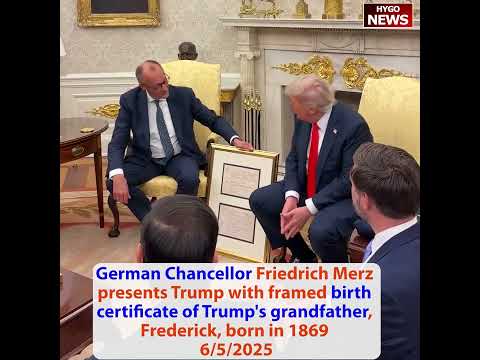
German Chancellor Friedrich Merz Presents Trump His Grandfather Frederick’s Birth Certificate, Born 1869 Near Bad Dürkheim; Bessent: “CBO Scored Tariff Revenue at Minimum $2.8T Over 10 Years — Actually Puts Bill in Surplus if You Include It”; Trump on Military Recruitment: “Highest in History — Spirit, They Love Our Country Again”
German Chancellor Friedrich Merz presented President Trump with a framed copy of his grandfather Frederick’s 1869 birth certificate during a June 2025 White House meeting. Trump: “That’s serious German. Bad Dürkheim is serious German. I want to thank you very much. It’s fantastic. We’ll put it up in a place of honor.” Treasury Secretary Scott Bessent addressed CBO scoring of OBBB: “I’m hearing from the CBO that there’s going to be a large deficit from the bill which we disagree with, but using the CBO scoring they came out and scored the tariff revenue. We think it’ll be the minimum of $2.8 trillion over the 10-year window, which actually puts the bill in surplus if you include the tariff revenue — which they won’t do. It gives you a tremendous surplus but we’re not allowed to use that. For some reason they say scoring. Nobody knows what scoring means. Maybe a couple of people but nobody.” Trump on Walz: “He’s a sick puppy, that poor guy feels sorry for him. They made a bad choice with him.” On foreign students: “Harvard didn’t want to give us the list. They’re going to be giving us the list now. I think they’re starting to behave actually.” On military recruitment: “We just hit the highest number in the history of our country. Highest in history of our country, recruitment, joining Army, Navy, Air Force, Marines, Coast Guard.” Merz asked why: “Spirit. They love our country again.”
The Birth Certificate Presentation
Chancellor Merz presented Trump with a framed historical document.
“We keep hearing this is the birth certificate of Donald Trump’s grandfather born in 1869 close to Bad Dürkheim,” the context indicated.
Trump recognized the name: “His Christian name was Flidlich. That’s serious German. Serious German. Serious German. Bad Dürkheim is serious German.”
Trump expressed gratitude: “But I want to thank you very much for, first of all I want to thank you for that. My pleasure. Thank you very much.”
He continued: “It’s fantastic. We’ll put it up in a place of honor. I don’t know maybe we can, let’s see. We have to put it up there someplace.”
The Trump Grandfather History
Trump’s paternal grandfather was Friedrich Trump (later anglicized to Frederick Trump). The history:
Friedrich Trump:
- Born October 14, 1869
- Birthplace: Kallstadt, Kingdom of Bavaria (near Bad Dürkheim)
- Died 1918
- Emigrated to America in 1885 at age 16
- Became Frederick Trump after immigration
- Built the family’s initial American fortune
The immigration story:
- Left Germany to avoid mandatory military service
- Arrived at Ellis Island as teenager
- Worked as barber, then hotel operator
- Expanded to boarding houses
- Built hotels in Seattle and Yukon
- Established Trump family wealth foundation
The Kallstadt region:
- Located in Rhineland-Palatinate
- Famous for wine production
- Also home of Heinz family (ketchup)
- Small, beautiful Bavarian village
- Culturally significant German location
The presentation by Chancellor Merz of this personal document was:
- A diplomatic gesture acknowledging Trump’s German heritage
- A personal touch beyond typical state visits
- Meaningful recognition of family history
- Emotional resonance that transcended politics
- A connection to Trump’s European roots
The CBO Scoring Controversy
Treasury Secretary Bessent addressed CBO projections.
“I’m hearing from the CBO that there’s going to be a large deficit from the bill which we disagree with but using the CBO scoring they came out and scored the tariff revenue,” Bessent said.
He cited the specific number: “We think it’ll be the minimum of $2.8 trillion over the 10-year window.”
He delivered the conclusion: “which actually puts the bill in surplus if you include the tariff revenue which they won’t do.”
He expressed frustration: “It gives you a tremendous surplus but we’re not allowed to use that.”
He described the methodology: “For some reason they say scoring. Nobody knows what scoring means. Maybe a couple of people but nobody.”
He made the political observation: “Somebody sits in the background they say well we’re not going to allow that. They’re not allowing other things that we have that are tremendously profitable for our country.”
The Tariff Revenue Issue
The specific CBO methodology dispute:
CBO’s traditional approach:
- Separates budget functions
- Tariff revenue is in trade function
- OBBB is in tax function
- Different functions don’t combine
- Each bill scored on its own function
The Bessent argument:
- Tariffs are generating real revenue
- Revenue funds federal government
- Should be counted against deficit calculations
- Excluding tariff revenue distorts fiscal picture
- Policy choices deserve holistic evaluation
The specific math:
- CBO projects OBBB adds to deficit
- CBO also scores tariff revenue at $2.8T over 10 years
- If you subtract tariff revenue from OBBB deficit
- Net effect is surplus
- But CBO won’t do that calculation
Why this matters:
- Deficit projections affect political debate
- Public understanding of fiscal reality
- Congressional decisions based on deficit impact
- Honest accounting for all revenues and costs
- Policy evaluation requires comprehensive view
Bessent’s point was that CBO was using accounting rules that made OBBB look worse than it actually was. The administration was both:
- Reducing spending through OBBB
- Generating revenue through tariffs
- Net effect was positive
- But CBO methodology isolated each
- Result: misleading public perception
The Sick Puppy
Trump pivoted briefly to Tim Walz.
“I think I would have won, Susie would say I would have won Pennsylvania easily anyway even if the governor ran, the real governor, not the governor from Minnesota who’s, I mean he’s a sick puppy, that poor guy feels sorry for him,” Trump said.
He added: “But they made a bad choice with him.”
The Walz Reference
The “sick puppy” framing targeted Tim Walz:
Walz’s political position:
- Minnesota Governor
- 2024 Democratic VP nominee
- Lost with Kamala Harris
- Was widely seen as poor campaign choice
- Had various gaffes and controversies
Why “sick puppy”:
- Walz had made various bizarre claims
- His Tiananmen Square story had proved false
- His military service stories had been questioned
- His policy positions had been extreme
- His personal conduct had been erratic
The Shapiro comparison:
- Josh Shapiro was Pennsylvania Governor
- Widely considered superior choice over Walz
- More moderate and mainstream
- Better campaign performance track record
- Would likely have been more effective
Trump’s framing was that Democrats chose poorly. Walz was a mistake that contributed to Democratic 2024 loss. Had Shapiro been chosen, Democrats might have been more competitive in Pennsylvania.
Foreign Students and Harvard
Trump addressed the Harvard situation.
“We want to have foreign students but we want them to be checked,” Trump said.
He specified the cases: “You know the case of Harvard and Columbia and others.”
He described the simple request: “All we want to do is see their list. There’s no problem with that. This is anybody outside of our country, international students.”
He explained the concern: “Because when we see some of the people that we’ve been watching, we say where do these people come from? How is that possible?”
He stated the principle: “We want to have foreign students come. We’re very honored by it but we want to see their list.”
He identified the specific institution: “Harvard didn’t want to give us the list. They’re going to be giving us the list now. I think they’re starting to behave actually if you want to know the truth.”
The Harvard Compliance Shift
Trump’s “they’re starting to behave” suggested Harvard was moving toward compliance.
The Harvard dispute:
- Administration requested list of foreign students
- Harvard refused to provide information
- Federal funding implications
- Legal pressure mounting
- Political pressure increasing
The administration’s position:
- Universities receive billions in federal funding
- Transparency requirements exist
- Security considerations require student information
- Visa program requires compliance
- Refusal violates federal requirements
The Harvard calculation:
- Resist federal demands on principle
- But face federal funding cuts
- Federal funding cuts were substantial
- Other universities had complied
- Isolation was becoming politically costly
The likely resolution:
- Harvard would ultimately provide some information
- Details would be negotiated
- Legal processes would take time
- Administration would continue pressure
- Eventually Harvard would comply or lose federal support
Trump’s “starting to behave” suggested the administration was winning. Harvard was beginning to move from absolute resistance toward negotiation. This represented institutional acknowledgment that continued resistance was untenable.
Military Recruitment Success
Trump made a striking announcement.
“We just hit the highest number in the history of our country we think but very close,” Trump said.
He specified the branches: “The highest in the history of our country, recruitment, joining the Army, Navy, Air Force, Marines, Coast Guard.”
He extended to law enforcement: “Police forces all over the country.”
Merz asked: “What did you do for that? What was the reason?”
Trump’s one-word answer: “Spirit.”
He elaborated: “They love our country again. You’re going to do the same thing.”
He extended the answer: “Spirit. We have great spirit as back in our country.”
The Recruitment Transformation
Trump’s recruitment claim was backed by data.
The Biden-era recruitment crisis:
- 2022: Services missed recruiting goals by tens of thousands
- 2023: Continued shortfalls across services
- 2024: Modest improvement but still below targets
- Major concerns about force readiness
- Unprecedented recruiting difficulties
The Trump-era recovery:
- 2025: Dramatic recruitment surge
- All branches meeting or exceeding targets
- Waiting lists for enlistment
- Higher quality recruits
- Strong retention improving
Why the dramatic change:
- Military leaders viewed as credible
- Mission focus restored
- DEI and political content eliminated
- Traditional military culture restored
- Veterans welcomed back
- Warrior ethos reinforced
”They Love Our Country Again”
Trump’s explanation was simple but substantive.
The “spirit” framing captured:
- National pride returning
- Cultural renewal
- Optimism about direction
- Willingness to serve
- Belief in mission
This was opposite the Biden-era environment:
- Cultural pessimism
- Self-loathing narratives
- DEI priorities over warrior culture
- Mission drift
- Military as social experiment laboratory
Under Trump, the military was being restored to:
- Warfighting priority
- Traditional standards
- Merit-based advancement
- Clear mission focus
- National pride
Young Americans who might have considered military service under these conditions had responded with record enlistment numbers. The recruitment surge reflected genuine cultural shift rather than merely policy change.
Trump’s “Susie” Reference
Trump mentioned Susie Wiles: “Susie would say I would have won Pennsylvania easily anyway.”
Wiles was:
- Trump’s 2024 campaign manager
- First female White House Chief of Staff
- Key political strategist
- Source of inside political information
- Trusted advisor
Her projection of Pennsylvania victory regardless of Democratic VP choice reflected:
- Deep knowledge of Pennsylvania political conditions
- Recognition of Trump’s strong position there
- Understanding that running mate mattered less than top of ticket
- Trump’s campaign’s own polling data
- Confidence in outcome regardless of Democratic strategy
The Foreign Student Framework
Trump’s approach to foreign students was nuanced.
What he wanted:
- Foreign students to come
- Legitimate academic study
- Honest participants
- Rule followers
- Respectful visitors
What he opposed:
- Spies
- Political activists from hostile countries
- People with violent intentions
- Those who wouldn’t respect American values
- Pattern of abuse by specific universities
The specific Harvard concern:
- 31% foreign students was too high
- Lack of transparency about backgrounds
- Specific individuals causing problems
- Ties to hostile foreign governments
- Resistance to American requirements
The resolution framework:
- Universities provide lists
- Background checks conducted
- Legitimate students welcomed
- Problematic students excluded
- Future applications screened
This was reasonable policy, not hostility to foreign students generally. The problem was specific universities and specific students, not foreign students as a category.
The Scoring Rule Problem
Bessent’s frustration with CBO scoring rules was substantive.
What CBO does:
- Independent Congressional office
- Provides budget projections
- Uses specific methodology
- Rules set by congressional committees
- Applied consistently across administrations
The scoring rules:
- Tariffs scored as trade policy
- Tax changes scored separately
- Spending changes scored separately
- Each bill isolated
- Combined effects not calculated
Why this creates problems:
- Policy makers can’t see total effect
- Voters misled about fiscal impact
- Biased toward maintenance of status quo
- Hurts comprehensive reform efforts
- Obscures actual outcomes
The administration’s argument:
- Real fiscal impact is what matters
- Tariffs generate real revenue
- Revenue funds real spending
- Net effect is what affects deficit
- Honest scoring requires comprehensive view
The counter-argument:
- CBO provides neutral analysis
- Rules prevent partisan manipulation
- Consistent methodology over time
- Protects CBO credibility
- Serves specific congressional needs
The debate was legitimate on both sides. But the political consequence was that:
- Republican achievements looked smaller than they were
- Deficit warnings were overstated
- Public was misled about fiscal reality
- Reform was made more politically difficult
- Media could cite misleading numbers
Key Takeaways
- Chancellor Merz presents Trump framed birth certificate of grandfather Frederick (Friedrich) Trump, born 1869 near Bad Dürkheim.
- Bessent: “CBO scored tariff revenue at $2.8 trillion over 10 years — actually puts OBBB in surplus if included, but they won’t do it.”
- Trump on Walz: “He’s a sick puppy, that poor guy feels sorry for him. They made a bad choice with him.”
- On Harvard: “They didn’t want to give us the list. They’re going to now. I think they’re starting to behave actually.”
- Military recruitment: “Highest in history. Merz: ‘What was the reason?’ Trump: ‘Spirit. They love our country again.’”