 HYGO News
 Georgia's new election law Jim Crow in the 21st century?
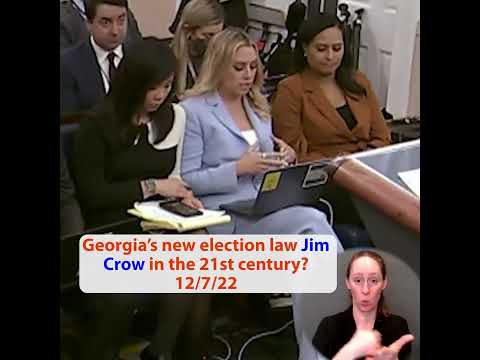
Reporter Confronts KJP: After Record Turnout in Primary, General, and Runoff — Is Georgia Election Law Still “Jim Crow 2.0”? KJP Claims “Suppression” Anyway
On 12/8/2022, a reporter pressed White House Press Secretary Karine Jean-Pierre on the administration’s claims that Georgia’s 2021 election law — which Biden had called “Jim Crow in the 21st century” — would suppress votes. The reporter noted the stark factual reality: “There was record turnout in the primary, there was record turnout in the general, record turnout in the runoff, in early voting absentee ballots and in-person voting.” The reporter asked whether the Department of Justice would now drop its lawsuit against Georgia given the turnout evidence, and whether Biden still viewed the law as a “blatant attack on the Constitution.” KJP refused to update the administration’s position despite the record turnout data: “You guys, you all reported this, that there was suppression, that we saw that throughout the Georgia election.” The exchange captured how the administration maintained its original political framing despite electoral data that contradicted the predictions that framing had been built on.
The Background: SB 202 and Administration Attacks
The Georgia election law (SB 202) had been signed by Republican Governor Brian Kemp in March 2021 following Democratic sweep victories in the 2020 general election and January 2021 runoffs. The law made various changes to Georgia election procedures, including:
Voter ID requirements — Extended ID requirements to absentee ballots.
Drop box regulations — Reduced and regulated drop box locations.
Ballot application deadlines — Tightened timelines for absentee ballot requests.
Election day procedures — Codified various procedural rules.
“Line warming” restrictions — Prohibited giving food and water to voters in lines within certain distances of polling places.
Expanded early voting — Added more required early voting days.
Runoff period changes — Shortened the runoff period.
The law generated intense national controversy. Biden had publicly called it “Jim Crow in the 21st century” and a “blatant attack on the Constitution.” The Department of Justice filed a lawsuit challenging the law. Major corporations relocated events from Georgia (MLB moved the All-Star Game out of Atlanta). Activists predicted dramatic voter suppression.
The Record Turnout Data
By December 2022, the predictions had been tested against actual election results — and the results didn’t support the predictions. The reporter laid out the data.
“But there was record turnout in the primary, there was record turnout in the general, record turnout in the runoff, in early voting absentee ballots and in-person voting,” the reporter said.
The factual claims were accurate. Georgia’s 2022 elections had produced:
Record primary turnout — Higher than any previous Georgia primary.
Record general election turnout — Among the highest midterm turnouts in Georgia history.
Record runoff turnout — The December 2022 runoff saw strong participation.
Record early voting — With massive participation in the early voting period.
Strong absentee ballot return — Despite new ID requirements.
The turnout numbers undermined the core prediction that had motivated opposition to SB 202. If the law was designed to suppress voters — especially minority voters — the suppression should have been visible in turnout data. Instead, turnout was higher than ever.
Various analyses also showed strong minority voter turnout. Black voter turnout was comparable to or higher than prior midterm cycles. Latino turnout also reached new highs. Young voter turnout was strong. The demographic patterns that “voter suppression” arguments had focused on showed no clear suppression effects.
The DOJ Lawsuit Question
The reporter asked about the legal case. “So is the DOJ going to drop their lawsuit against the state?” the reporter asked.
This was a substantive legal and political question. The DOJ’s lawsuit alleged that SB 202 violated the Voting Rights Act by intentionally discriminating against Black voters. Proving this required showing that the law had — or was likely to have — discriminatory effects.
The record turnout made the case harder to win. If Black voter turnout was comparable to or higher than prior cycles, arguing that the law had significant suppressive effects on Black voters was difficult. Courts would want to see evidence of actual suppression, not just theoretical concerns about provisions.
The reporter was asking whether the administration would update its legal strategy given the data. Had the empirical results caused the DOJ to reconsider its case? Or was the administration committed to the lawsuit regardless of electoral outcomes?
The DOJ Deflection
KJP declined to discuss DOJ strategy. “I can’t speak to DOJ’s actions and what they’re going to do,” KJP said.
The DOJ deflection was superficially appropriate — the White House press secretary typically didn’t speak for the Justice Department’s litigation strategy. But it was also a way to avoid engaging with the substantive question about whether the administration’s predictions had been wrong.
The deflection also couldn’t be fully maintained given what followed. KJP went on to characterize the Georgia election as involving “suppression” — a legal conclusion that went beyond what the DOJ had been willing to claim publicly. So KJP was willing to make substantive claims about Georgia elections while declining to discuss DOJ strategy that depended on those claims.
The Biden “Jim Crow” Statements
The reporter pressed on the President’s specific language. “The President, though, called it Jim Crow in the 21st century and a blatant attack on the Constitution. So does he still see it that way?” the reporter asked.
The Biden statements had been central to the administration’s political framing. The “Jim Crow 2.0” and “blatant attack on the Constitution” language had characterized SB 202 in severe terms:
Jim Crow comparison — Linked SB 202 to the segregation-era systematic disenfranchisement of Black voters.
“Blatant attack” — Characterized as intentional wrongdoing, not just poor policy.
“On the Constitution” — Claimed constitutional violation, not just statutory concerns.
These were serious charges that, if accurate, warranted the strongest political and legal responses. If they were inaccurate or exaggerated, they raised questions about administration credibility and about how willing the administration was to update its claims in light of evidence.
The reporter was asking whether Biden still stood by this severe language given the election results. If Biden still called SB 202 “Jim Crow 2.0,” that claim would need to be reconciled with record minority turnout. If Biden no longer used such language, that update would be newsworthy in itself.
The Refusal to Update
KJP refused to address whether Biden still held his original position. “I’ll say this. I’m not going to speak to the Department of Justice legal actions. That’s something for them to speak to. What I can say and not going to get into specifics of your question, but you guys, you all reported this, that there was suppression, that we saw that throughout the Georgia election. So that is something that was been,” KJP said.
The response had multiple features:
Repeated DOJ deflection — Refusing to engage with legal specifics.
“Not going to get into specifics” — Avoiding concrete engagement with turnout data.
Appeal to reporters’ prior coverage — “You guys, you all reported this” — attempting to shift claims about suppression to media sources.
Assertion of suppression despite record turnout — Claiming “we saw” suppression when turnout data contradicted this.
Trailing off — “So that is something that was been” was incomplete.
The key claim — “you all reported this, that there was suppression, that we saw that throughout the Georgia election” — was factually questionable. Reporters had covered various aspects of the Georgia election, but mainstream reporting hadn’t uniformly concluded that systematic suppression had occurred. Individual incidents may have occurred, but characterizing “throughout the Georgia election” as showing suppression was stronger than the available evidence supported.
The “You All Reported” Technique
KJP’s attempt to attribute suppression claims to media reporting was a common political technique. By citing media as the source of claims, officials could:
Share accountability — If claims were wrong, media was also responsible.
Claim third-party validation — Media reporting looked like independent confirmation.
Avoid specific evidence — Pointing to “reporting” rather than specific facts.
Deflect pushback — Critics would have to argue with media, not just with the administration.
But the technique depended on the media actually having reported what was being claimed. In this case, KJP’s characterization was questionable. While some reporters had documented individual concerns, the aggregate media picture of the Georgia election was closer to “strong turnout despite predictions of suppression” than to “widespread suppression observed.”
The Empirical-Political Tension
The exchange captured a fundamental tension in political communications. Political framings often make empirical predictions. When the predictions are tested by events, the framings need either:
Updating — Accepting that predictions were wrong and revising positions.
Reinterpretation — Arguing that predictions were right but effects were masked by other factors.
Redefinition — Shifting what the predictions actually claimed.
Denial — Maintaining that predictions were right despite contrary evidence.
KJP’s response pursued a combination of redefinition and denial. The suppression claim was maintained, but the definition of suppression was implicitly narrowed from “dramatic turnout reduction” to “any evidence of difficulty for any voters.” By narrowing the definition, the claim could survive evidence that would have disproved a stronger claim.
But the political costs of this approach accumulated over time. If predictions consistently required post-hoc reinterpretation to survive contact with reality, the credibility of the predictions was eroded. Future administration predictions would be taken less seriously.
Key Takeaways
- A reporter noted Georgia’s 2022 elections produced record turnout in the primary, general, and runoff — despite administration claims that SB 202 would suppress votes.
- Biden had called the law “Jim Crow in the 21st century” and “a blatant attack on the Constitution” when it was signed in March 2021.
- Asked whether DOJ would drop its lawsuit given turnout data, KJP declined to speak for DOJ.
- Asked whether Biden still held his “Jim Crow” view, KJP claimed suppression anyway: “You guys, you all reported this, that there was suppression, that we saw that throughout the Georgia election.”
- The exchange illustrated how administration maintained political framings despite electoral data that contradicted original predictions.
Transcript Highlights
The following is transcribed from the video audio (unverified — AI-generated from audio).
- The White House and the President were very vocal about Georgia’s new election law when it was signed in March of 2021.
- There was record turnout in the primary, there was record turnout in the general, record turnout in the runoff, in early voting absentee ballots and in-person voting.
- So is the DOJ going to drop their lawsuit against the state?
- The President, though, called it Jim Crow in the 21st century and a blatant attack on the Constitution. So does he still see it that way?
- I’m not going to speak to the Department of Justice legal actions.
- You guys, you all reported this, that there was suppression, that we saw that throughout the Georgia election.
Full transcript: 175 words transcribed via Whisper AI.