 HYGO News
 Gen NATO: recognize decisive action, man of strength/peace; Trump: unbelievable hit by genius pilot
Gen NATO: recognize decisive action, man of strength/peace; Trump: unbelievable hit by genius pilot
NATO Secretary General Mark Rutte opened his meeting with Trump at The Hague by formally commending the president for his Iran action, calling Trump “a man of strength” and “a man of peace” in the same breath. Rutte then walked through what he called a two-phase transformation of NATO defense spending — Phase One running from 2016-2017, when Trump pressured European allies into adding $1 trillion to their defense budgets, and Phase Two beginning in January 2025, when all NATO members committed to the 2% GDP target and today committed to move toward 5%. Trump, in separate remarks, continued his broadside against American media outlets for questioning the Iran strikes — calling CNN, MSDNC, and The New York Times “scum” for framings that, he argued, denied the B-2 pilots the credit they deserve.
”A Man Of Strength, A Man Of Peace”
Rutte opened with the formal commendation. “I just want to recognize your decisive action of Iraq. Thank you. You are a man of strength, but you’re also a man of peace. And the fact that you are now also successful in getting this ceasefire done between Israel and Iran, I really want to comment you for that.”
The transcription artifact “action of Iraq” is almost certainly “action on Iran” given context. Rutte is commending Trump for the Iran strikes and for the ceasefire that followed.
“A man of strength, a man of peace” is the framing Rutte chose. The combination is unusual in diplomatic characterization. Leaders are typically described as one or the other — strong and confrontational, or peaceful and diplomatic. Rutte is arguing Trump is both — that his strength produced the peace that followed.
Why Rutte’s Characterization Matters
The characterization is politically significant for several reasons. First, it validates the administration’s own framing. Trump has been arguing that the strikes were the path to peace — that military force was the prerequisite for diplomatic resolution. Rutte is saying essentially the same thing.
Second, it comes from the alliance’s secretary general. NATO’s official institutional voice is endorsing both the method (force) and the outcome (peace) of the Iran operation. That endorsement gives the administration’s framing additional international credibility.
Third, it addresses the coalition-management question. Some European allies had expressed concern about the strikes before and during their execution. Rutte, speaking for the alliance, is signaling that the institutional consensus supports what Trump did.
The Two-Phase Framework
Rutte then walked through his two-phase analysis of European defense spending transformation. “When you became president in 2016-2017, you forced Europeans and Canadians to pay more. At this moment, the result of that phase is one trillion extra agriculture defense men by the Canadians and the Europeans.”
The transcription “agriculture defense men” appears to be Whisper artifact for “aggregate defense money” or similar. The substantive claim is that Trump’s first-term pressure produced $1 trillion in additional European and Canadian defense spending.
The claim is verifiable. NATO member defense budgets in 2016 were substantially below current levels. The trajectory from 2016 to 2025 shows measurable increases in most members’ budgets. Whether Trump deserves sole credit is a matter of interpretation, but the increase is real.
Phase Two: The 2% Commitment
Rutte continued. “Then came phase two, when you became president January last year. Phase two is that all other countries, not just on 2%, have now committed to the 2%. This is the old goal from Wales in 2014. Seven were not on 2%. Some were saying somewhere in the 2030s, now this year, all of them, including Canada, including Italy, including Belgium, they have all now committed to the 2%.”
The 2% commitment traces back to the Wales Summit in 2014, when NATO members pledged to move toward 2% of GDP on defense. That pledge was aspirational for most members. Implementation was patchy for a decade. As of the current moment, Rutte is declaring that all members have committed to reach the target this year.
The specific countries named — Canada, Italy, Belgium — had been laggards. Canada in particular has been chronically below target throughout its NATO participation. Italy and Belgium, similarly, had not been meeting the commitment. All now commit.
The 5% Target
“Today, we will decide to go to 5%. We have to keep ourselves safe for our adversaries, but also because it is fair to equalize with the United States. With this 5%, the Europeans and the Canadians will equalize their defense spending with the United States.”
The 5% target is the summit’s most consequential deliverable. Moving NATO members toward 5% of GDP on defense is substantially more ambitious than the 2% target. For most members, reaching 5% would require sustained defense budget increases over years.
The “equalize with the United States” framing captures why the target matters to Trump. The president has long argued that Americans should not subsidize European defense. If Europeans and Canadians spend the same percentage of their economies on defense as Americans do, the equalization addresses the free-rider problem Trump has complained about.
”This Is Not About American Taxpayers Paying More”
Rutte drove the point home. “So this is not about American taxpayers paying more. This is about Europeans, Canadians paying more. And again, this would not have happened.”
The political framing is important for the American audience. American voters might have heard “5% defense spending” and assumed it meant American budget increases. Rutte is clarifying that the increase is on the European and Canadian side — Americans are already at that level, while the Europeans and Canadians are catching up.
”Would Not Have Happened”
Rutte ended with the credit attribution. “I’m really saying this here, and some people might criticize me. But then when I speak with them, they all say, yes, you’re right, this would not have happened. If you would not have been elected to 20%.”
The transcription at the end is unclear, but the thrust is that European defense budget increases would not have occurred without Trump’s election. Rutte is giving Trump personal credit for the structural transformation of NATO’s defense economics.
“Some people might criticize me” is Rutte acknowledging that his public endorsement of Trump is politically costly in some European quarters. He is willing to accept that cost because he believes the credit attribution is accurate.
Trump On The Iran Strikes Credit
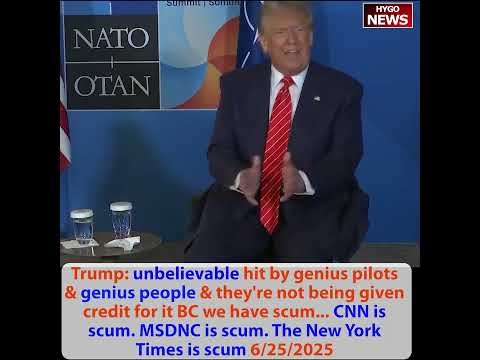
Trump, in separate remarks, returned to the media coverage of the Iran strikes. “This was an unbelievable hit by genius pilots and genius people in the military. And they’re not being given credit for it because we have SCUM that’s in this group.”
“Genius pilots and genius people in the military” is Trump’s continued elevation of the operational personnel. The framing is important because it links the media’s coverage of the operation to its characterization of the personnel. To question the completeness of the strike’s success is, in Trump’s framing, to withhold credit from the pilots who executed it.
”SCUM”
The all-caps transcription captures Trump’s emphasis. “And not all of you are. You have some great reporters, but you have SCUM. CNN is SCUM. MSDNC is SCUM. The New York Times is SCUM. They’re bad people. They’re sick.”
Three specific outlets named. Each treated as not merely biased but as morally compromised. “Bad people. They’re sick.”
The willingness to name specific outlets in specific terms is characteristic Trump communication. Most presidents criticize media generally. Trump is specific. Reporters at the named outlets read the framing and understand that they personally are being characterized as scum.
Why Name The New York Times
The inclusion of The New York Times alongside CNN and MSNBC is notable. The Times is traditionally considered the American newspaper of record. Its coverage of the Iran strikes, while sometimes hedged, has generally been more balanced than the cable networks Trump typically targets. Its inclusion in the “scum” list reflects Trump’s view that even the most prestigious traditional print journalism is, in its current posture, in the same category as the cable networks he more frequently attacks.
The characterization serves multiple purposes. It elevates the scope of the media critique beyond cable news. It signals to Trump’s supporters that no major American media outlet can be trusted. And it puts pressure on the Times specifically, which typically values its reputation for balance.
”Something Less”
Trump articulated the specific critique. “What they’ve done is they’re trying to make this unbelievable victory into something less. Now, even they admit that it was hit very hard. Okay? But it wasn’t. It was hit brutally, knocked it out.”
The framing is about magnitude. The critics, Trump argues, acknowledge that the strikes were effective — but they are minimizing how effective. Moving the characterization from “obliterated” to “damaged” to “set back” to “delayed” is, in Trump’s view, a gradual erasure of the operation’s accomplishment.
”Obliteration”
Trump defended his preferred term. “The original word that I use, I guess it got us in trouble because it’s a strong word. It was obliteration. And then they make that in.”
The acknowledgment that the word “got us in trouble” is Trump conceding that the maximalist framing invited pushback. Critics treated “obliteration” as a testable claim and assembled evidence suggesting that the term was too strong.
But Trump is doubling down. “It was obliteration.” Whatever criticism the word invited, he is not retreating from it. The operational facts, in his view, support the characterization.
The Family Photo
The video closed with Trump participating in the NATO summit family photo. The family photo is one of the enduring rituals of international summitry — all participating leaders assembled in a single group shot. The photo captures the alliance as a collective, all 32 members and their heads of government present.
Trump’s participation in the photo is, in itself, a signal. Presidents who want to distance from the alliance can find reasons not to attend or not to participate in ceremonial elements. Trump’s participation signals that he is engaged in the alliance.
The Hague Summit Arc
The summit arc as captured in this video is revealing. Rutte opens with effusive praise. Trump responds with engagement. The 5% commitment is announced. The American media critique continues as a parallel track. The family photo seals the collective ceremonial moment.
Europeans watching the summit see their alliance being praised for increasing defense spending. Americans watching see their president getting institutional validation from a key European voice while simultaneously attacking American media. Both audiences get content from the same event.
The Policy Substance
Beneath the media coverage, the substantive achievement of the summit is significant. If NATO members genuinely implement the 5% target — even over a multi-year period — the alliance’s defense posture will be transformed. European forces will be better-equipped, better-manned, and more capable of sustaining operations. The burden on American forces will decrease. The deterrent against Russia will increase.
Whether the commitment translates into implementation is the question that will be answered over the coming years. Aspirational commitments often falter in domestic political implementation. Each member government now has to translate the summit commitment into budget legislation that actually increases defense spending.
Key Takeaways
- NATO Secretary General Mark Rutte: “You are a man of strength, but you’re also a man of peace…the fact that you are now also successful in getting this ceasefire done between Israel and Iran, I really want to comment you for that.”
- Phase One of the defense spending transformation: “one trillion extra” in European and Canadian defense spending under Trump 45.
- Phase Two under Trump 47: “All other countries, not just on 2%, have now committed to the 2%…Today, we will decide to go to 5%.”
- Rutte on the credit attribution: “This would not have happened. If you would not have been elected.”
- Trump on American media: “CNN is SCUM. MSDNC is SCUM. The New York Times is SCUM. They’re bad people. They’re sick.”