 HYGO News
 Gabbard: Obama to influence election not if but how; Mamdani's policies; NEGATIVE NET MIGRATION
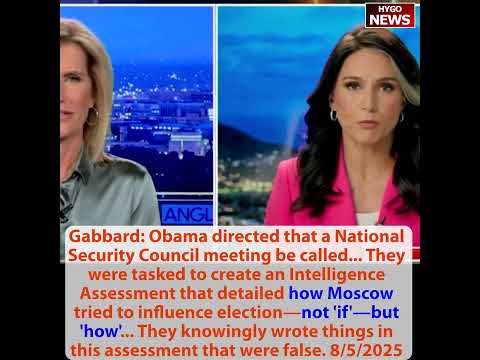
Gabbard: Obama to influence election not if but how; Mamdani’s policies; NEGATIVE NET MIGRATION
DNI Tulsi Gabbard invited Morning Joe and other skeptical commentators to actually read the documents at odni.gov: “If they have actually read the documents, every single page of the documents that we’ve released over the last couple of weeks … President Obama directed that a National Security Council meeting be called … they were tasked to create an intelligence assessment that detailed how Moscow tried to influence the election, not if, but how. And this was the beginning of this manufactured intelligence assessment where they knowingly wrote things in this assessment that were false and they knew they were false.” A DSA activist praised “Mamdani-like policies” as “the kind of work we need to be doing.” Sen. Elissa Slotkin called the border czar “Thomas Holgren” (the actual name is Tom Homan). And a statistical bombshell: “We may be dealing with negative net migration to the United States in 2025. That would be the first time there is negative net migration in this country in at least 50 years."
"Challenge Them to Read the Documents”
Gabbard’s opening challenge. “As you were playing those clips of these people, like Morning Joe seemingly befuddled, saying that by no account is any of this true, I would challenge them to see if they have actually read the documents, every single page of the documents that we’ve released over the last couple of weeks.”
That is a specific accountability challenge. Morning Joe and similar commentators have characterized Gabbard’s Russia-hoax revelations as false or baseless. Gabbard is asking: have they actually read the documents? If so, point to the specific evidentiary gaps. If not, their characterization is uninformed commentary rather than substantive rebuttal.
“If not, go to odni.gov, GOV. It’s all right there for anyone to see.”
The documents are on the ODNI website. Public. Available. Anyone can verify Gabbard’s claims by reading the primary sources.
That transparency is significant. The administration is not relying on media coverage to convey the documents’ contents. The raw material is available for direct public inspection. Skeptics can read and challenge specific passages rather than relying on general characterizations.
The NSC Meeting
“And those who go in and read this will see how President Obama directed that a National Security Council meeting be called to talk about Russia.”
That is the specific claim. Obama personally directed a National Security Council meeting. Not Susan Rice. Not some deputy. The former president himself called the meeting that began the manufactured-intelligence process.
“That the report that came out of that meeting was filled with tasks that were delivered by James Clapper’s assistant to John Brennan and to other elements of the intelligence community.”
The operational chain. Obama directs the NSC meeting. The meeting produces tasks. Clapper’s assistant delivers the tasks to Brennan (CIA) and other intelligence elements. The manufactured-intelligence operation was structured through that specific chain of command.
“John Brennan was the head of the CIA at the time, all saying, per the president’s direction, per the president’s order.”
“Per the president’s direction … per the president’s order.” That is the specific evidentiary frame. The tasks flowing to Brennan explicitly cited Obama’s authority. This was not rogue intelligence community activity. This was presidential order executed through normal command structure.
”Not If, But How”
“And very specifically, they were tasked to create an intelligence assessment that detailed how Moscow tried to influence the election, not if, but how.”
That is the critical distinction Gabbard keeps emphasizing. The intelligence assessment was not asked to determine whether Moscow influenced the election. The assessment was asked to document how Moscow influenced the election — with the conclusion already assumed.
Professional intelligence analysis does not begin with predetermined conclusions. Analysts assess the evidence and reach conclusions that flow from the evidence. When the conclusion is predetermined, the analysis becomes advocacy — arranging evidence to support a foregone conclusion.
“And this was the beginning of this manufactured intelligence assessment where they knowingly wrote things in this assessment that were false and they knew they were false.”
“Knowingly wrote things … that were false.” That is the specific accusation. Not mistake. Not good-faith analysis that later proved wrong. Knowing falsification.
“They knew that they were basing it on discredited intelligence or documents like the Steele dossier that was politically motivated and that they knew was false.”
The Steele Dossier as the known-false source. Clinton-campaign-funded opposition research. Discredited by the intelligence community at the time. Used anyway to build the “manufactured intelligence assessment."
"Years-Long Coup”
“And this was how they came up with the rush hoax that was then weaponized and used to try to delegitimize the president, President Trump, and to try to ultimately enact this year’s long coup throughout his entire four years of his first administration.”
“Rush hoax” is Whisper’s rendering of “Russia hoax.” Gabbard’s characterization: the manufactured assessment became the foundational document for the years-long effort to delegitimize Trump. The Mueller investigation. The first impeachment. The sustained media narrative. All rested on the corrupted foundation.
“Years-long coup.” That is the characterization. Not political opposition. Coup. Attempted overthrow of an elected administration through institutional means.
Whether historians ultimately accept the “coup” framing is a question for the future. What matters now is that the sitting DNI is publicly characterizing the Russia-collusion operation as a coup — and providing the documentary evidence for readers to verify.
DSA on Mamdani
The DSA activist’s framing. “I think the Mamdani-like policies, the policies that you’ve mentioned fighting for, I think, you know, the policies that Katie was urging us to turn towards, like all of that, I think stands out for me as examples of the kind of work that we’re doing.”
“Mamdani-like policies” as the model. The DSA is explicitly framing Mamdani’s platform — rent freezes, government grocery stores, defund-adjacent policing, anti-Israel positions, universal free services — as the template for DSA’s ongoing work.
“And of course, like the reproductive justice.”
“Reproductive justice.” That is the framing that goes beyond abortion rights. Reproductive justice, as a progressive framework, addresses the full scope of reproductive decision-making, including access to abortion, contraception, and gender-affirming care. In some articulations, it includes the “right” to abortion funded by public programs, the “right” to gender-affirming care for minors, and related expansions.
”Thomas Holgren”
Sen. Elissa Slotkin’s gaffe. “And in general, if I can be frank, Thomas Holgren, who runs border policy largely from the White House.”
“Thomas Holgren.” That is Slotkin’s version of the border czar’s name. The actual person is Tom Homan — ICE Executive Associate Director, serving as the border czar for the administration.
Homan is not an obscure figure. He has been publicly visible across multiple cycles — on news shows, in congressional testimony, in administration press events. For a U.S. senator to get his name wrong is a tell. Slotkin is either not paying attention to the border policy she is criticizing, or she is performatively using incorrect names.
“They have been a disaster. They have been un-American. They have done things that I have heard this morning in Grand Rapids from our Latino Chamber of Commerce that make you feel you are in an autocratic nation.”
“Autocratic nation.” That framing. Slotkin is characterizing border enforcement as autocratic — characteristic of authoritarian regimes rather than democratic ones. That aligns with the broader “existential threat to democracy” framing Slotkin deployed in the earlier segment.
The counter-framing: enforcement of immigration laws is the ordinary function of sovereign states. Democratic states enforce their immigration laws just as authoritarian states do. Characterizing enforcement as “autocratic” requires treating enforcement itself as illegitimate — which is a specific political position, not an autocracy-democracy distinction.
”Latino Chamber of Commerce”
Slotkin’s specific source. “I have heard this morning in Grand Rapids from our Latino Chamber of Commerce.”
That is an interesting framing. Slotkin represents Michigan. Grand Rapids is in Michigan. The Latino Chamber of Commerce in Grand Rapids is a specific organization.
What specifically that Chamber told Slotkin is not disclosed. But the framing positions the Latino Chamber of Commerce as authoritative source on border enforcement. Whether that Chamber’s perspective reflects broader Latino-American opinion is a separate question.
Polling has consistently shown Latino voters, especially working-class Latino voters, supportive of border enforcement. The Latino Chamber of Commerce may or may not reflect that broader view. Slotkin’s framing takes one specific organization’s perspective as representative of a much broader constituency.
Negative Net Migration
The segment’s most striking data point. “How about net migration? Many of the United States, get this, it’s down. It’s going to be down at least 60 percent. We may be dealing with, get this, negative net migration to the United States in 2025.”
“Negative net migration to the United States in 2025.” That is the statistical projection. For the first time in at least 50 years, more people will leave the United States than arrive.
“That would be the first time there is negative net migration in this country in at least 50 years.”
That is extraordinary. American history has been, overwhelmingly, a history of immigration. Periods of low net migration exist but are rare. Negative net migration for a calendar year has not occurred in modern American history.
“We’re talking about down from 2.8 million in 2024.”
2024 saw 2.8 million net migration (mostly Biden-era border flows). 2025 is projected to produce negative net migration. That is a swing of more than 3 million people — the scale of a mid-sized American state’s population.
”Record High Tariff Rates”
“So Donald Trump has always run on tariffs and he’s running a hawkish line on immigration. And on both of those issues, we are seeing record high tariff rates for this century going all the way back, well back into the early part of the 20th century.”
Record high tariffs for this century. Back to early 20th century levels. That is the broader economic-policy context. The tariff regime represents a return to pre-1945 trade policy frameworks.
“And when it comes to immigration, net migration, we are seeing record low levels way down from where we were during the Abidin administration.”
“Abidin administration” is Whisper’s rendering of “Biden administration.” Net migration during Biden years was historically high. Net migration under Trump second term is historically low — with negative net migration projected for 2025.
“We are potentially looking at negative net migration for the first time in at least 50 years.”
That is the summary. The administration’s signature immigration promise — ending illegal immigration and reversing demographic pressure — is producing measurable results at scales not seen in half a century.
The Three Threads Connect
Gabbard’s Russia hoax documentation. DSA’s Mamdani policies framework. Slotkin’s border-policy criticism mixing wrong names and “autocratic” framing. Plus the negative net migration projection.
The common thread: the administration is executing specific policies with documented results, while the opposition responds through either revolutionary framing (DSA), conspiratorial rhetoric (Slotkin’s “autocratic”), or silence (on Gabbard’s documentary evidence).
Voters will assess. The administration is producing data (jobs, tariffs, migration metrics, peace deals, economic indicators). The opposition is producing rhetoric (existential threat, autocratic nation, manufactured-intelligence denials). The 2026 midterms will test which framing dominates.
Key Takeaways
- DNI Gabbard challenged skeptics: “Go to odni.gov … see how President Obama directed that a National Security Council meeting be called” — with tasks passing through Clapper’s assistant to Brennan “per the president’s direction, per the president’s order.”
- The critical distinction: “They were tasked to create an intelligence assessment that detailed how Moscow tried to influence the election, not if, but how … they knowingly wrote things in this assessment that were false.”
- DSA activist on Mamdani: “The Mamdani-like policies … stands out for me as examples of the kind of work that we’re doing.”
- Sen. Elissa Slotkin called Tom Homan “Thomas Holgren” while framing border enforcement as “an autocratic nation” — based on input from “our Latino Chamber of Commerce” in Grand Rapids.
- Migration milestone: “We may be dealing with negative net migration to the United States in 2025. That would be the first time there is negative net migration in this country in at least 50 years — we’re talking about down from 2.8 million in 2024.”