 HYGO News
 FoxNews: Putin steamrolled Trump unusual not good; CNN host on Trump Nobel Peace Prize; Swalwell
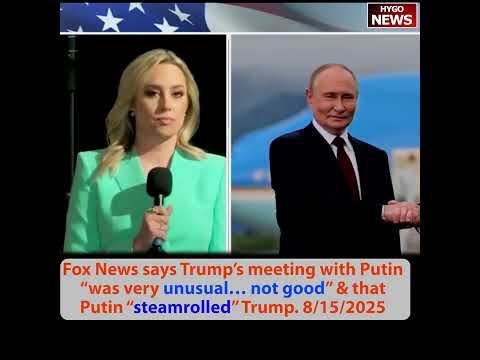
FoxNews: Putin steamrolled Trump unusual not good; CNN host on Trump Nobel Peace Prize; Swalwell
A media reaction composite. Fox News’s own reporter noted the summit “felt in the room was not good” and that Putin “steamrolled” Trump. Trump returned to Washington at 3AM after 20 hours round-trip to Alaska. A CNN host acknowledged Trump would deserve the Nobel Peace Prize if Ukraine accepts his peace deal — “I don’t know how you’d vote no on that … That will be Trump Derangement Syndrome!” And Rep. Eric Swalwell revived his Russian-asset framing: “I don’t know if Donald Trump is or is not a Russian asset. I do know that at press conferences like this and like at Helsinki, he certainly acts like one.” Fox reporter: “It was just very unusual, atypical … the way that it felt in the room was not good. It did not seem like things went well and it seemed like Putin came in and steamrolled, got right into what he wanted to say.” CNN: “President Trump brokers a peace agreement between Russia and Ukraine that Ukraine finds acceptable … I don’t know how you’d vote no on that … I don’t get it. I truly don’t get it. That will be Trump Derangement Syndrome.” Swalwell: “You just saw the President of the United States achieve zero.”
Fox News: “Putin Steamrolled”
The Fox News reporter’s observation. “It was just very unusual, atypical, and I think we’re all awaiting, you know, the readout because the way that it felt in the room was not good. It did not seem like things went well and it seemed like Putin came in and steamrolled, got right into what he wanted to say and got his.”
That is Fox News criticism of Trump’s summit performance. “Very unusual, atypical.” Most Trump-friendly coverage of the summit would frame it positively. This Fox reporter specifically characterized the atmospherics as “not good.”
“Putin came in and steamrolled.” That is a specific claim. Putin dominated the meeting. Set the agenda. Got what he wanted. Trump was not the dominant party in the exchange.
Whether that characterization is accurate is the open question. Trump’s own characterization (multiple segments) was “extremely productive” with “many points agreed to.” Putin characterized the relationship as “business-like and trustworthy.” The Fox reporter’s “steamrolled” framing is one interpretation among multiple possibilities.
”Mr. President, How Did Your Call Go?”
Reporters shouting questions. “Mr. President, how did your call go? How did your call go, Mr. President? Mr. President, go and speak.”
Trump walking past reporters post-summit. Reporters shouting multiple questions. Trump declining to stop for detailed answers at that moment — likely because the substantive briefing would come in the formal press engagement after returning to Washington.
CNN Host: “Trump Would Deserve Nobel Peace Prize”
The CNN host’s analysis. “President Trump brokers a peace agreement between Russia and Ukraine that Ukraine finds acceptable. I was very careful to put that in the question. I didn’t just say, should you get an obel peace prize? First of all, they’ve got to resolve the war and Ukraine has to find it acceptable. And frankly, I don’t know how you’d vote no on that.”
That is CNN acknowledgment. If Trump brokers a peace agreement that Ukraine finds acceptable, he deserves the Nobel Peace Prize. Voting “no” on that Nobel nomination would be indefensible.
“I was very careful to put that in the question.” The host is specifying the conditions. Not merely “if Trump does some negotiations.” Specifically: a peace agreement that Ukraine finds acceptable. If that specific outcome occurs, the Peace Prize is deserved.
”I Anticipate Trump Is Going to Come Out on the Losing End”
“I proved this to you last week on air when I covered my eyes and Catherine asked me to predict, you know, what’s the outcome of the poll. You learned a couple of things. I don’t cheat on these things. I don’t know what the results are. I anticipate that President Trump is going to come out on the losing end of this stick when we come back with the results in just a few minutes.”
The host predicting poll results. He anticipates that CNN’s poll will show respondents opposing Trump getting the Nobel Peace Prize. The poll outcome, when revealed, will likely be anti-Trump.
“But I don’t get it. I truly don’t get it. That will be Trump Derangement Syndrome. Because how could you say if he negotiates a fair peace that he’s undeserving? I don’t understand it. I really don’t.”
That is notable self-awareness. The CNN host is predicting his own audience’s anti-Trump response. He characterizes that response as “Trump Derangement Syndrome” — the specific Republican framing of the irrational anti-Trump reflex.
“How could you say if he negotiates a fair peace that he’s undeserving?” That is the rhetorical question. If Trump actually produces the peace, rejecting the Peace Prize is indefensible. The only explanation for such rejection is pure partisan hatred — TDS.
A CNN host using Republican framing (“Trump Derangement Syndrome”) to characterize his own audience’s likely response is extraordinary. It suggests even CNN’s talent recognizes the specific absurdity of partisan denial of achievable outcomes.
Swalwell: “Achieved Zero”
Rep. Eric Swalwell’s analysis. “You just saw the President of the United States achieve zero.”
“Achieved zero.” That is Swalwell’s specific framing. The summit produced nothing. No ceasefire. No trilateral commitment. No territorial framework. Zero.
The characterization is reductive. The summit did produce: agreement on many points (per Trump), setup for Zelensky-Putin meeting, Putin’s stated willingness to continue engagement, Putin’s public confirmation that the war would not have happened under Trump. Whether those count as “zero” or as “substantial progress short of final deal” depends on the evaluative framework.
”What More Are They Willing to Do”
“And they will have to ask themselves what more are they willing to do if they too could be thrown under the bus if Russia ever moved farther west.”
Swalwell’s specific warning. European allies who saw Trump’s summit engagement might worry about being “thrown under the bus” if Russia expands westward. The implied comparison: Trump’s willingness to engage Putin signals U.S. willingness to abandon allies if Russia threatens them.
That framing requires specific inferences that are not directly supported by the summit content. Trump engaging Putin to end the Ukraine war does not imply willingness to abandon NATO allies. The Article 5 commitment remains in place. Russia attacking NATO territory would produce NATO response regardless of Trump’s engagement with Putin.
”I Was Hoping to Hear Trilateral”
“But as far as objectives, I was hoping to hear that there would be a trilateral meeting. That didn’t come out of this.”
Swalwell’s specific objective: trilateral meeting announcement. That is not quite accurate. Trump explicitly said (in the previous segment): “They’re going to set up a meeting now between President Zelensky and President Putin. And myself, I guess.” That is trilateral commitment — Trump, Zelensky, Putin in the same room.
“I was hoping to hear there would be a ceasefire. That didn’t come out of this.”
No immediate ceasefire announced. Trump wanted ceasefire “today” but acknowledged “I don’t know if it’s going to be today.” Ceasefire did not emerge from the summit. That is accurate.
But ceasefire emerging from a first summit, three years into a war, was always unlikely. Ceasefires require specific technical arrangements — front-line monitoring, exchange protocols, communications mechanisms, pullback sequencing. Those require specific negotiation that first-meeting diplomacy does not typically produce.
“And I was hoping to at least hear about the territory that would be proposed or exchanged by both sides. That didn’t come out of this.”
Territorial details were not announced. That is expected. Territorial terms are among the most sensitive negotiating points. Announcing specific territorial terms before Zelensky has committed would undermine the negotiation. Keeping those terms confidential until the trilateral is standard diplomatic practice.
”Russian Asset” Framing
“Look, Alicia, I don’t know if Donald Trump is or is not a Russian asset. I do know that at press conferences like this and like at Helsinki, he certainly acts like one. And that is cold comfort for anyone in the United States, particularly in our military, that the Commander-in-Chief would be so flattering of and so charming to a ruthless dictator like Vladimir Putin.”
“Russian asset.” Swalwell reviving the specific Russia-collusion-era characterization of Trump. The framing that dominated 2017-2019 political discourse. The framing that multiple investigations — Mueller, Horowitz IG, Senate Intelligence Committee — could not substantiate despite extensive investigation.
“I don’t know if Donald Trump is or is not a Russian asset.” That is Swalwell’s specific rhetorical move. Explicit acknowledgment that he cannot state Trump is a Russian asset. But maintaining the characterization through “acts like one” language.
“At Helsinki.” That references Trump’s 2018 Helsinki summit with Putin. Democrats widely criticized Trump’s posture at that summit. The specific concerns at Helsinki — Trump’s statements about Russian election interference — were specific facts from 2018. Extrapolating those concerns to the 2025 Alaska summit involves different substantive issues.
“So flattering of and so charming to a ruthless dictator like Vladimir Putin.” Swalwell characterizing Trump’s specific manner toward Putin. Trump’s engagement with Putin is typically cordial — the personal dynamic he uses across foreign policy. That does not signal subservience. It signals Trump’s specific diplomatic style.
The Russian-asset framing is itself politically costly. Democrats who continue invoking the Russia-collusion framing from 2017-2019 alienate voters who have moved past that narrative. The multiple investigations that did not substantiate the collusion theory have reduced public receptivity to the framing. Swalwell repeating it suggests he is operating in an older political moment rather than current reality.
Swalwell’s Own Russia Exposure
Swalwell’s credibility on Russian-influence issues is complicated by his own documented relationship with Fang Fang — a Chinese intelligence operative who reportedly had a close personal relationship with Swalwell. While not Russian, the Chinese intelligence exposure raises questions about whose “asset” claims Swalwell is positioned to make.
The FBI briefed Swalwell about Fang Fang’s intelligence role. Swalwell ended the relationship. But the specific exposure to hostile foreign intelligence — and Swalwell’s continued presence on the House Intelligence Committee despite that exposure — makes Swalwell’s “Russian asset” accusations against Trump particularly awkward.
The 3AM Return
“WOW! President Trump steps off Air Force One at 3AM in Washington after a whopping 20 hours to and from Alaska. Trump is an absolute workhorse. Progress has been made toward peace.”
Trump’s physical schedule. 3AM arrival in Washington. 20 hours round-trip to Alaska. At 79 years old (Trump’s age during this period), that is a demanding travel schedule. Most leaders of that age would stay multiple days or would not make the trip at all.
“Absolute workhorse.” The supportive framing. Trump’s willingness to physically travel that distance on that timeline signals serious engagement with the diplomatic process. “Progress has been made toward peace” — consistent framing across Trump-friendly media.
Three Media Framings
Fox News reporter’s “Putin steamrolled” characterization. CNN host’s “Trump deserves Nobel Peace Prize” acknowledgment. Swalwell’s “Russian asset” framing.
Three different media framings of the same underlying event. Fox News — typically Trump-friendly — offered critical atmospherics. CNN — typically Trump-critical — offered a substantive concession that Trump would deserve the Nobel Peace Prize on specific conditions. Swalwell — consistent Democratic attack voice — reverted to the Russia-asset framing that has political history but limited current credibility.
The spectrum shows the specific difficulty of maintaining a unified media narrative about complex diplomacy. The reality of the summit — partial progress, specific agreements, remaining questions, human stakes — resists the framings that either pole wants to impose.
Key Takeaways
- Fox News reporter: “It was just very unusual, atypical … the way that it felt in the room was not good. It did not seem like things went well and it seemed like Putin came in and steamrolled, got right into what he wanted to say.”
- CNN host’s unexpected concession: “President Trump brokers a peace agreement between Russia and Ukraine that Ukraine finds acceptable … I don’t know how you’d vote no on that. Frankly, I don’t get it. That will be Trump Derangement Syndrome.”
- Trump’s physical schedule: “Steps off Air Force One at 3AM in Washington after a whopping 20 hours to and from Alaska. Trump is an absolute workhorse.”
- Rep. Eric Swalwell: “I don’t know if Donald Trump is or is not a Russian asset. I do know that at press conferences like this and like at Helsinki, he certainly acts like one.”
- Swalwell: “You just saw the President of the United States achieve zero” — despite Trump’s announced Zelensky-Putin meeting and Putin’s public confirmation that the war would not have happened under Trump’s leadership.