 HYGO News
 Former Biden NSC: extremely high marks; Speaker: big sigh of relief; Miller: Everyone said to WWIII
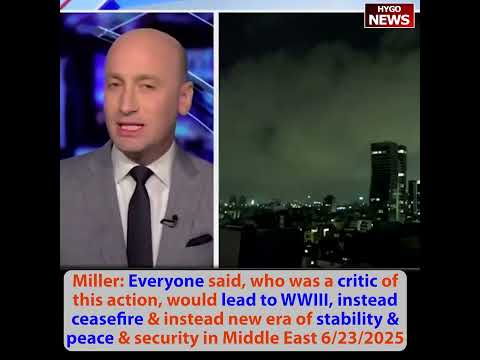
Former Biden NSC: extremely high marks; Speaker: big sigh of relief; Miller: Everyone said to WWIII
The reactions to Trump’s ceasefire announcement compressed into one news cycle the most striking bipartisan acknowledgment of the administration’s accomplishment in its young tenure. Brett McGurk, who served as Middle East coordinator in the Biden National Security Council, gave the Trump national security team “extremely high marks” for managing the crisis. That endorsement, from a senior professional of the previous administration, is the kind of validation the administration values most. Speaker Mike Johnson described the moment on Capitol Hill as “a big sigh of relief.” Stephen Miller — Trump’s deputy chief of staff for policy — observed that “everyone who was a critic of this action said it would lead to World War III; instead, we have a ceasefire.” Schumer and Jeffries, meanwhile, continued to demand classified briefings and complain about presidential unilateralism — staging a political argument that the substance of the outcome has undercut.
McGurk: “Extremely High Marks”
Brett McGurk’s endorsement was the most surprising of the day. “Look, bottom line, this is about the best place we can be. I give extremely high marks to this national security team and President Trump for managing this crisis and giving where we are.”
McGurk is not a political ally of the Trump administration. He served as the Obama administration’s envoy to the anti-ISIS coalition, and he held Middle East coordination roles across multiple administrations. He is the kind of professional whose career survives political transitions because his judgment is respected by career diplomats and intelligence officers.
McGurk’s “extremely high marks” assessment is therefore not a partisan endorsement. It is a professional judgment from someone with extensive experience in Middle East crisis management. When McGurk says the administration handled this well, the statement has weight that a partisan endorsement would not.
”Now Let’s Follow Through”
McGurk added a forward-looking note. “But now let’s follow through. There’s a chance for diplomacy here. We haven’t seen this in a while and it’s really a big sigh of relief here on Capitol Hill.”
“Follow through” is the professional diplomatic term for converting tactical success into strategic gains. The administration achieved a tactical objective — destruction of the nuclear program and a ceasefire. Converting that tactical achievement into a durable strategic settlement requires continued diplomatic engagement, creative solutions to hard regional problems, and the patience to build international architecture around the outcome.
Speaker Johnson’s Relief
Speaker Mike Johnson offered the legislative side’s reaction. “We certainly hope and pray and trust that Iran will end its nuclear enrichment program. They’ll heed the calls of the rest of the world and that we can have peace in the Middle East and peace in Israel. It’s a really, really big day. Historic.”
“Really, really big day. Historic” is the framing Johnson is using for his caucus. The congressional Republicans who had been under pressure to either support or distance themselves from the strikes now have the validation of a successful outcome to carry back to their districts. The political cost of supporting the administration is minimized when the outcome validates the support.
Schumer’s Continuing Objection
Senate Minority Leader Chuck Schumer, despite the successful outcome, maintained his procedural objection. “This afternoon, I asked the Trump administration to immediately provide a classified briefing, laying out the full threat picture. As I said Saturday night, Congress and the American people are owed answers. No president should be allowed to unilaterally march this nation into war with erratic threats, no strategy, no explanation.”
The Schumer framing is the Democratic process objection in its most consistent form. The outcome may have been successful, but the process was wrong. Presidents should not have the authority to initiate military action without congressional consultation.
The political problem with Schumer’s framing is that the American public tends to evaluate decisions on outcomes rather than process. A failed operation executed through proper process would receive harsher political judgment than a successful operation executed through disputed process. Schumer is, in effect, asking voters to care about process when the outcome has delivered on the underlying policy objective.
”That’s Why I Have Called On Leader Thune”
Schumer continued with the procedural remedy. “That’s why I have called on Leader Thune to hold a vote immediately to enforce the war powers resolution. The law requires the Trump administration to consult with Congress. The Constitution demands it.”
The War Powers Resolution requires presidents to notify Congress within 48 hours of committing forces and to withdraw forces within 60 days absent a declaration of war or specific authorization. The administration’s position is that the Iran strikes fall within presidential Article II authority and that the WPR’s constitutionality is disputed. Schumer’s call for a vote to enforce the WPR is the formal procedural response.
Whether Thune will schedule such a vote, and whether it would pass, are separate questions. The political calculation for Republican senators is whether to join Schumer in a procedural rebuke of the administration. Most Republican senators, given the operation’s success, are unlikely to do so.
Stephen Miller On The Historical Arc
Deputy Chief of Staff Stephen Miller provided the administration’s contextual framing. “Think about how historic this moment is. Presidents going back to Bill Clinton have said it is the policy of the U.S. government not to allow Iran to have a nuclear weapon. Under every president except Trump, Iran marched closer and closer to being able to put onto a ballistic missile, a nuclear warhead that could take out an entire city.”
The historical arc Miller is describing covers seven administrations — Clinton, Bush 43, Obama, Trump 45, Biden, Trump 47. Each of those administrations declared that Iran could not have a nuclear weapon. Six of them left office with Iran closer to a weapon than they found it. Only one — the current administration — has left Iran further from a weapon than it was at the start of the term.
That is the historical claim Miller is making. Whether the claim holds depends on whether Iran rebuilds the program. As of the ceasefire moment, the claim is empirically accurate.
”Flawlessly Through The United States Military”
Miller described the execution. “President Trump took action flawlessly through the United States military to obliterate Iran’s nuclear sites and to stop them through the use of military force from having a nuclear weapon.”
“Flawlessly” is the characterization of the execution. Major military operations rarely proceed without complications. Even successful operations typically have specific challenges that require improvisation. The “flawless” characterization suggests that this operation met its objectives without the complications that would normally arise.
Whether the characterization holds up to detailed after-action review is a separate question. But the surface-level execution — penetration to the target, weapon delivery, damage assessment, safe return of aircrews, ceasefire within days — is consistent with the characterization.
”Without A Single Leak”
Miller highlighted the operational security achievement again. “It was a bold, courageous action and it happened without a single leak, without a single, solitary service member losing their life.”
The leak discipline was notable in itself. Major American military operations often leak. The inability of the press to develop advance knowledge of the strikes reflected discipline across the administration that is rare in modern Washington.
The zero American casualty rate is the other remarkable element. The operation involved multiple B-2 sorties from Missouri, extensive defensive overflights, and coordination across multiple theaters. Any of these elements could have produced casualties. None did.
”Everyone Said It Would Lead To World War III”
Miller delivered the line that will likely be quoted for years. “Everyone said, who was a critic of this action, that it would lead to World War III and instead we have a ceasefire and instead we have the beginnings of a new era of stability and peace and security in the Middle East.”
The “World War III” prediction was the dominant Democratic and media framing in the hours and days before the strikes. Commentators predicted that Iranian retaliation would pull the United States into a broader conflict that would draw in Russia, China, and other powers. The result — a 12-day war ending in a ceasefire — does not fit the World War III prediction.
Miller is noting that fact for the political record. When critics make predictions that do not come true, and when the administration acts over those predictions and is proven right, the political advantage belongs to the administration.
”He Alone Has The Wisdom”
Miller closed with a presidential endorsement. “President Trump once again has demonstrated that he alone has the wisdom, the judgment, the strength and the courage to see this nation through the most dangerous challenges we face.”
“He alone” is strong language. Miller is arguing that Trump’s specific capabilities — wisdom, judgment, strength, courage — are uniquely suited to the challenges the country faces. The claim is political. It positions Trump as the irreplaceable leader of the moment.
Whether the claim extends beyond the rhetorical is a matter of evaluation. What is clear is that the outcome of the Iran crisis supports the argument that the current administration is capable of executing major national security missions successfully. That support does not require acceptance of the “he alone” framing, but it does help it land.
Jeffries’s Continued Complaint
House Minority Leader Hakeem Jeffries continued to push the procedural complaint. “All we received from the White House was a so-called courtesy call with no explanation as to the rationale for the decision that was taken that could have serious consequences for the American people. I asked for a gang of eight briefing. It has yet to occur and it’s not clear to me what the administration is hiding from the Congress and from the American people if they have a case to make come up to Capitol Hill and make it.”
The Gang of Eight briefing request is a specific procedural request. The Gang of Eight consists of the top congressional leadership of both parties plus the chair and ranking member of each intelligence committee. They are the highest-cleared members of Congress and receive the most sensitive intelligence briefings.
The administration has offered classified briefings. The question is whether Jeffries considers those briefings adequate. His continued complaint suggests he does not.
”What The Administration Is Hiding”
The “what the administration is hiding” framing is the Democratic rhetorical move. If the administration is not hiding anything, full briefings should be available. If full briefings are not being offered, the administration must be hiding something.
The administration’s counter is that briefings at the appropriate classification level have been offered. The Democratic preference for more extensive briefings does not equate to administrative hiding. The two sides disagree on what level of information sharing is appropriate. Neither side is hiding anything, except perhaps their underlying motivations.
”House Republican Leaders Are Going To Have To Explain”
Jeffries closed with a political shot at the House Republican majority. “House Republican leaders are going to have to explain that to their own base, which also does not want to see another dangerous, potentially disastrous Middle Eastern war.”
The argument is that elements of Trump’s own political base were opposed to the strikes. Representatives Massie and others on the libertarian-right had raised concerns. Commentators like Tucker Carlson had objected before apologizing. If the administration’s own base has concerns, the argument goes, House Republicans who support the administration need to explain themselves to their constituents.
The counter-argument is that most Republicans, including most elements of the MAGA base, support the strikes. Polling has consistently shown Republican support for action against Iran’s nuclear program. Jeffries’s characterization of the Republican base as opposed to the strikes is not well-supported by the available evidence.
The Day’s Political Lesson
The reactions, taken together, captured the political lesson of the moment. The administration had executed a major military operation that achieved its objectives within days, produced no American casualties, and ended in a ceasefire. That outcome was endorsed by professionals from the previous administration, acknowledged by Republican leaders, and defended by administration officials. The Democratic procedural objections, while formally valid, were in tension with the substantive success.
Americans who watch political outcomes rather than procedural arguments tended to see the operation favorably. Americans who focus on process concerns tended to join the Democratic critique. The administration’s bet is that more Americans fall in the first group than the second.
Key Takeaways
- Brett McGurk, former Biden NSC Middle East coordinator: “I give extremely high marks to this national security team and President Trump for managing this crisis and giving where we are.”
- Speaker Johnson: “It’s really a big sigh of relief here on Capitol Hill…It’s a really, really big day. Historic.”
- Stephen Miller’s signature line: “Everyone said, who was a critic of this action, that it would lead to World War III — and instead, we have a ceasefire.”
- Miller on Trump’s historical uniqueness: “Presidents going back to Bill Clinton have said it is the policy of the U.S. government not to allow Iran to have a nuclear weapon. Under every president except Trump, Iran marched closer and closer.”
- Jeffries’s continued complaint: “I asked for a gang of eight briefing. It has yet to occur” — Schumer calling for a War Powers Resolution vote.