 HYGO News
 Biden's Hurricane Idalia Photo-Op: Mumbles Through Remarks, Lectures on Climate Change
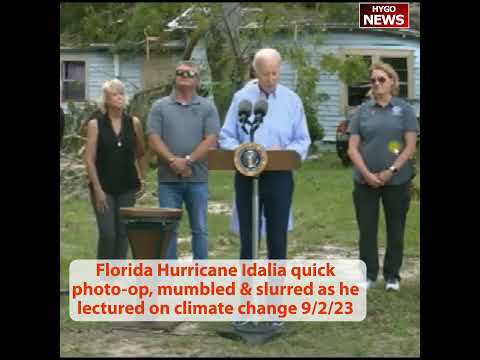
Biden’s Hurricane Idalia Photo-Op: Mumbles Through Remarks, Lectures on Climate Change
On September 2, 2023, President Joe Biden and First Lady Jill Biden traveled to Live Oak, Florida, to survey damage from Hurricane Idalia, which had struck Florida’s west coast days earlier as a Category 3 storm. The visit came only after significant public backlash over Biden’s handling of the Maui wildfire disaster, where he had been criticized for continuing his beach vacations while residents of Lahaina dealt with the deadliest U.S. wildfire in over a century. Biden struggled through his prepared remarks at the Florida event, mumbling and slurring his way through a speech that pivoted quickly from disaster relief to a lecture on climate change, producing a verbal stumble that critics seized upon as either a Freudian slip or another example of Biden’s declining verbal abilities.
The Verbal Stumble
The moment that drew the most attention was Biden’s description of his administration’s response to extreme weather events. Reading from prepared remarks, Biden said: “I also convened my entire cabinet as part of a whole of government response, and that response is to increase the number and intensity of the extreme weather events.”
The sentence, as Biden spoke it, suggested that his administration’s response to extreme weather was to make extreme weather worse — to “increase the number and intensity” of the very events they were supposed to be addressing. What Biden presumably meant to say was that the government response was aimed at addressing the increasing number and intensity of extreme weather events, or words to that effect.
The garbled phrasing was quickly circulated online, where commentators debated whether it constituted a Freudian slip revealing some hidden intent, a simple misreading of his prepared text, or another data point in the accumulating evidence of Biden’s difficulty with public speaking. Whatever the explanation, a president standing in a hurricane-damaged community and appearing to say that his government’s goal was to increase extreme weather was not the message the White House intended to send.
Biden continued: “Nobody can deny the impact of the climate crisis. At least nobody intelligent can deny the impact of the climate crisis anymore.” The qualifying addition of “nobody intelligent” was another moment that critics flagged as dismissive and condescending, effectively calling anyone who questioned climate change narratives unintelligent during what was supposed to be a nonpartisan disaster response visit.
DeSantis Refused to Meet Biden
Florida Governor Ron DeSantis, who was at the time a candidate for the Republican presidential nomination, declined to meet with Biden during the visit. DeSantis’s decision to snub the president was both a political statement and a practical one. DeSantis stated that he was focused on disaster response rather than what he characterized as a presidential photo opportunity.
The governor’s refusal highlighted the political dynamics surrounding the visit. DeSantis had been critical of Biden’s disaster response patterns and had contrasted his own on-the-ground management of Florida emergencies with what he described as the federal government’s slower and more bureaucratic approach.
Biden’s team attempted to frame the visit as bipartisan and focused on relief, but DeSantis’s absence ensured that the story was about the political dynamics rather than the disaster response. The governor’s snub was covered extensively by media outlets and reinforced the narrative that Biden’s Florida trip was motivated more by political optics than genuine concern.
The Maui Backlash That Forced the Visit
Biden’s decision to visit Florida after Hurricane Idalia was widely understood as a response to the criticism he had received over his handling of the Maui wildfire disaster. On August 8, 2023, a catastrophic wildfire destroyed much of the historic town of Lahaina, killing over 100 people and making it the deadliest U.S. wildfire in more than a century.
Biden’s initial response to the Maui fires was widely criticized. When asked about the death toll on August 13, Biden responded with “no comment” while lounging on a beach in Rehoboth Beach, Delaware. The image of a president on vacation while Americans died in a wildfire was politically devastating.
Biden eventually visited Maui on August 21, nearly two weeks after the fires began, and delivered remarks that included a widely criticized anecdote in which he compared the Maui disaster to a small kitchen fire at his own home years earlier. Survivors and residents found the comparison tone-deaf and insulting.
The backlash from the Maui response created political pressure for Biden to respond more promptly to Hurricane Idalia. The Florida visit appeared designed to demonstrate that Biden had learned from the Maui criticism and was capable of responding to disasters with appropriate urgency. However, the rushed nature of the visit, the verbal stumbles during his remarks, and the political controversy surrounding DeSantis’s absence all undermined that objective.
Hurricane Idalia
Hurricane Idalia made landfall near Keaton Beach, Florida, on August 30, 2023, as a Category 3 hurricane with maximum sustained winds of 125 miles per hour. It was the strongest hurricane to hit Florida’s Big Bend region in over 125 years.
The storm caused significant damage across Florida’s Gulf Coast, including extensive flooding in Cedar Key, structural damage in Perry and Live Oak, and widespread power outages affecting hundreds of thousands of customers. The storm then moved across northern Florida and into Georgia and the Carolinas, causing additional flooding and damage.
While Idalia caused significant property damage and disrupted lives across the region, the relatively low population density of the Big Bend area meant that the death toll was lower than it might have been had the storm struck a more populated part of the coast. Early evacuations ordered by Governor DeSantis and local officials were credited with preventing larger casualty numbers.
Biden’s Climate Change Lecture
The bulk of Biden’s remarks in Live Oak focused not on the immediate disaster response or the needs of affected residents but on climate change. Biden used the hurricane damage as a backdrop for his broader climate messaging, arguing that extreme weather events were becoming more frequent and more intense due to climate change.
“Nobody can deny the impact of the climate crisis,” Biden said. “At least nobody intelligent can deny the impact of the climate crisis anymore. Just look around. Around the nation and the world for that matter. Dark floods, intense droughts, extreme heat, deadly wildfires that have caused serious damage like we’ve never seen before.”
He continued: “Just since being president in two and a half years, I’ve flown over more land burned to the ground as a consequence of wildfires than occupy the entire land of the state of Maryland. From down in New Mexico and Alabama all up in the Montana and around — it’s been devastating.”
The climate change focus drew criticism from those who felt a disaster site visit should prioritize the immediate needs of affected residents rather than serve as a platform for policy advocacy. Hurricane survivors wanted to hear about relief funding, insurance assistance, rebuilding timelines, and federal aid — not a lecture on climate policy.
The Pattern of Disaster Response
Biden’s handling of Hurricane Idalia fit a pattern that had developed throughout his presidency. Major disasters consistently exposed the gap between the White House’s messaging about presidential leadership and the reality of Biden’s response.
The East Palestine, Ohio, train derailment in February 2023 saw Biden fail to visit for approximately a year while Trump visited within three weeks. The Maui wildfires in August 2023 produced the “no comment” beach vacation response and the tone-deaf kitchen fire comparison. Hurricane Idalia produced a forced visit, verbal stumbles, a political confrontation with the Florida governor, and a speech that was more about climate policy than disaster relief.
In each case, the Biden White House appeared to be reacting to political pressure rather than proactively demonstrating presidential leadership. The visits felt obligatory rather than urgent, the remarks felt scripted and off-topic, and the overall impression was of a president going through the motions of disaster response without the energy or focus that the situations demanded.
The Broader Context
Biden was 80 years old at the time of the Hurricane Idalia visit, and questions about his stamina and cognitive sharpness were a persistent undercurrent in coverage of his public appearances. His difficulty reading prepared remarks, his tendency to mumble and slur words, and his frequent verbal errors all contributed to a narrative that he was struggling with the demands of the presidency.
The Live Oak speech was another data point in that narrative. Biden’s inability to deliver a clean reading of prepared text — producing the “response is to increase the number and intensity of extreme weather events” error — reinforced concerns about his capacity to communicate effectively on behalf of the nation, particularly in moments that demanded clarity and precision.
Key Takeaways
- Biden visited Live Oak, Florida, on September 2, 2023, to survey Hurricane Idalia damage, but the visit was seen as a reaction to backlash over his handling of the Maui wildfire disaster.
- Biden stumbled through his remarks, appearing to say his administration’s response was “to increase the number and intensity of the extreme weather events,” an apparent misreading of his prepared text.
- Florida Governor Ron DeSantis declined to meet with Biden during the visit, characterizing it as a photo opportunity rather than a genuine disaster response.
- Biden used the hurricane damage as a backdrop for a climate change lecture, saying “nobody intelligent” could deny the climate crisis, drawing criticism for making the visit about policy rather than relief.
- The visit followed Biden’s widely criticized “no comment” response to the Maui wildfires while vacationing at his Rehoboth Beach house, continuing a pattern of reactive rather than proactive disaster response.