 HYGO News
 First Lady Melania Advocates for Take It Down Act at Capitol Roundtable: 'Protect Our Children'
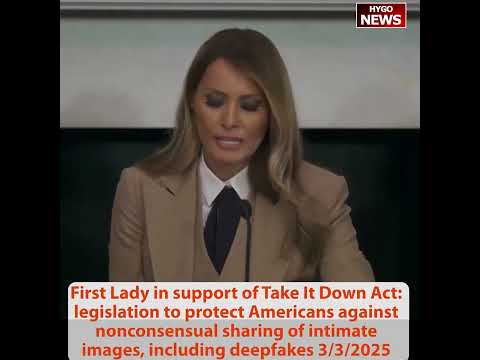
First Lady Melania Advocates for Take It Down Act at Capitol Roundtable: “Protect Our Children”
First Lady Melania Trump arrived at the U.S. Capitol on March 3, 2025, to host a roundtable advocating for the Take It Down Act, bipartisan legislation to protect Americans against the nonconsensual sharing of intimate images, including AI-generated deepfakes. Melania called the digital landscape “hostile” for young people and said “every young person deserves a safe online space to express themselves freely, without the looming threat of exploitation or harm.” She connected the legislation to her expanded Be Best initiative and noted pointedly that she “expected to see more Democrats” at the event, urging that “surely as adults, we can prioritize Americans’ children ahead of partisan politics.”
The Take It Down Act
Melania’s Capitol Hill appearance marked one of her most significant policy engagements of the second term. The Take It Down Act was bipartisan legislation co-sponsored by Senator Ted Cruz (R-TX) and Senator Amy Klobuchar (D-MN) that would criminalize the nonconsensual distribution of intimate images — including AI-generated deepfakes — and require social media platforms to remove such content within a specified timeframe upon receiving a valid complaint.
The legislation addressed a growing crisis. The proliferation of AI tools capable of generating realistic fake intimate images of real people had created a new category of digital abuse that existing laws were poorly equipped to address. Victims — disproportionately women and minors — had limited legal recourse to force platforms to remove the content, and the speed at which AI-generated images could spread often meant the damage was done before any response was possible.
The First Lady’s decision to personally advocate for the bill at the Capitol — rather than delegating to staff or issuing a written statement — demonstrated both the priority she placed on the issue and her willingness to use her platform for legislative advocacy.
”Abusive Behavior in the Digital Domain”
Melania opened her remarks by framing the issue in terms of its impact on families and communities.
“The widespread presence of abusive behavior in the digital domain affects the daily lives of our children, families, and communities,” she said. “Addressing this issue is essential for fostering a safe and supportive environment for our young people.”
She connected the roundtable to the specific legislation. “I hope today’s roundtable builds awareness of the harm caused by nonconsensual imagery and eventually the approval of this bill,” Melania said.
The First Lady then addressed the broader privacy threat posed by artificial intelligence. “In today’s AI-driven world, the threat to privacy is alarming and high,” she said. “As organizations harness the power of our data, the risk of unauthorized access and misuse of personal information escalates. We must prioritize robust security measures and uphold strict ethical standards to protect individual privacy.”
The AI framing elevated the Take It Down Act from a narrow anti-revenge-porn bill to a component of a broader privacy agenda. Melania was arguing that the nonconsensual image problem was a symptom of a larger disease: the unchecked power of technology companies and AI systems to manipulate personal data and imagery without consent.
Be Best: Expanded for the Second Term
Melania connected her advocacy directly to the Be Best initiative she had launched during the first term and pledged to expand in the second.
“As First Lady, my commitment to the Be Best initiative underscores the importance of online safety in an era where digital interactions are integral to daily life,” she said. “Ensuring their protection is not just a responsibility but a vital step in nurturing tomorrow’s leaders.”
She described the mission in urgent terms: “We must prioritize their well-being by equipping them with the support and tools necessary to navigate this hostile digital landscape.”
The word “hostile” was significant. Melania was not describing the internet as merely challenging or complicated for young people; she was characterizing it as actively dangerous — a landscape that required defensive tools and adult intervention to navigate safely. The framing justified legislative action rather than relying on parental guidance alone.
Addressing Survivors and Advocates
In the most personal portion of her remarks, Melania spoke directly to the victims of nonconsensual intimate imagery.
“To the brave survivors of NCII, your strength inspires courage in others,” she said. “To the advocates, your voices power our youth and hopefully bring change. And to the families, your unwavering love is a pillar of resilience.”
The acknowledgment of survivors was important because NCII — nonconsensual intimate imagery — carried a stigma that often prevented victims from speaking publicly. By honoring survivors from the podium of the U.S. Capitol, Melania was normalizing the conversation and encouraging others to come forward.
The Bipartisan Coalition — and the Missing Democrats
Melania acknowledged the Republican leaders who attended the roundtable by name: Senator Cruz, Speaker Johnson, House Majority Leader Scalise, Representative Salazar, Chairman Gowdy, Chairwoman McMorris Rodgers, and others.
She noted the bipartisan origins of the legislation: “I was heartened to learn that Senator Cruz and Senator Klobuchar are united to prioritize this fundamental matter.”
Then came the pointed observation that generated headlines. “I must admit, however, I expected to see more Democrats, leaders with us here today, to address this serious issue,” Melania said. “Surely as adults, we can prioritize Americans’ children ahead of partisan politics.”
The critique was delivered with the measured elegance that characterized Melania’s public persona, but its substance was sharp. The Take It Down Act was bipartisan legislation addressing a problem that affected children regardless of party affiliation. The absence of Democratic leaders from a roundtable advocating for children’s online safety — hosted by the First Lady at the Capitol — suggested that partisan opposition to the Trump administration took precedence over protecting children from digital exploitation.
The implicit message was that Democrats who boycotted the event were placing their hostility toward Trump above the well-being of American children — a comparison that was politically difficult to defend.
The Legislative Ask
Melania concluded with a direct call to action that was unusually specific for a First Lady’s remarks.
“I urge Congress to prioritize the passage of the Take It Down Act,” she said. “This legislation is essential for addressing the growing concerns related to online safety, protecting individual rights, and promoting a healthier digital environment.”
She described the bill’s purpose: “By advocating this bill, Congress can take an important step towards ensuring accountability and fostering responsible online behavior.”
Melania’s closing elevated the legislation from a policy proposal to a moral imperative: “The Take It Down Act represents a powerful step toward justice, healing, and unity.”
The use of “unity” in the closing was a callback to the bipartisan nature of the legislation and a final implicit rebuke of the Democrats who had chosen not to attend. Unity was available — the bill had bipartisan co-sponsors — but some had chosen partisanship over unity, even when children’s safety was at stake.
The Be Best Evolution
Melania’s Capitol appearance illustrated how the Be Best initiative had evolved between the first and second terms. During the first term, Be Best had focused on broad themes of children’s well-being, online safety, and opioid awareness. In the second term, Melania was translating those themes into specific legislative advocacy.
The shift from awareness campaigns to legislative action represented a maturation of the First Lady’s platform. Rather than simply calling attention to problems, Melania was now leveraging her position to push specific bills through Congress — using the roundtable format to create political pressure and media attention for the Take It Down Act.
Her willingness to call out the absent Democrats added a political edge that the first-term Be Best initiative had lacked. Melania was demonstrating that she could be both a gracious advocate for children and a pointed critic of those who let politics interfere with protecting them.
Key Takeaways
- First Lady Melania Trump hosted a Capitol roundtable advocating for the Take It Down Act, bipartisan legislation to criminalize nonconsensual intimate images including AI deepfakes.
- She called the digital landscape “hostile” for young people and said “every young person deserves a safe online space without the looming threat of exploitation or harm.”
- Melania pointedly noted she “expected to see more Democrats” at the event, saying: “Surely as adults, we can prioritize Americans’ children ahead of partisan politics.”
- She connected the legislation to her expanded Be Best initiative and described AI-driven privacy threats as “alarming and high.”
- The bill was co-sponsored by Senator Cruz (R) and Senator Klobuchar (D), with Melania urging Congress to “prioritize the passage” as “a powerful step toward justice, healing, and unity.”