 HYGO News
 Finnish: past 2 weeks more progress than 3 yrs; PM Giorgia Meloni: new phase something has changed
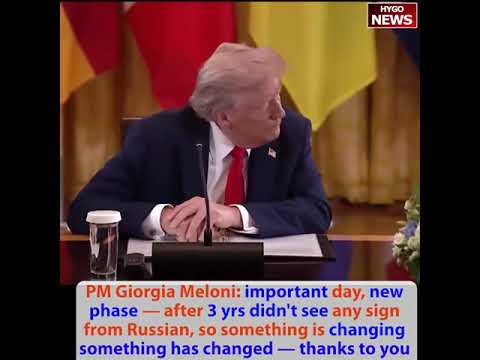
Finnish: past 2 weeks more progress than 3 yrs; PM Giorgia Meloni: new phase something has changed
Extraordinary consecutive endorsements of Trump’s Ukraine diplomacy from European leaders and NATO leadership. Finnish President Alex Stubb: more progress in two weeks than in 3.5 years. Italian Prime Minister Giorgia Meloni: new phase, something has changed thanks to Trump. NATO Secretary General Rutte: Trump broke the deadlock by starting dialogue with Putin. UK Prime Minister Keir Starmer: historic step could come out of this meeting. Stubb: “I think in the past two weeks we’ve probably had more progress in ending this war than we have in the past three and a half years.” Meloni: “It is an important day, a new phase, after three years and a half, that we didn’t see any kind of sign from the Russian side that there was a willing for dialogue. Something is changing, something has changed, thanks to you.” NATO SG: “I really want to thank you, President of the United States, Donald, for the fact that you broke the deadlock basically with President Putin by starting that dialogue … I think it was in February that you had first a phone call and from there we are now where we are today.” Starmer: “I think today will be seen as a very important day in recent years in relation to a conflict which has gone on for three and a bit years, and so nobody’s been able to bring it to this point, so thank you for that.”
Stubb: “More Progress in Two Weeks Than in 3.5 Years”
Finnish President Alex Stubb’s observation. “I think in the past two weeks we’ve probably had more progress in ending this war than we have in the past three and a half years.”
That is a specific quantitative claim from a head of state. Two weeks of active Trump diplomacy. More progress than 3.5 years of prior efforts.
Stubb’s perspective matters. Finland borders Russia. Finland recently joined NATO (April 2023) specifically because of Russian threat perception. Stubb is not a distant observer — Finland has specific skin in the Ukraine outcome. His assessment that Trump’s two-week engagement exceeded 3.5 years of prior diplomacy represents substantial acknowledgment.
The 3.5 years covered multiple diplomatic initiatives:
- Biden administration’s multilateral support coordination
- Various European mediation attempts
- UN-facilitated grain corridor deals
- Brazil-China peace proposals
- Zelensky’s specific peace framework
None of those produced the specific progress that Trump’s two weeks of engagement have generated. Stubb is acknowledging the specific difference Trump’s approach has made.
Meloni: “New Phase”
Italian Prime Minister Giorgia Meloni’s specific framing. “I think it is an important day, a new phase, after three years and a half, that we didn’t see any kind of sign from the Russian side that there was a willing for dialogue. Something is changing, something has changed, thanks to you.”
“New phase.” That is specific diplomatic language. The war’s trajectory has shifted. Not merely another round of negotiations. A new phase — characterized by actual Russian dialogue willingness.
“We didn’t see any kind of sign from the Russian side that there was a willing for dialogue.” That is Meloni’s specific assessment of the past 3.5 years. Russia did not signal willingness. Russia continued military operations. Russia rejected various peace proposals.
“Something has changed, thanks to you.” Direct attribution to Trump. Not collective Western pressure. Not sanctions escalation. Trump specifically produced the change in Russian posture.
”Stalling in the Battlefield”
“Thanks also to the stalling in the battlefield, which was achieved with the bravery of Ukrainians and with the unity that we all provided to Ukraine.”
Meloni acknowledging multiple factors. Ukrainian military resistance. Western unity. Trump’s diplomacy. All three contributed to the current moment.
“Stalling in the battlefield” — the war has not produced decisive Russian victory despite Russia’s specific military advantages. Ukraine has prevented Russian breakthrough at multiple critical junctures. The battlefield stalemate combined with Russian economic pressure and Trump’s diplomatic engagement produces the current negotiating opening.
“The bravery of Ukrainians.” Specific acknowledgment of Ukrainian sacrifice. Ukrainian soldiers and civilians who have resisted at enormous cost. Without that resistance, Russia’s military objectives might have been achieved, eliminating the current negotiating moment.
”Count on Italy”
“You can obviously count on Italy as it was from the beginning. We are on the side of Ukraine and we absolutely support your efforts towards peace.”
Meloni reaffirming Italian support. Italy has been consistent on Ukraine throughout the war — providing weapons, supporting sanctions, accepting Ukrainian refugees, coordinating with EU and NATO decisions.
“Absolutely support your efforts towards peace.” Italian support extends to Trump’s specific peace initiative. Meloni is endorsing not merely the general goal of peace but Trump’s specific diplomatic approach.
NATO Secretary General: “Broke the Deadlock”
NATO Secretary General Mark Rutte’s statement. “I really want to thank you, President of the United States, dear Donald, for the fact that you, as I said before, broke the deadlock basically with President Putin by starting that dialogue.”
“Dear Donald” — personal framing from NATO’s top official. Not “Mr. President” or more formal diplomatic language. Personal address signaling genuine appreciation.
“Broke the deadlock.” That is substantive characterization. The 3.5 years of war had produced diplomatic deadlock. Neither Russian nor Western positions had moved. Trump specifically broke that deadlock.
“By starting that dialogue.” Trump’s specific action. Initiating direct dialogue with Putin. Other Western leaders could not or would not do that. Trump’s willingness to engage directly produced the specific diplomatic movement.
”February Phone Call”
“I think it was in February that you had first a phone call and from there we are now where we are today.”
February 2025. Trump’s first substantive phone call with Putin during his second term. From that single call, the specific diplomatic progression — regular engagement, summit preparation, Alaska meeting, European coordination, trilateral preparation.
Six months from first call to where we are today. That is specific diplomatic tempo. Most negotiated war conclusions require years. Trump’s diplomacy compressed that timeline substantially.
Rutte’s framing: without that February call, the current moment would not exist. The war would still be in deadlock. The specific progress is directly attributable to Trump’s willingness to engage.
Starmer: “Real Progress”
UK Prime Minister Keir Starmer’s remarks. “It is a terrible war, so I’m really excited. I think this is such an important meeting. As a group, I think we’ve had a discussion on the phone a number of times, Mr. President, but be able now to be around the table to take it forward.”
“Really excited.” That is specific emotional framing from Starmer. Not merely professionally engaged. Genuinely optimistic about the specific meeting’s potential.
“Be able now to be around the table.” Previous coordination was via phone. Now direct in-person engagement. That shift matters because specific complex issues require real-time in-person negotiation rather than phone calls that are inherently more fragmented.
”Article 5 Style Guarantees”
“And I really feel that we can, with the right approach this afternoon, make real progress, particularly on the security guarantees, on your indication of security guarantees, of some sort of Article 5 style guarantees, fits with what we’ve been doing with the Coalition of the Willing, which we started some months ago.”
“Article 5 style guarantees.” That is specific NATO vocabulary. NATO Article 5 commits members to mutual defense — attack on one member triggers collective response. Trump apparently indicated support for “Article 5 style” — meaning similar architecture, without Ukraine formally joining NATO.
That framework addresses Russia’s specific objection (Ukraine joining NATO would threaten Russian security, per Russian position) while providing Ukraine actual security (collective-defense commitment equivalent to NATO but through different structure).
“Coalition of the Willing.” Starmer referencing the UK-initiated coalition for specific Ukraine security support. France, Italy, Germany, UK, Nordic countries, and others have coordinated specific Ukraine support through that framework. Trump’s “Article 5 style” proposal integrates with that pre-existing coalition.
”Historic Step”
“With you coming alongside the US, alongside what we’ve already developed, I think we could take a really important step forward today, a historic step actually could come out of this meeting in terms of security for Ukraine and security in Europe.”
“Historic step.” Starmer’s specific characterization. Not merely a normal diplomatic meeting. A meeting whose outcomes could be historically significant.
“Security for Ukraine and security in Europe.” The dual framing. Ukraine’s specific security guarantees matter. But the broader European security architecture also matters. Russia’s relationship with Europe — threat or partner — depends on how this specific war concludes.
”Just and Lasting Outcome”
“I also feel that we can make real progress towards a just and lasting outcome, obviously that has to involve Ukraine. And a trilateral meeting seems the sensible next step, so thank you for being prepared to take that forward.”
“Just and lasting outcome.” Two specific qualifiers. Just — fair to both sides, consistent with specific principles. Lasting — durable, not easily overturned by subsequent changed circumstances.
“Obviously that has to involve Ukraine.” Starmer emphasizing Ukrainian agency. Ukraine is not a token in broader negotiations. Ukraine is a principal party whose specific agreement is required.
“Trilateral meeting seems the sensible next step.” Starmer endorsing the trilateral format. Zelensky, Putin, Trump together. That format’s specific advantages: direct principal-to-principal engagement, Trump’s specific facilitation role, potential final agreement at that specific meeting.
”Nobody’s Been Able to Bring It to This Point”
“I think today will be seen as a very important day in recent years. In relation to a conflict which has gone on for three and a bit years, and so forth, nobody’s been able to bring it to this point, so thank you for that.”
Starmer’s final acknowledgment. Three and a bit years of war. Multiple diplomatic initiatives. Multiple world leaders attempting peace. None successful.
“Nobody’s been able to bring it to this point.” Specific recognition that Trump’s approach — which critics have characterized as naive, as too accommodating, as inappropriate — has achieved what no other approach achieved.
“So thank you for that.” Direct gratitude from UK Prime Minister to U.S. President. Formal diplomatic acknowledgment that British interests have been advanced through American initiative.
Four Consecutive European Endorsements
Stubb (Finland): More progress in two weeks than in 3.5 years. Meloni (Italy): New phase, something has changed thanks to Trump. Rutte (NATO Secretary General): Broke the deadlock by starting dialogue. Starmer (UK): Historic step could come out of this meeting, nobody else could bring it to this point.
Four consecutive leaders of major European institutions — publicly, on camera — crediting Trump specifically for the diplomatic breakthrough. That is unusual in contemporary European-American politics. European leaders typically have maintained diplomatic distance from Trump because of specific policy disagreements (trade, climate, NATO spending).
The specific Ukraine achievement has produced unified European acknowledgment. Europeans see what Trump has accomplished. Europeans are willing to publicly credit him. The diplomatic success transcends the political complications of the broader transatlantic relationship.
Political Implications
The endorsements have specific political implications for the U.S. domestic context. Critics who characterize Trump’s Putin engagement as inappropriate or naive must now contend with endorsements from:
- The Finnish president (leader of country bordering Russia, NATO member)
- The Italian prime minister (leader of G7 member, major EU economy)
- The NATO Secretary General (head of the Western military alliance)
- The UK prime minister (head of the UK, closest U.S. historical ally)
Those endorsements do not prove Trump’s approach is correct. But they substantially weaken the argument that Trump’s approach is unprecedented or unreasonable. If leaders across European institutions specifically credit Trump, the specific criticisms from U.S. Democratic figures become more difficult to sustain.
Key Takeaways
- Finnish President Alex Stubb: “I think in the past two weeks we’ve probably had more progress in ending this war than we have in the past three and a half years.”
- Italian PM Giorgia Meloni: “It is an important day, a new phase, after three years and a half, that we didn’t see any kind of sign from the Russian side that there was a willing for dialogue. Something is changing, something has changed, thanks to you.”
- NATO Secretary General: “I really want to thank you, President of the United States, Donald, for the fact that you broke the deadlock basically with President Putin by starting that dialogue … I think it was in February that you had first a phone call and from there we are now where we are today.”
- UK PM Keir Starmer on Article 5 style guarantees: “On your indication of security guarantees, of some sort of Article 5 style guarantees, fits with what we’ve been doing with the Coalition of the Willing … We could take a really important step forward today, a historic step actually could come out of this meeting.”
- Starmer’s final acknowledgment: “I think today will be seen as a very important day in recent years in relation to a conflict which has gone on for three and a bit years, and so nobody’s been able to bring it to this point, so thank you for that.”