 HYGO News
 FINALE HISTORIC 250th Army Parade, Army robot dogs march, GREATEST, FIERCEST, BRAVEST; VP: unbroken
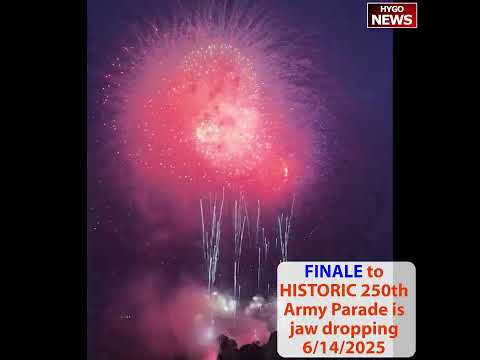
FINALE HISTORIC 250th Army Parade, Army robot dogs march, GREATEST, FIERCEST, BRAVEST; VP: unbroken
The final sequence of the United States Army’s 250th anniversary parade was designed to make an impression, and it did. Robot dogs — the next generation of Army quadrupedal ground systems — marched down D.C. streets alongside the traditional infantry formations. President Trump saluted as soldiers of the 75th Ranger Regiment and Special Forces units passed the reviewing stand. CH-47 Chinook helicopters flew over the Lincoln Memorial in the evening’s climactic flyover. Trump delivered a speech that named the Army as “the greatest, fiercest and bravest fighting force ever to stride the face of this earth.” Vice President Vance described the Army as “an unbroken line of greatness, of excellence.” The parade compressed 250 years of American military history into a single evening along the National Mall, and the emotional register ranged from the ceremonial to the theatrically modern as robot dogs kept pace with the pipes and drums.
The Robot Dogs
The parade’s most viral sequence was the deployment of Army robot dogs. “They have a standard walk speed of 2 miles per hour and are working towards 6.7 miles per hour sprint.”
The mechanical quadrupeds — descendants of research that has been developing across defense and private-sector robotics programs for the past decade — represent one of the administration’s priorities for future force structure. The ability of small, autonomous ground systems to conduct reconnaissance, logistics, and in some configurations direct action tasks has been on military planners’ drafting tables for years. Their presence at a ceremonial parade is a signal that the program has matured sufficiently for public display.
The Walking Speed Specification
The specific mention of “2 miles per hour…working towards 6.7 miles per hour sprint” is the kind of engineering detail that reveals where the technology currently sits. Two miles per hour is roughly a relaxed human walking pace. A 6.7 mph sprint is between a fast jog and a low run. The fact that the spec is a “sprint” figure rather than a sustained velocity means the system is designed for short bursts of higher speed rather than continuous operation at that pace.
For ground combat applications, the meaningful benchmark is the ability to keep up with dismounted infantry over varied terrain. An infantry squad moving tactically covers ground at rates that vary with load, terrain, and security posture. A robot dog that can manage 2 mph sustained with 6.7 mph sprints is beginning to approach the performance envelope infantry requires.
The 75th Ranger Regiment
The parade featured one of the Army’s most storied special operations units. “After the 9-11 terrorist attacks, Rangers were called upon to leave the way of the war on terrorism. As part of the US Army Special Operations Command, the 70th Ranger Regiment based out of Fort Bragg, North Carolina represents a lethal agile and flexible…” (The transcription appears to have confused “75th” with “70th” — the unit is the 75th Ranger Regiment.)
The 75th Ranger Regiment traces its lineage to Rogers’ Rangers of the French and Indian War, through the Ranger units of World War II, into the modern formation established in 1974. The regiment has been continuously deployed in support of combat operations since the post-9/11 conflicts began. Its presence in the parade lineup connects the Army’s 250 years to its most current combat experience.
Daniel Boone And Abraham Lincoln
The ceremony’s narration emphasized the Army’s deep roster of historical figures. “The likes of Daniel Boone and Abraham Lincoln in their ranks.”
The reminder is important. Daniel Boone served in the colonial militia that evolved into the Continental Army. Abraham Lincoln served in the Illinois militia during the Black Hawk War — a brief tour that shaped his later understanding of military service. The Army has carried, through its 250 years, many Americans who would later become known for other reasons. The fact that the country’s Army has shaped figures from Boone to Lincoln to Eisenhower to countless modern veterans is one of its less celebrated legacies.
Trump’s Signature Line
The president delivered the line that defined the evening. “And above all, thank you to the greatest, fiercest and bravest fighting force ever to the face of this earth, the United States Army.”
Three adjectives in a row — greatest, fiercest, bravest — is the kind of superlative construction that a president uses when he wants a line to be quotable. The construction prevents the audience from isolating any single claim; the string travels as a unit. The result is a memorable compliment that becomes associated with the presidency that delivered it.
”The Army Keeps Us Free”
Trump continued with the formulation that compresses the civilian-military relationship into a single sentence. “Because the Army keeps us free, you make us strong, and tonight you have made all Americans very proud.”
“The Army keeps us free” is not a controversial statement, but its specific phrasing matters. It locates American freedom in the practical fact of military capability. The country is not free because of abstract principles alone. It is free because the Army — and its sister services — make freedom defensible against actors who would curtail it.
“You make us strong” then reverses the direction. The Army does not just preserve freedom. The Army is the source of national strength. Without a credible Army, the country’s diplomatic, economic, and moral influence would degrade. With a credible Army, those other forms of influence find their backstop.
”Watching From All Over The World”
Trump acknowledged the global audience. “They’re watching from all over the world actually. They’re all very proud.”
The parade was broadcast internationally. Allies who serve alongside American forces, partners who rely on American security guarantees, and adversaries who calculate American resolve all had the opportunity to watch. Trump’s observation that “they’re all very proud” is aimed primarily at the domestic audience, but it also communicates to the international audience that the president values the ceremonial and strategic signal the parade is designed to send.
Vance: “An Unbroken Line Of Greatness”
Vice President Vance’s contribution centered on the concept of institutional continuity. “This evening, as we celebrate the 250th anniversary of the United States Army, the oldest bridge of the greatest fighting force ever known to man, I want to say to all the soldiers all across our nation’s capital and all across the world, happy birthday soldiers, we’re proud of you. And I want to say you represent an unbroken line of greatness, of excellence.”
“Unbroken line” is the key phrase. The Army, unlike almost any other American institution, has operated continuously since 1775. It has absorbed technological revolutions, doctrinal overhauls, political controversies, and social transformations without interruption of its essential mission. The unbroken line runs from the Continental Army through every war the country has fought, every peacetime garrison, every overseas deployment, every training cycle.
”Our Most Precious Resource”
Vance returned to the framing he had used earlier. “And one of the things the President of the United States has told his entire administration, from the Vice President on down is that we must remember that the young men and women who put on the uniform and serve this nation are our most precious resource.”
The repetition of “most precious resource” across multiple speeches of the ceremony is intentional. The administration is working to establish a phrase. When a political movement wants an idea to stick, it deploys the exact same language repeatedly across speakers and events. The audience begins to associate the phrase with the movement, and the phrase takes on the weight of a doctrine.
”We Must Honor Them, We Must Respect Them, We Must Fight For Them”
Vance’s triplet — honor, respect, fight for — is the action formulation that matches the “most precious resource” principle. It moves from the abstract (they are precious) to the concrete (we will honor, respect, and fight for them). The verbs matter. “Fight for” is not a passive commitment. It is a promise of active engagement on behalf of servicemembers when their interests are on the line.
The Chinook Flyover
The evening concluded with a CH-47 Chinook flyover above the Lincoln Memorial. The Chinook has been the Army’s heavy-lift helicopter since the early 1960s, with continuous upgrades keeping the airframe relevant through half a dozen decades of combat operations. The sight of Chinooks over the Lincoln Memorial — a monument to the 16th president who served briefly in the Illinois militia — closed the loop between the ceremonial past and the operational present.
The Chanting Formations
The video captures soldiers “pridefully chanting through the streets of Washington, DC.” Military cadence calls are an ancient part of Army culture. They regulate pace, build unit cohesion, and mark the rhythm of a formation’s movement. When a formation chants through a ceremonial parade, the sound carries the same weight it carries in any other military context — the sound of a unit that is moving together as one.
The Ceremonial Grammar
A military parade is not primarily a political event. It is a ceremonial expression of institutional identity, conducted according to traditions that predate the republic itself. Parades convey the institution’s self-understanding to its members, to the citizens they serve, and to any watching adversary.
Trump’s role at the parade was as the reviewing officer — the civilian commander-in-chief who, under the Constitution, sits above the military chain of command. His presence is part of the ceremony’s design. The president is reviewed, soldiers salute the reviewing stand, and the cycle reinforces the civilian-military relationship that has defined the republic.
The Political Subtext
The ceremony had political subtext that should be acknowledged. Trump’s administration has been moving aggressively on multiple fronts — immigration enforcement, tariff policy, regulatory rollback. Opponents have argued that the administration’s posture is authoritarian in tendency. The Army’s 250th birthday parade was an opportunity for the administration to associate itself with an institution whose legitimacy is not in dispute.
Whether one accepts or rejects the political framing, the parade was a signal that the administration wants the country to see. That signal was received.
The Institutional Moment
Standing back, the most consequential element of the evening was probably the simplest: the United States Army turned 250 years old. It was founded before there was a United States. It has been continuously in the field for a quarter of a millennium. Most Americans will not see its 300th birthday. The ceremony was, whatever else it was, a moment that will be remembered in institutional histories long after the current political moment has faded.
Key Takeaways
- Army robot dogs marched in the parade at “standard walk speed of 2 miles per hour and are working towards 6.7 miles per hour sprint.”
- Trump’s signature line: “thank you to the greatest, fiercest and bravest fighting force ever to stride the face of this earth, the UNITED STATES ARMY.”
- Vance: the Army represents “an unbroken line of greatness, of excellence” — the institutional continuity that distinguishes the Army from almost any other American institution.
- The Trump doctrine on soldiers: “we must remember that the young men and women who put on the uniform and serve this nation are our most precious resource. We must honor them, we must respect them, we must fight for them.”
- The ceremonial grammar: CH-47 Chinooks over the Lincoln Memorial, chanting formations through D.C. streets, the 75th Ranger Regiment marching past the reviewing stand — 250 years of continuous service compressed into a single evening.