 HYGO News
 Final moments unanswered question; CNN poll just 36%; Why Biden not do hour-long press conf
Karine Jean-Pierre’s Final Briefing Ends With Unanswered Questions, 36% Approval, and No Departure Press Conference
The final White House press briefing of the Biden presidency, held on January 17, 2025, ended the way many of Karine Jean-Pierre’s briefings had proceeded over the preceding two years — with deflection, awkward pauses, and questions left hanging in the air. From a CNN poll showing historically low approval ratings to the President’s refusal to hold a traditional departure press conference, the last briefing encapsulated the communication struggles that defined the Biden White House’s relationship with the press corps.
A Fitting Farewell: The Unanswered Question
The final moments of KJP’s last-ever briefing produced an exchange that felt almost scripted in its symbolism. As Jean-Pierre attempted to wrap up with a quick “All right guys, I have to go,” Brazilian TV correspondent Raquel Krahenbuhl asked whether she had been in contact with her incoming successor, Karoline Leavitt.
“I have not, I have not been in touch with her, but I certainly wish her luck,” Jean-Pierre replied.
When the Associated Press’s Zeke Miller followed up with the obvious question — “Karine, why have you not been in touch with her?” — Jean-Pierre offered only a shrug and the words, “Come talk to me in the back.”
The press room broke into laughter. It was a moment that captured something essential about Jean-Pierre’s tenure: the preference for off-the-record conversations over on-the-record transparency. The tradition of incoming and outgoing press secretaries coordinating a smooth transition is a basic professional courtesy. Jean-Pierre’s inability or unwillingness to explain why she had not extended that courtesy — and her resort to a private aside rather than a public answer — served as an unintentionally revealing coda to her time at the podium.
CNN Poll: Just 36% Approval
The most substantive challenge of the briefing came from CNN’s Kayla Tausche, who confronted Jean-Pierre with a new poll showing that just 36 percent of American adults approved of the way Biden had handled the presidency. For a president who had entered office promising to unite the country and restore competence to the executive branch, the number represented a devastating final verdict.
Jean-Pierre’s response was a masterclass in deflection. “I’ve been very careful in talking about polls and not speaking to every pole,” she said, before pivoting to a list of policy talking points: “beating big Pharma,” “lowering health care costs,” “bringing manufacturing jobs back,” and “capping the insulin at 35 bucks a month for seniors.”
What she did not do was address the number itself. She did not attempt to explain why, if those policies were as popular as she claimed, only about a third of the country approved of the President’s performance. The gap between the administration’s self-assessment and the public’s judgment had been a persistent theme of the Biden presidency, and it persisted right through the final briefing.
The 36 percent figure placed Biden’s exit approval among the lowest for any modern president, a remarkable outcome for an administration that had once positioned itself as a return to normalcy after the turbulence of the Trump years.
The Missing Departure Press Conference
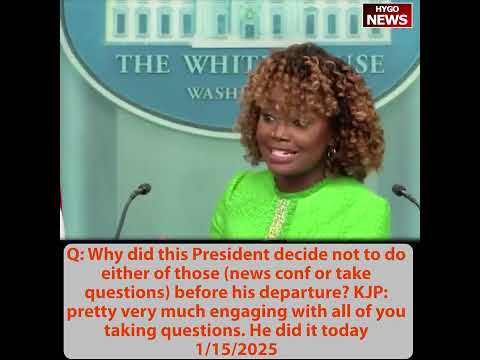
Perhaps the most telling exchange of the briefing came from NBC’s Peter Alexander, who pressed Jean-Pierre on why President Biden had broken with tradition by declining to hold an hour-long departure press conference. It is customary for outgoing presidents to take extended questions from the press corps in their final days, providing a capstone opportunity for accountability and reflection.
Jean-Pierre attempted to reframe the situation, arguing that Biden had been “pretty very much engaging with all of you” and “taking questions” in recent days. She pointed to a short session where Biden had taken a handful of questions as evidence that he was meeting his obligations to the press.
Alexander was not persuaded. “Candidly, that’s different, you know, than an hour-long press conference,” he said. “That’s why I asked the question.”
Jean-Pierre’s response devolved into the kind of circular, filler-heavy rhetoric that had become her trademark: “He took questions on an array of issues, went back and forth, and he took questions today. He’s been pretty consistent over the past couple of days in doing that, and that shows his performance.”
The word “performance” was perhaps more revealing than intended. The question of Biden’s ability to sustain extended, unscripted interactions with the press had been a source of concern for years, intensifying dramatically after his disastrous June 2024 debate performance. Alexander’s follow-up — “Were there any concerns about his public performance in a setting like that?” — went directly to that issue, and Jean-Pierre had no real answer for it.
The Letter Question
ABC’s Karen Travers posed a simple question with historical weight: would President Biden leave a letter for President-elect Trump, following the tradition maintained by outgoing presidents for decades?
Jean-Pierre’s answer was strikingly uncertain for something that should have been a straightforward piece of presidential protocol. “Uh — well — uh — I guess we’ll see. We’ll see. We’ll see. I don’t have anything — uh — that’s gonna be up to the President. I don’t have anything on that, but it’s a good question. I’m curious too.”
The fact that the White House press secretary was herself “curious” about whether the President would observe a basic tradition spoke volumes about the state of internal communication in the final days of the administration. Either the decision had not been made with only days remaining, or Jean-Pierre had not been informed of it — neither scenario reflecting well on the operation.
A Press Secretary Defined by Deflection
Jean-Pierre’s tenure as White House press secretary, which began in May 2022 when she succeeded Jen Psaki, was historic in several respects — she was the first Black woman and the first openly LGBTQ+ person to serve in the role. But her performance at the podium was consistently criticized across the political spectrum for a reliance on pre-written talking points, an inability to engage substantively with follow-up questions, and a tendency to treat legitimate press inquiries as hostile attacks.
The final briefing crystallized these patterns. Every difficult question was met with either a pivot to prepared talking points, a non-answer dressed in verbose filler language, or an outright refusal to engage. The 36 percent approval number was met with policy boilerplate. The press conference question was met with circular assertions that Biden had been “engaging.” The Leavitt question was met with a shrug and an invitation to talk off-camera.
For the reporters in that room — many of whom had spent years trying to extract substantive information from the podium — the final briefing must have felt less like a farewell and more like a confirmation of everything that had frustrated them about dealing with this particular White House.
The Broader Legacy Question
The final briefing matters because it was the last opportunity for the Biden White House to frame its own narrative before handing over the keys. Instead of a confident, reflective sendoff, reporters got evasion on approval ratings, confusion over basic traditions, and a refusal to explain why the President would not face extended questioning in his final days.
Whether the decision to skip the departure press conference was made to protect Biden from a potentially damaging public appearance or simply reflected organizational dysfunction, the effect was the same: it reinforced the narrative that the Biden White House prioritized image management over transparency, even in its final hours.
Key Takeaways
- Karine Jean-Pierre admitted she had not contacted incoming press secretary Karoline Leavitt, and when asked why, she shrugged and told the reporter to “come talk to me in the back” rather than answer publicly.
- A CNN poll released the morning of the final briefing showed just 36 percent of American adults approved of Biden’s handling of the presidency, placing him among the lowest-rated departing presidents in modern history.
- Jean-Pierre could not explain why Biden broke with tradition by declining to hold an hour-long departure press conference, leading NBC’s Peter Alexander to push back that brief question sessions are “different than an hour-long press conference.”
- When asked whether Biden would leave a letter for President-elect Trump, Jean-Pierre said, “I guess we’ll see. We’ll see. We’ll see… I’m curious too,” suggesting she had not been briefed on the decision.
- The final briefing encapsulated the communication challenges that defined Jean-Pierre’s tenure: reliance on talking points, circular non-answers, and a preference for deflection over direct engagement.