 HYGO News
 FBI Dir Kash: let good cops be cops simplicity; US Atty Pirro: starts TODAY, change law to catch you
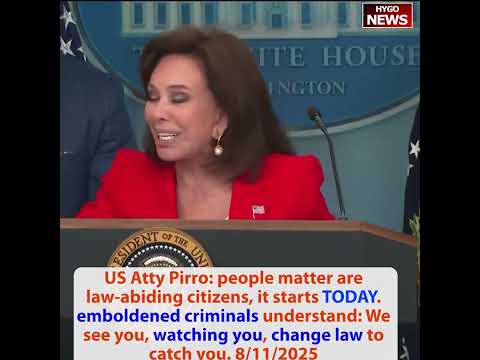
FBI Dir Kash: let good cops be cops simplicity; US Atty Pirro: starts TODAY, change law to catch you
FBI Director Kash Patel detailed the Northern Virginia proof-of-concept for what is coming to DC: “In one month, we arrested 545 violent felons … thanks to Governor Yonkin’s partnership. And that simplicity in law enforcement is what’s coming to Washington, DC. When you let good cops be cops, when you give them the intel they need … we are going to clean up Washington, DC.” U.S. Attorney Jeanine Pirro then detailed the juvenile-crime problem: “I see too much violent crime being committed by young punks … They can be in DuPont Circle, but they know that we can’t touch them.” A specific case: “I convict someone of shooting another person with an illegal gun on a public bus in the chest. Intent to kill? I convict him. And you know what the judge gives him? Probation. It says you should go to college.” And the structural targets: “Go after the DC Council and their absurd laws … get rid of this concept of no cash bail.”
Northern Virginia: 545 Violent Felons
FBI Director Kash Patel’s opening. “What we did in Northern Virginia, thanks to Terry Cole and Governor Yonkin and the team, we stood up a task force out in my Northern Virginia field office and we said, let’s let good cops be cops, let’s get them the intelligence and what they need, and let’s get the red tape out of their way, and let’s get DOJ partnered up with us to bring great prosecutions, and that’s exactly what we did.”
The specific elements of the Northern Virginia task force:
- FBI Northern Virginia field office as base
- Good cops freed from bureaucratic constraints
- Intelligence flow improvements
- Reduced red tape
- DOJ prosecutorial partnership
“In one month, we arrested 545 violent felons, 545 in the state of Virginia, thanks to Governor Yonkin’s partnership.”
545 violent felons arrested in one month. That is a specific, measurable result. For comparison, many U.S. cities average fewer than 545 violent-felon arrests per year across their entire law-enforcement apparatus. Northern Virginia under federal-state partnership produced that number in a single month.
“And that simplicity in law enforcement is what’s coming to Washington, DC.”
“Simplicity in law enforcement.” That is the framing. Not bureaucratic complexity. Not political constraints. Not jurisdictional friction. Simple: let good cops work effectively with federal support.
”Let Good Cops Be Cops”
“When you let good cops be cops, when you give them the intel they need, when you work with our Homeland Security Task Force, when you work with Terry and Gaddy and I go way back to Miami, these guys are great leaders of the respective departments in law enforcement capacities, and when you have the DOJ and President Trump driving behind this mission, we are going to clean up Washington, DC and we’re going to do it the right way, the lawful way, and we’re going to make sure Washington, DC is safe again.”
“Let good cops be cops.” That phrase captures the administration’s theory. Good officers exist in every department. They are frequently constrained by:
- Bureaucratic processes that slow response
- Political pressure to avoid aggressive enforcement
- Prosecutorial declinations that reverse arrests
- Community-relations frameworks that prioritize conflict avoidance
- Legal uncertainty about warrant requirements and probable cause
Removing those constraints — “letting good cops be cops” — produces the 545-arrest pattern. Good officers, given authority and support, produce arrests at pace.
“Miami” is the career connection Patel is citing. He worked with Terry Cole and Gati Serrata in Miami earlier in their careers. The relationships are decades old. That history provides operational trust among the federal law-enforcement team now working DC.
“The right way, the lawful way.” Patel is emphasizing legal compliance. Federalization of MPD is legally grounded. Task-force operations follow established procedures. Prosecutions meet evidentiary standards. The aggressive enforcement is not extralegal vigilantism. It is vigorous application of existing law.
”Young Punks in DuPont Circle”
Pirro’s intervention. “I see too much violent crime being committed by young punks who think that they can get together and they don’t care where they are. They can be in DuPont Circle, but they know that we can’t touch them. Why? Because the laws are weak.”
“Young punks” is specific characterization. Pirro is describing organized juvenile groups committing violent crimes in public areas.
“DuPont Circle” is a specific DC neighborhood — upscale, residential, commercial, historically safe. The fact that juvenile crime is now occurring in DuPont Circle reflects the broader spread of DC crime beyond traditional high-crime neighborhoods.
“They know that we can’t touch them.” The juvenile criminals are aware of their legal protection. They know that juvenile laws limit consequences. They operate with that knowledge.
“Because the laws are weak.” That is the specific critique. DC juvenile-crime laws provide insufficient deterrence. Consequences for juvenile offenses are minimal enough that the offenders don’t adjust behavior.
”I Can’t Touch You If You’re 14, 15, 16, 17”
“I can’t touch you if you’re 14, 15, 16, 17 years old and you have a gun.”
That is the specific legal framework. DC’s juvenile-justice system limits Pirro’s ability to pursue felony charges against minors even for serious armed offenses. Gun possession by juveniles — which would be a serious felony if committed by adults — receives juvenile-court treatment that does not effectively deter the conduct.
For jurisdictions that allow adult prosecution of juveniles for specific serious offenses, similar crimes receive substantially more serious consequences. DC’s current framework produces results Pirro is characterizing as ineffective.
The Bus Shooting Case
“I convict someone of shooting another person with an illegal gun on a public bus in the chest. Intent to kill? I convict him. And you know what the judge gives him? Probation. It says you should go to college.”
That is an extraordinary case. Pirro secured a conviction for:
- Shooting another person
- With an illegal gun
- On a public bus
- In the chest
- Intent-to-kill predicate
That is a serious violent crime. Under most jurisdictions’ laws, the sentence for such a crime would range from 15-25 years in prison, potentially more depending on specific circumstances.
DC’s sentence, per Pirro: probation. “It says you should go to college.”
Probation. The convicted shooter serves no prison time. The recommendation is college attendance. That is a remarkably lenient outcome for a near-fatal public shooting.
For Pirro — a former judge and prosecutor with decades of experience — that kind of outcome is evidence of DC’s systemic leniency toward violent criminals. Her specific case illustrates what she is characterizing as DC’s broken justice system.
”Go After the DC Council”
“We need to go after the DC Council and their absurd laws. We need to get rid of this concept of no cash fail. We need to recognize that the people who matter are the law-abiding citizens, and it starts today.”
Three specific targets:
- The DC Council (city legislative body responsible for local laws)
- Specific laws Pirro characterizes as “absurd”
- The “no cash bail” concept
DC’s Council, controlled by progressive Democrats, has passed laws that Pirro and other conservatives consider weak on crime. Those include:
- Juvenile-justice leniency
- Cash bail elimination (no-cash-bail)
- Specific sentencing limitations
- Policing constraints
- Prosecutorial discretion limits
“Get rid of this concept of no cash bail.” No-cash-bail has been advocated by progressive criminal-justice reformers as eliminating wealth-based pretrial detention disparities. Critics argue it results in dangerous defendants being released pending trial who then commit additional crimes or fail to appear.
“The people who matter are the law-abiding citizens.” That is Pirro’s framing. Criminal-justice reform movements have, in her framing, prioritized offender interests over victim and community interests. Her framework reverses that — law-abiding citizens’ safety and quality of life come first.
”It Starts Today”
“And it starts today. But it’s not going to end today because the president is going to do everything we need to do to make sure that these emboldened criminals understand we see you, we’re watching you, and we’re going to change the law to catch you.”
“Starts today” — federalization is the immediate action. “Doesn’t end today” — the broader effort continues over time.
“Emboldened criminals understand we see you, we’re watching you, and we’re going to change the law to catch you.”
Three specific messages to criminals:
- “We see you” — federal surveillance and intelligence resources are being deployed
- “We’re watching you” — operations are ongoing
- “We’re going to change the law to catch you” — legal reform to address the loopholes
The third element is structural. Tactical enforcement alone will not solve DC crime. The legal framework (juvenile justice, bail policies, sentencing) needs reform. The administration is committing to pursue both — immediate tactical response plus structural legal reform.
”Yoga and Arts and Crafts”
“And my final note is this. These kids understand that the jurisdiction is through the state attorney general, Brian Schwab. I did a poster of the young man from Doge who was beat and then I did a poster of what happens to those kids because I can’t arrest them, I can’t prosecute them. They go to family court and they get to do yoga and arts and crafts. Enough. It changes today.”
“Brian Schwab” is Whisper’s rendering of Brian Schwalb, DC’s elected Attorney General (not U.S. Attorney — a separate office). DC AG Schwalb has jurisdiction over juvenile cases. Pirro, as U.S. Attorney, has jurisdiction over adult federal prosecutions.
The DOGE staffer attack referenced earlier in the segment is apparently the case Pirro made posters about. The young man who was attacked in DC. The juvenile attackers, per Pirro, go to family court rather than criminal court.
“They go to family court and they get to do yoga and arts and crafts.”
That is a striking characterization. DC’s juvenile detention facilities — under the DC Department of Youth Rehabilitation Services — do include rehabilitative programming. Yoga, arts and crafts, educational activities, therapy. The rehabilitative framework was adopted on the theory that juvenile offenders benefit more from rehabilitation than punishment.
But Pirro’s point is that the rehabilitative programming is the consequence for a violent attack on an American citizen. The DOGE staffer was beaten badly. His attackers, if juveniles, face family-court proceedings that include yoga and arts and crafts.
For the victim — and for law-abiding DC residents generally — that outcome does not represent justice.
“Enough. It changes today.”
That is Pirro’s commitment. The specific system she is describing — where violent juvenile offenders face yoga and arts and crafts rather than prison — changes under the new federal-led approach.
The Comprehensive Plan
The Northern Virginia template applied to DC. 545 arrests in one month as the indicator of what federal-state task force collaboration can produce. Pirro’s juvenile-crime targeting as the specific DC adaptation. Legal reform to address structural loopholes. Federal resources deployed across multiple agencies.
If the Northern Virginia model scales to DC, the operational impact over the 30-day emergency period could be substantial. Arrests in the thousands. Violent felons removed from circulation. Specific patterns disrupted (gang activity, drug trafficking, carjacking networks).
Whether DC’s crime situation improves durably depends on continuation. 30 days of federalization is short. If Congress extends federal oversight or if DC implements sustainable reforms under federal pressure, the improvement could persist. If everything returns to pre-federalization patterns after 30 days, the 30-day intervention provides temporary relief without structural change.
Key Takeaways
- FBI Director Kash Patel on the Northern Virginia proof-of-concept: “In one month, we arrested 545 violent felons … thanks to Governor Yonkin’s partnership. And that simplicity in law enforcement is what’s coming to Washington, DC.”
- Patel’s framework: “Let good cops be cops, let’s get them the intelligence and what they need, and let’s get the red tape out of their way, and let’s get DOJ partnered up with us.”
- U.S. Attorney Pirro: “I see too much violent crime being committed by young punks … They can be in DuPont Circle, but they know that we can’t touch them. Why? Because the laws are weak.”
- The specific bus shooting case: “I convict someone of shooting another person with an illegal gun on a public bus in the chest. Intent to kill? I convict him. And you know what the judge gives him? Probation.”
- Pirro’s targets: “Go after the DC Council and their absurd laws … get rid of this concept of no cash bail … the people who matter are the law-abiding citizens.”