 HYGO News
 FBI Claims No Epstein Client List But What About Speed Dial List of Names? LA Mayor Bass ICE raid
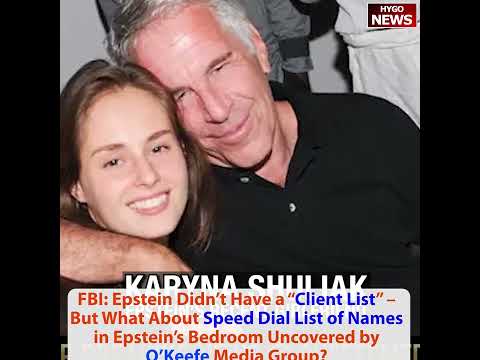
FBI Claims No Epstein Client List But What About Speed Dial List of Names? LA Mayor Bass ICE raid
The FBI’s 2-page memo concluding that Jeffrey Epstein did not have a “client list” sparked immediate questions about other evidence. The O’Keefe Media Group had previously obtained and published footage from Epstein’s island bedroom showing pre-programmed speed-dial lists on his landline telephones — lists bearing the names of Epstein’s staff, associates, and potentially other figures. If those speed-dial lists exist (and O’Keefe Media’s footage appears to confirm they do), the FBI’s characterization of “no client list” requires specific parsing. Separately, LA Mayor Karen Bass physically obstructed an ICE operation in Los Angeles. And Treasury Secretary Bessent previewed upcoming trade announcements — “several in the next 48 hours” — as the August 1 tariff deadline approaches.
The FBI Memo
The FBI released a 2-page memo on Sunday concluding that Jeffrey Epstein did not have a client list that he used for blackmail. The memo said there was no evidence Epstein had blackmailed powerful political figures. It also suggested that no further Epstein records would be released.
The memo represents the administration’s resolution of the client list question. If the FBI — the institution with access to all Epstein-related evidence — has concluded no client list exists, that conclusion is the authoritative finding.
The question the memo leaves open: what specifically was on Epstein’s desk and in his files? Documents existed. Paperwork existed. What those documents contained, if not a “client list,” is a separate question from whether they constituted a specific list.
The O’Keefe Media Group Footage
The video then captured the context for the memo’s reception. “In Epstein’s bedroom, we’ve made our most dramatic discovery yet. Landline telephones that show pre-programmed speed dial buttons, buttons labeled with names. You see the phones on the side of the bedroom tables here.”
O’Keefe Media Group — the investigative journalism outlet founded by James O’Keefe — had previously obtained and published images from Epstein’s island bedroom. Those images showed specific speed-dial labels on Epstein’s landline telephones.
”Speed Dial Buttons Bear The Names”
The O’Keefe reporter described the finding. “The most striking detail, we see a Panasonic console phone on each bedside table. The multiple lines are labeled. The speed dial buttons bear the names of Epstein’s staff and associates. These are the individuals Epstein called most frequently from his private island.”
The speed-dial lists are not the same as a “client list” in the sense the FBI’s memo addresses. A client list implies a specific record of individuals who procured services from Epstein’s trafficking operation. A speed-dial list shows whom Epstein called frequently.
But the distinction may be smaller than the FBI’s framing suggests. If the same individuals appear on both lists — Epstein’s frequent contacts and those involved in his trafficking — then the speed-dial records provide investigative leads that the FBI presumably pursued.
The Specific Names
The O’Keefe footage captured specific names. “Here you have NY office. That’s Jeff Epstein’s New York City office. This is Karina Karina Shuliac. Epstein’s last girlfriend, Darren Off. That’s Darren Indike, an Epstein advisor and lawyer. You have Rich Office. That’s Richard D. Kahn, Epstein’s advisor and lawyer. And Patrick Sell, that’s Patrick McMullen, an Epstein associate. And STC office. That’s the special tax office of the U.S. Virgin Islands.”
Several of the names identified are Epstein’s staff — New York office, advisors, lawyers, an associate. The specific tax office of the U.S. Virgin Islands is where Epstein’s offshore arrangements were managed.
Those contacts are not, in themselves, evidence of criminal involvement by the individuals on the list. Speaking with Epstein, even frequently, is not itself a crime. Epstein’s lawyers, advisors, and staff had legitimate reasons to communicate with him.
The Second Phone
The video then introduced a second phone. “Here we have another phone that was actually in a different room, but we see some of the same names and some new names. We see a Carlos, a Danny, which looks to be scribbled out with Kim written above it, a Mike, and Anna, and a Juggly.”
The second phone’s speed-dial list includes different names: Carlos, Danny (scribbled out with Kim written above), Mike, Anna, and Juggly.
The first-name-only format makes identification harder. Many Carloses exist. Many Mikes exist. Without surnames, the specific individuals on this phone cannot be determined from the transcript alone.
”Juggly”
The video flagged one unusual entry. “Now what’s interesting about Juggly is at first we thought it was Galeen Maxwell’s nickname, but from what we could see online, her nickname Epstein referred to her as G-Max. Don’t know who Juggly is, but maybe you in the audience can help us solve that mystery.”
“Juggly” is unusual enough to have prompted speculation. The reporter’s initial hypothesis was that it might be Ghislaine Maxwell’s nickname, but online research suggested Epstein referred to her as G-Max instead. The identity of “Juggly” remains unknown from the public record.
Crowd-sourced investigation — “maybe you in the audience can help us solve that mystery” — has been O’Keefe’s characteristic approach. The organization’s coverage often invites viewer participation in identifying specifics.
The Administration’s Position
The O’Keefe footage and the FBI memo create an apparent tension. The footage shows speed-dial lists. The memo says no client list exists.
Both claims can be simultaneously true. Speed-dial lists of contacts are not the same as client lists of trafficking customers. Epstein’s frequent communications with his staff, lawyers, and associates does not establish those individuals’ involvement in his trafficking operation.
For viewers who want specific accountability for specific individuals, the distinction may feel like a dodge. For investigators focused on criminally chargeable offenses, the distinction matters because speed-dial lists do not support specific charges without additional evidence.
Why The Epstein Question Persists
The Epstein case persists in public consciousness because of the specific pattern of wealthy and powerful individuals who were known to associate with him. Prince Andrew, Bill Clinton, Bill Gates, and various other prominent figures had documented connections to Epstein. Americans across political lines want specific accountability for any specific wrongdoing by those associates.
The administration’s position is that it has reviewed the available evidence and found no client list that would support additional prosecutions. That position will not satisfy observers who believe specific individuals escaped accountability. But if the underlying evidence genuinely does not support additional prosecutions, the position is legally defensible regardless of political dissatisfaction.
LA Mayor Bass And The ICE Raid
The video then pivoted to a separate story. “LA Mayor Karen Bass is trying to stop a federal immigration raid: ‘THEY NEED TO IMMEDIATELY LEAVE, NOW.’ Los Angeles Democrat Mayor Karen Bass obstructs an ICE operation.”
The reported incident involves Mayor Bass physically or verbally obstructing a federal ICE operation in Los Angeles. The specific details — where, when, what operation — are not fully specified in this transcript.
Why The Bass Action Matters
A mayor physically or verbally obstructing federal law enforcement is legally complicated. Federal law enforcement operates under federal authority that municipal mayors cannot override. Mayors who obstruct federal operations may face legal consequences.
At the same time, mayors have broad political authority to criticize federal actions and to advocate against them. Bass, as an elected mayor, is entitled to voice opposition to ICE operations. The line between legitimate political opposition and illegal obstruction is the specific legal question.
The administration has been tracking these kinds of incidents with specific interest. Bass, Mamdani (when he assumes office), and other sanctuary city mayors are being catalogued by the administration as specific examples of resistance to federal enforcement. Each incident contributes to a broader record that may eventually inform federal decisions about specific sanctions or prosecutions against obstructing officials.
”They Need To Immediately Leave, Now”
Bass’s specific language — “They need to immediately leave, now” — is the mayor demanding federal law enforcement officers leave the area. The demand has no legal force. Federal officers operating under federal authority do not have to comply with municipal mayor demands.
But the demand creates specific operational costs. Officers who are verbally challenged by elected officials face public attention they might prefer to avoid. The operational environment is made more difficult by municipal opposition. The specific mission — whatever ICE was attempting to accomplish — may or may not succeed depending on the specific circumstances.
Bessent On Trade Announcements
The video closed with Bessent previewing upcoming trade news. “We are going to have several announcements in the next 48 hours. What President Trump is concerned about is the quality of the deals, not the quantity.”
“Several announcements in the next 48 hours” signals that trade activity is intensifying. Countries that are finalizing deals will have them announced. Countries that are not reaching deals will receive the tariff letters.
“Quality not quantity” is the framing. Trump is not trying to maximize the number of deals for the number’s sake. He is trying to produce specific deals whose terms serve American interests. Some countries may not get deals at all if the administration cannot secure terms that meet the quality threshold.
”Herding The Cats”
Bessent described the negotiation dynamics. “As you could imagine, as he started herding the cats and trying to get everyone across the finish line, when he said that there’s a chance that countries could boomerang back to their April 2nd Reciprocal Tariff Levels, we’ve had a lot of people change their tune in terms of negotiations.”
“Herding the cats” captures the difficulty of coordinating 15+ simultaneous bilateral negotiations. Each country has specific interests, specific political constraints, and specific preferred outcomes. Getting them all to alignment with American terms requires the kind of diplomatic-economic coordination that few administrations attempt.
“Boomerang back to their April 2nd Reciprocal Tariff Levels” references a specific negotiation technique. The administration had threatened that countries that did not reach deals would face the specific tariff rates that had been announced on April 2. Those rates were, in many cases, substantial. The threat of reverting to them created specific incentives for countries to accept deals that might have been less favorable to them in isolation.
”A Lot Of People Change Their Tune”
Bessent noted the negotiating effect. “My mailbox was full last night with a lot of new offers, a lot of new proposals, so it’s going to be a busy couple of days.”
The specific framing — full mailbox, new offers, new proposals — captures what happens when the administration creates real pressure. Foreign governments that had been slow-playing negotiations now have urgent reason to produce specific offers. Those offers will be evaluated against the administration’s quality threshold.
”August 1st”
Bessent confirmed the deadline. “But importantly too, that President Trump has said that the countries would not go back to the reciprocal rate until August 1st.”
The August 1 deadline provides the specific timing for when the declared tariff rates will take effect if no deals are reached. Countries have until that date to reach deals. After that date, the tariffs apply to countries that did not reach agreements.
That specific deadline creates specific incentives. Countries that want to avoid the tariffs have a clear timeline. Countries that reach deals avoid the tariffs. Countries that do not reach deals face them.
Why The Trade Framework Is Working
The trade framework is producing specific outcomes because it creates specific incentives. Countries cannot delay indefinitely. They must either reach deals or accept specific consequences. Most countries, facing that choice, engage substantively rather than delay.
That outcome validates the administration’s approach. Traditional trade negotiations often produced extended timelines without specific deliverables. The current approach produces specific deliverables on specific timelines. Whether the resulting deals are favorable to American interests is the test — but deliverables are emerging regardless.
The Day’s Coverage Integration
The video integrates three distinct stories: the Epstein FBI memo and O’Keefe footage, the LA Mayor Bass ICE obstruction, and the trade announcement preview. Each story operates in its specific policy domain.
Voters processing all three stories form composite impressions of the administration’s operating environment. The Epstein story shows unresolved questions about accountability. The Bass story shows continuing resistance from sanctuary jurisdictions. The trade story shows active progress in international negotiations.
Each story is real. None contradicts the others. Together, they capture the multi-domain reality of presidential governance.
Key Takeaways
- The FBI memo: “2-page memo on Sunday concluding Jeffrey Epstein did not have a ‘client list’…there is no evidence that Epstein blackmailed powerful political figures.”
- The O’Keefe footage: “Landline telephones that show pre-programmed speed dial buttons, buttons labeled with names…the individuals Epstein called most frequently from his private island.”
- The unresolved “Juggly” mystery: “At first we thought it was Galeen Maxwell’s nickname, but…her nickname Epstein referred to her as G-Max. Don’t know who Juggly is.”
- LA Mayor Bass obstructing ICE: “They need to immediately leave, now.”
- Bessent on trade: “Several announcements in the next 48 hours…my mailbox was full last night with a lot of new offers…countries would not go back to the reciprocal rate until August 1st.”