 HYGO News
 Excerpts of McCarthy record breaking 8 hours speech, against tax and social spending bill
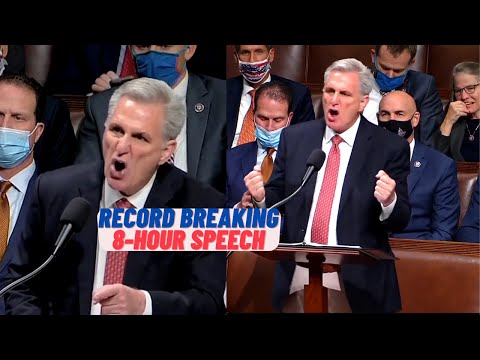
McCarthy’s Record-Breaking 8-Hour-33-Minute Speech: “The Single Most Reckless and Irresponsible Spending Bill in Our Nation’s History”
On November 18, 2021, House Minority Leader Kevin McCarthy began speaking on the House floor at 8:38 p.m. and did not stop until 5:11 a.m. on November 19 — an 8-hour-and-33-minute marathon that broke the record for the longest continuous speech in modern House history. McCarthy used the time to systematically dismantle the nearly $2 trillion Build Back Better Act, calling it “the single most reckless and irresponsible spending bill in our nation’s history.” He covered inflation, gas prices, the border crisis, the Afghanistan withdrawal, religious freedom, China, IRS expansion, and the Wharton School’s analysis showing the bill would cost $4 trillion and lower economic growth. The House ultimately passed Build Back Better on November 19 after McCarthy’s speech delayed the vote from Thursday evening to Friday morning, though the bill would die in the Senate the following month.
”A Direct Correlation to January 20th”
McCarthy opened his attack on the bill’s economic impact by connecting it to the price increases Americans were already experiencing. He drew a direct line from Biden’s inauguration to rising energy costs: “There is a direct correlation to the price of gas to January 20th. And it’s just getting worse.”
He cited the University of Pennsylvania’s Wharton School analysis of the legislation, which had produced significantly different numbers than the White House’s projections. “Wharton School is an amazing school. They never accepted me. They studied this bill. You didn’t have to wait for the CBO. You know what it costs? $4 trillion,” McCarthy said. “It also tells you it’s going to lower our growth.”
The $4 trillion figure represented Wharton’s estimate of the true cost if the bill’s temporary programs were made permanent, as critics expected Congress would eventually do. The White House had scored the bill at roughly $1.75 trillion by making many provisions temporary, but analysts across the political spectrum noted that Congress had historically been unable to let popular programs expire once enacted.
McCarthy used Biden’s electric vehicle promotion as an illustration of who the bill actually served: “I watched President Biden, up in Michigan with the other members from Democrat, driving that electric truck so fast and so excited. You know how much that truck costs? $125,000. Who do you think is going to get the tax break for that? I guess it’s the people Jared was talking about, the millionaires.”
The Border Crisis and the $450,000 Payments
McCarthy devoted a significant portion of his speech to the border crisis, presenting statistics that framed the situation as historically unprecedented. He cited 1.7 million encounters and noted that “between February and October, more people have crossed than 2018, 2019, and 2020 combined.”
He attacked both Biden and Harris for their absence from the border: “The closest the President has ever been to the border in 42 years is to drive through El Paso. A Vice President who is the czar of the border” — leaving the sentence hanging as an indictment of Harris’s limited engagement with the crisis.
McCarthy connected the Build Back Better Act directly to the border situation: “What do you think is going to happen to that border when you provide a billion dollars in amnesty? What do you think is going to happen when you reward people with $450,000? Where do you get the money? From the hardworking taxpayers of America who have less to give.”
He then tied the border spending to the bill’s tax enforcement provisions: “But you know what? They’re going to have to give more because you’re hiring 87,000 IRS agents to come after them.” The 87,000 figure referred to the bill’s funding for expanded IRS enforcement, which supporters said would target wealthy tax evaders but critics argued would disproportionately affect middle-class Americans.
Religious Freedom and China
McCarthy highlighted two amendments that Democrats had rejected, framing each as a window into the party’s priorities.
The first was a religious freedom amendment that would have prevented discrimination against faith-based childcare providers. McCarthy made it personal: “I remember when my kids were young, when we played sporting events and others, we went to the church. Why? Because we knew everybody. They knew us. We knew what was being taught.” He warned that the bill’s language could exclude religious childcare providers from receiving federal funds: “The Democrat bill includes the constitutionally questionable prohibition on religious affiliated childcare providers from receiving funds under the bill.”
The second was an amendment that would have prohibited funds from going to entities tied to the Chinese Communist Party. McCarthy expressed disbelief that it had been voted down: “Now her amendment that would prohibit funds from going to entities tied to the Chinese Communist Party. Come on! Seriously! I’m serious! This is an amendment that was rejected.”
Both examples served McCarthy’s broader argument that the bill’s priorities were fundamentally misaligned with the values and concerns of ordinary Americans.
Afghanistan and Gold Star Families
One of the speech’s most emotional passages came when McCarthy turned to the Afghanistan withdrawal. He recalled meeting with a Gold Star father in his office whose daughter had been killed in the August 26 suicide bombing at Kabul airport.
“A father who had his daughter who wasn’t even supposed to be there but volunteered. She was an electrician,” McCarthy said. “Just days before, you see photos of her holding a young child. She told her sister, I’m going out in front of the wall because you can’t believe it. Someone needs to be there for them.”
McCarthy used the story to draw a contrast with the bill’s spending priorities: “You know what this bill does? Nothing for them. It gives more money to an illegal person who crossed this border. I’m sorry. Americans expect more. Our priorities should be different. These people risk their life every day for us.”
He also referenced Americans still stranded in Afghanistan: “I watched the President look America in the eye and tell us he would not leave until every American’s out. What do you say to those Americans that are still stuck there? The last time we felt like this, Jimmy Carter was president.”
The Closing Warning: “355 Days”
McCarthy saved his most pointed political argument for the end. With the 2022 midterm elections less than a year away, he framed the vote as a defining moment for every Democrat in the chamber.
“If you vote for the bill, I hope you know it’s wrong,” McCarthy said. “If you hand your voting card over to Speaker Pelosi, if you put partisanship above people, that same fate awaits in 355 days.”
He then made the argument personal to individual members: “You all don’t have to do it. Just five. That’s all, just five.” McCarthy was noting that with the narrow Democratic majority, only five defections would have been enough to kill the bill.
He closed with a pointed jab at Pelosi, noting that she had traveled to Europe three times in the three months while the bill was being negotiated: “Has there been a Speaker that in three months, when you’re working on the most important bill, the culmination of your career, that you’ve been able to go to Europe three times in three months?” He suggested Pelosi should “stay for the consequences” of the legislation she called “the culmination of her career.”
The final question to Democrats: “Do you want it to be the culmination of yours?”
The speech ultimately failed to peel off the five votes McCarthy sought. The House passed Build Back Better 220-213 on November 19, with one Democrat — Jared Golden of Maine — voting against it. The bill then moved to the Senate, where Senator Joe Manchin’s opposition would effectively kill it the following month.
Key Takeaways
- McCarthy spoke for 8 hours and 33 minutes starting at 8:38 p.m. on November 18 through 5:11 a.m. on November 19, breaking the modern House record, and cited the Wharton School’s analysis showing the Build Back Better Act would cost $4 trillion and “lower our growth” — calling it “the single most reckless and irresponsible spending bill in our nation’s history.”
- He connected the bill to the border crisis (1.7 million encounters, more crossings from February to October than 2018-2020 combined), the $450,000 migrant payments, and 87,000 new IRS agents, while highlighting rejected amendments that would have protected faith-based childcare providers and prohibited funds from going to CCP-linked entities.
- McCarthy warned Democrats that “the same fate awaits in 355 days” if they voted for the bill, needed only five defections to block it, and took a parting shot at Pelosi for traveling to Europe three times during the bill’s negotiation — but the House passed it 220-213 with only one Democratic defection before it died in the Senate.