 HYGO News
 EU to Trump: You're tough negotiator & dealmaker; Trump on Gaza: We gave $60M & nobody acknowledged
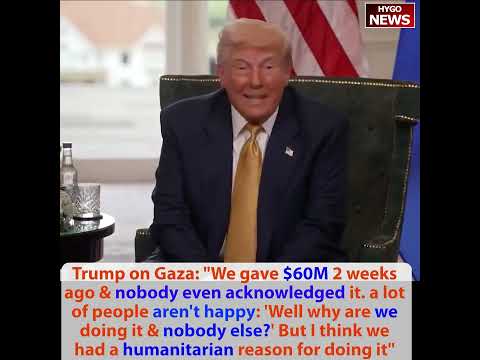
EU to Trump: You’re tough negotiator & dealmaker; Trump on Gaza: We gave $60M & nobody acknowledged
Ursula von der Leyen, President of the European Commission, opened her meeting with Trump in Scotland by characterizing him as “a tough negotiator and deal maker.” Trump added: “And fair.” The exchange set the tone for the EU trade deal that would emerge. Trump confirmed the Japan deal’s historic scale and hinted at progress with China — “we really sort of made a deal with China, but we’ll see how that goes.” On Gaza, Trump delivered one of the more personally expressive moments of the term: $60 million in humanitarian aid provided two weeks earlier went unacknowledged by recipients or other nations. “Nobody said, gee, thank you very much … It would be nice to have at least a thank you.” Trump described meeting with grieving parents of dead hostages still held by Hamas. The Consumer Brands Association — Coca-Cola, Amazon, Target, and others — pledged to eliminate synthetic food dyes by end of 2027, another major MAHA win.
”Tough Negotiator and Deal Maker”
Von der Leyen’s characterization. “You are known as a tough negotiator and deal maker. But fair. What is in front?”
Trump, interjecting: “And fair.”
“And what is in front of us? That’s most important. If we are successful, I think it would be the biggest deal each of us has ever struck. So I’m very much looking forward.”
Trump: “Ever struck by anybody? That’s true. Yeah, that’s true.”
That exchange captures the tone of the EU negotiation. Von der Leyen came in respecting Trump’s reputation as a negotiator while preserving the professional framing (“fair”). Trump accepted the “fair” framing while pushing the claim toward “biggest deal ever.” The combination — tough, fair, big — is the rhetorical positioning both leaders were signaling before the details were revealed.
”Right Now That Honor Goes to Japan”
“Right now we have that honor goes to Japan. We just struck a deal with Japan, as you know.”
Trump naming Japan as the current record-holder for biggest deal. Within hours, the EU deal would displace Japan’s standing. The pacing of announcements — Japan earlier in the week, Indonesia, Philippines, now EU — means the “biggest deal ever” marker keeps being transferred.
“And we’re very close to a deal with China. We really sort of made a deal with China, but we’ll see how that goes.”
“We really sort of made a deal with China” is Trump’s characteristic hedge. The U.S.-China trade relationship has been managed through a mix of bilateral talks, tariff escalations, and carve-outs. A comprehensive deal has not been publicly announced. Trump’s “sort of made a deal” suggests substantive progress without finalized terms.
”Mostly I’m Just Going to Charge Tariffs”
“We have numerous other deals, and mostly I’m just going to charge tariffs. And you know, there’s not a deal per se, but people are going to pay tariffs. And we’re doing them at the low end, not the high end, because we don’t want to hurt anybody.”
That is Trump revealing the dual-track approach. Countries that negotiate deals get favorable terms (like Japan’s financing mechanism, the EU’s 15% flat rate, Indonesia’s specific package). Countries that don’t negotiate get tariffs imposed unilaterally — “mostly I’m just going to charge tariffs.”
“Low end, not the high end” for the non-negotiating countries. That is calibrated restraint. Trump is not maximizing tariff rates against everyone who refuses to negotiate. He is applying sustainable rates that preserve commercial relationships while signaling future willingness to escalate if needed.
”Biggest Trading Partnership in the World”
“You and I both figured this is really the biggest trading partnership in the world. So we should give it a shot, right?”
Von der Leyen: “Yeah. Very much looking forward to that.”
Trump: “Oh, thank you very much. I do too.”
The U.S.-EU trading relationship is indeed the largest bilateral commercial relationship in the world — larger than U.S.-China in dollar terms (because of services) and larger than any other combination. Getting it right, on mutually agreeable terms, is a larger economic event than any individual bilateral deal could produce.
”$60 Million … Nobody Acknowledged”
The segment pivoted to Gaza, where Trump’s tone shifted markedly. “We gave $60 million two weeks ago, and nobody even acknowledged it for food. You really at least want to have somebody say thank you.”
That is unusual personal honesty for a president on the record. Trump is complaining that a $60 million U.S. humanitarian contribution to Gaza food aid went unacknowledged by anyone.
“No other country gave anything. We gave $60 million two weeks ago for food, for Gaza. Nobody acknowledged it. Nobody talks about it. And it makes you feel a little bad when you do that, and you know, you have other countries not giving anything. None of the European countries, by the way, gave. I mean, nobody gave but us.”
“None of the European countries, by the way, gave.” That is the operational reality of Gaza humanitarian funding. European countries that publicly criticize Israel’s Gaza operations most aggressively are often not the countries providing the largest humanitarian contributions. The U.S. — which the same critics frame as backing Israel’s military operations — was the only country providing the $60 million food aid.
”It Would Be Nice to Have at Least a Thank You”
“And nobody said, gee, thank you very much. And it would be nice to have at least a thank you. And I took a lot of heat. You know, when I do that, a lot of people aren’t happy about that because they say, well, why are we doing it and nobody else?”
Trump is acknowledging the political cost of the humanitarian funding. His own political base includes voices arguing that American aid should not flow to Gaza while other countries do nothing. “A lot of people aren’t happy about that” — Trump faced internal criticism for the $60 million contribution.
“But I think we had a humanitarian reason for doing it.”
“Humanitarian reason” is Trump’s framing. The specific context — famine conditions in Gaza, civilian casualties, displaced populations — required some American response. Trump provided it. Whatever the political cost, the humanitarian need was real.
The Hostage Negotiations
“What’s going to happen? I don’t know. I can tell you that Hamas, as I said, would happen at the end. You know, we’ve gotten back a lot of hostages. A tremendous number of hostages. Most of them.”
The hostage framing. U.S.-brokered diplomatic efforts during the Trump administration have resulted in the release of a significant number of Hamas-held hostages, including American citizens and Israeli dual nationals.
“And now we have dead hostages, and the mothers want them back. And we have 20 people, approximately, but they’re living. But we have a lot of bodies. And the parents want those bodies as much as they would want their child if that child were alive.”
The remaining hostage situation, as Trump describes it: approximately 20 living hostages still held by Hamas, plus the bodies of deceased hostages that families want returned for burial.
“The parents want those bodies as much as they would want their child if that child were alive.” That is a recognition of a specific kind of grief. A family whose child died in captivity needs the body for proper burial, closure, and the continuation of mourning rituals that require physical presence.
”Please Get My Son Back”
“I met with parents that were, it was so sad. Sir, please get my son back. How is your son doing? Well, he’s dead. But they have his body. And it’s so important. More important. It’s almost like more, but it’s as important as if the child were living. These people were, I mean, they’re devastated.”
That is Trump’s description of meeting with hostage families — specifically, parents of deceased hostages. A parent asking “please get my son back” when the son is already dead is the specific grief of families whose mourning has been extended indefinitely by the continued detention of their loved one’s remains.
Trump’s “almost like more” phrasing captures the unusual moral weight of the situation. For a parent of a living hostage, the hope is reunion. For a parent of a deceased hostage, the hope is the proper return of remains. Both categories of parent are suffering.
”Hardened Up”
“And I said, when you get it down to a certain number, you’re going to be able to make a deal with Hamas because once they give them up, then they feel that that’s going to be the end of them. And what I said is exactly true. You know, they had a routine discussion the other day, and all of a sudden they hardened up. They don’t want to give them back. So Israel’s going to have to make a decision.”
“Hardened up” is Trump’s assessment of the Hamas negotiating posture. The routine discussion that apparently looked productive — on track for additional hostage releases — shifted. Hamas’s leadership pulled back. The hostages remaining represent Hamas’s last leverage.
“So Israel’s going to have to make a decision. I know what I do, but I don’t think it’s appropriate that I say, but Israel’s going to have to make a decision.”
That is Trump explicitly declining to publicly instruct Israel on its military decisions. “I know what I do” — Trump has a view. He is keeping it private. Israel is sovereign. Israel will decide.
The implicit signal: if Hamas will not negotiate the release of the remaining hostages, Israel faces a choice between indefinite military operations or a decisive ground campaign to dismantle Hamas. Either choice carries costs. Trump is declining to publicly preference one over the other.
MAHA: Coca-Cola, Amazon, Target
The segment closed with another MAHA industry commitment. “Breaking today, some of America’s biggest brands are backing the Making America Healthy Again movement. This Consumer Brands Association includes all the big brands like Coca-Cola, Amazon, Target, pledging to eliminate synthetic food dyes by the end of 2027.”
Coca-Cola, Amazon, Target. Three of the most recognized consumer brands in America, all pledging to eliminate synthetic food dyes from their products by 2027.
That is the scale MAHA is achieving. Previous commitments covered the dairy industry (including IDFA for ice cream) and 90% of ice cream volume. The new commitments extend to beverages (Coca-Cola), general retail (Amazon, Target), plus the broader Consumer Brands Association membership.
When the Consumer Brands Association — which includes Tyson, PepsiCo, Nestle, Hershey, Conagra, Kraft Heinz, General Mills — commits in aggregate, the U.S. food supply is structurally shifting. By end of 2027, artificial dyes in American consumer food products will be the exception rather than the norm.
The MAHA Achievement
That is a public-health policy outcome at a scale rare in American institutional history. Through voluntary industry commitments driven by administration leadership and consumer-brand recognition pressure, a systemic change to the American food supply is being implemented without federal regulatory rulemaking.
Whether every commitment is fully executed is the future question. Industry commitments made publicly with two-year deadlines create strong reputational incentives for follow-through. The pace of progress — from dairy to ice cream to Coca-Cola/Amazon/Target — suggests the momentum is durable.
Key Takeaways
- Ursula von der Leyen opened with “tough negotiator and deal maker” characterization of Trump — Trump added “and fair.”
- Trump on China: “We really sort of made a deal with China, but we’ll see how that goes” — plus countries that don’t negotiate “are going to pay tariffs … at the low end, not the high end.”
- Trump on Gaza humanitarian aid: “We gave $60 million two weeks ago … and nobody even acknowledged it … None of the European countries, by the way, gave. I mean, nobody gave but us.”
- On hostages: “The parents want those bodies as much as they would want their child if that child were alive” — meeting with “parents that were so sad … ‘Sir, please get my son back.’”
- MAHA win: Consumer Brands Association — including Coca-Cola, Amazon, Target — pledged to eliminate synthetic food dyes by end of 2027.