 HYGO News
 Zeldin Closes $4M Biden EPA Museum -- '$315 Per Visitor'; Consolidates Office Space Saving $18M/Year; $22B in Grants Canceled
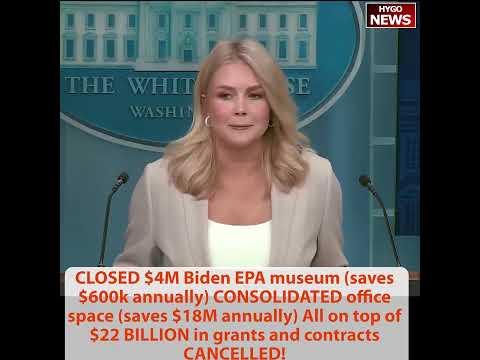
Zeldin Closes $4M Biden EPA Museum — “$315 Per Visitor”; Consolidates Office Space Saving $18M/Year; $22B in Grants Canceled
EPA Administrator Lee Zeldin announced three major cost-cutting measures in April 2025: closing a $4 million Biden-era EPA museum that cost $600,000 annually to operate but attracted only 1,909 external visitors in nine months — working out to “$315 per external visitor”; consolidating office space by vacating 323,000 square feet of unnecessary EPA space, saving $18 million per year in lease costs; and canceling over $22 billion in wasteful grants and contracts. Press Secretary Leavitt called Zeldin’s performance “tremendous” and Zeldin himself filmed a walkthrough of the museum, calling it “a shrine to environmental justice and climate change” built by the Biden administration.
The $4 Million Museum: “$315 Per Visitor”
Zeldin produced a video walkthrough of the EPA museum that made the waste argument in the most visual possible way.
“I’m currently standing inside of this museum, which was built and curated by the Biden administration with $4 million in taxpayer dollars,” Zeldin said.
He described the content: “If you were to visit the museum located here at EPA headquarters in DC, you would learn a lot about the road to environmental justice and climate change. This museum claims EPA pursues its mission by advancing environmental justice, equity, and civil rights compliance.”
Zeldin noted a telling omission: “A timeline of key events conveniently omits any mention of President Trump’s first administration.”
He then delivered the cost analysis: “As if this wasn’t enough of a price tag to fill a room the size of an apartment, this shrine to environmental justice and climate change cost the American taxpayer $600,000 to operate annually.”
The breakdown was specific: “This agency has been spending $123,000 on cleaning, $207,000 for security, $54,000 on maintenance, and an additional $54,000 on storage.”
Then the devastating attendance figure: “From May 2024 through last month, only 1,909 members of the public visited the museum. Even though it is free admission, this museum costs you, the taxpayer, $315 per external visitor.”
The $315-per-visitor calculation was the kind of number that made abstract waste concrete. Every person who walked through the museum’s doors had unknowingly cost taxpayers more than the price of a nice dinner for two. The museum was not providing a public service; it was providing a private indulgence for the handful of visitors who happened upon it, funded by the millions of Americans who would never see it.
Zeldin announced the closure: “I have pledged to be an exceptional steward of taxpayer dollars, so this shrine to EJ and climate change will now be shut down for good.”
He offered an alternative vision: “I will do my part to help the American people learn more about the amazing work of our agency to provide cleaner, healthier, and safer land, air, and water. We will do so without paying over half a million in tax dollars on a museum that is barely visited and designed to tell an ideologically partial story of the EPA."
"A Room the Size of an Apartment”
Zeldin’s description of the museum as occupying “a room the size of an apartment” put the $4 million construction cost in perspective. In Washington, DC, an apartment-sized space could be leased for a fraction of what the museum cost to build and operate. The Biden administration had spent $4 million constructing what was essentially a climate change exhibit in a single room, then committed $600,000 annually to maintain it — all within a government building that was already being paid for by taxpayers.
The museum’s content was, by Zeldin’s description, ideologically curated. It told “a selective story” of EPA history that emphasized environmental justice and climate change while omitting Trump’s first term entirely. It was, in effect, a Biden administration propaganda exhibit housed within a federal agency, funded by taxpayers regardless of their political views.
The closure would save $600,000 annually in operating costs. Over a decade, that was $6 million — more than the original construction cost. The museum had been designed to be expensive in perpetuity.
323,000 Square Feet of Unnecessary Space
Press Secretary Leavitt announced the office consolidation.
“Just yesterday and today it will be going into effect to announce that taxpayers will be saved $18 million in annual lease costs by moving staff out of the 323,000 square feet of space that the EPA currently occupies, which is completely unnecessary,” Leavitt said.
The 323,000 square feet was approximately the size of a large suburban shopping mall. The EPA had been maintaining office space equivalent to six football fields of floor area that was “completely unnecessary” — space that sat empty or underutilized while taxpayers paid $18 million annually in lease costs.
The consolidation reflected a post-COVID reality that many government agencies had been slow to acknowledge. With significant portions of the federal workforce working remotely, the physical office space required to house government employees had shrunk dramatically. But lease agreements had continued, and agencies had been slow to reduce their real estate footprint. Zeldin was doing at the EPA what the private sector had been doing since 2021: right-sizing office space to match actual usage.
$22 Billion in Grants and Contracts
Leavitt placed the museum closure and office consolidation in the context of Zeldin’s broader cost-cutting.
“Just at EPA alone, and the cuts that they have made, they’ve saved taxpayers more than $22 billion in wasteful grants and spending,” she said.
The $22 billion figure dwarfed the museum and office savings combined. The museum closure saved $600,000 per year. The office consolidation saved $18 million per year. But the grant cancellations — which Zeldin had detailed in previous briefings, including the $2 billion to Stacey Abrams’s NGO and the $20 billion distributed through eight pass-through organizations — represented savings on a fundamentally different scale.
The three measures together illustrated the layers of waste that existed within a single agency. At the surface level, there was the vanity project of a $4 million museum. Below that, there was the real estate waste of 323,000 square feet of unnecessary office space. And at the foundation, there was the $22 billion in grants that had been distributed to organizations that served ideological rather than environmental purposes.
”Under President Trump, We Are Ending This”
Zeldin concluded his video walkthrough with a statement that connected the museum closure to the administration’s broader philosophy.
“Under President Trump, we are ending the practice of burning tax dollars on pet projects that do nothing to help this agency achieve our mission of protecting human health and the environment,” Zeldin said.
The framing was important. Zeldin was not arguing against environmental protection; he was arguing that the Biden-era EPA had diverted resources from actual environmental protection to ideological projects. A $4 million museum about environmental justice did not clean a river, remediate a toxic site, or monitor air quality. The $22 billion in canceled grants had gone to intermediaries and pass-throughs, not to communities affected by pollution.
By closing the museum, consolidating offices, and canceling wasteful grants, Zeldin was arguing that the EPA could be simultaneously more efficient and more effective — doing more for the environment with less taxpayer money by eliminating the ideological overhead that had consumed an increasing share of the agency’s resources.
Key Takeaways
- Zeldin closed a $4M Biden-era EPA museum that cost $600K/year to operate but had only 1,909 visitors in 9 months — “$315 per external visitor.”
- The museum told “a selective story” of EPA history emphasizing environmental justice and climate change while omitting Trump’s first term entirely.
- EPA consolidated office space, vacating 323,000 square feet of unnecessary space, saving $18 million annually in lease costs.
- Total EPA savings under Zeldin: over $22 billion in canceled grants and contracts, plus the museum and office consolidation.
- Zeldin: “Under President Trump, we are ending the practice of burning tax dollars on pet projects that do nothing to help protect human health and the environment.”