 HYGO News
 Emir of Qatar: 'First American President to Officially Visit Qatar'; Trump on Syrian Leader: 'Young, Attractive, Tough -- Real Shot at Holding It Together'
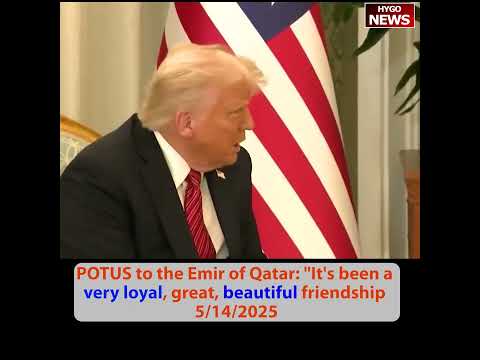
Emir of Qatar: “First American President to Officially Visit Qatar”; Trump on Syrian Leader: “Young, Attractive, Tough — Real Shot at Holding It Together”
President Trump arrived in Qatar on his historic Middle East trip in May 2025, greeted by the Emir with a notable distinction: “You are the first American president to officially visit Qatar.” Trump described his meeting with Syria’s new leader as “very good”: “I think he’s a good, young, attractive guy, tough guy. Strong past. Very strong past — fighter. But he’s got a real shot at pulling it together.” He thanked Crown Prince MBS for Saudi hospitality: “We have a special relationship. It was an honor to spend a couple of days with you.” He celebrated the Abraham Accords and UAE-Bahrain signatories: “I hope in the near future we can continue that progress by adding more countries.” He cited the mandate: “The most consequential election in America in 129 years."
"First American President”
The Emir of Qatar greeted Trump with historic distinction.
“We’re extremely honored to have you here. We’re very excited, very happy. It’s a historic visit,” the Emir said.
He delivered the significant detail: “And I don’t know if you know that you are the first American president to officially visit Qatar.”
The Emir repeated: “So we’re very honored. We’re very honored.”
The “first American president to officially visit” distinction was geopolitically significant. Qatar had hosted American presidents for brief stops and military visits, but a formal state visit had never occurred. Trump becoming the first U.S. president to make such a visit elevated the bilateral relationship to historic levels.
The timing was important. Qatar hosted Al-Udeid Air Base, America’s largest military installation in the Middle East. Qatar also played complex diplomatic roles — hosting Hamas political leaders, mediating in Afghanistan negotiations, providing natural gas to Europe. The American-Qatari relationship had always been substantial but understated; Trump’s visit brought it into the open.
The Emir’s emphasis on honor — repeating “we’re very honored” — reflected the Arab diplomatic tradition of demonstrating respect through explicit acknowledgment. For Qatar, hosting an American president for the first time was a moment worthy of the most formal welcome ceremonies, elaborate gift exchanges, and public celebration.
The Syrian Leader Assessment
Trump offered a candid assessment of Ahmed al-Sharaa, the former jihadist commander who now led Syria’s transitional government.
“How did you find the Syrian President?” a reporter asked.
Trump’s response was vivid: “I think we’re a good, young, attractive guy, tough guy.”
He described the personal history: “Strong past. Very strong past — fighter.”
He delivered the strategic assessment: “But he’s got a real shot at pulling it together. I look forward to working with you.”
The “strong past — fighter” language was Trump’s acknowledgment of al-Sharaa’s background as Abu Mohammad al-Julani, former commander of Hayat Tahrir al-Sham and before that the al-Nusra Front. The United States had previously designated al-Sharaa as a terrorist with a $10 million bounty on his head.
Trump’s willingness to meet with al-Sharaa and characterize him favorably reflected the administration’s pragmatic approach to Middle East diplomacy. Al-Sharaa had emerged as Syria’s effective leader after Assad’s collapse. Whatever his past affiliations, he now controlled the state and could either be engaged diplomatically or treated as a continuing enemy.
Trump chose engagement. By meeting with al-Sharaa, describing him positively, and announcing sanctions relief, Trump gave the new Syrian government a real chance to succeed. The “real shot at pulling it together” assessment was conditional — al-Sharaa had the opportunity to stabilize Syria, but whether he would succeed remained to be seen. American support would help; American opposition would have guaranteed failure.
Thanks to MBS
Before departing Saudi Arabia, Trump paid tribute to his host.
“I want to thank Mohammed. I want to thank you, Crown Prince,” Trump said. “We have a special relationship. We have long had a special relationship, but it was an honor to spend a couple of days with you.”
He signaled future contact: “I’ll see you again soon and I’ll see you a lot. Thank you all very much.”
The Trump-MBS relationship had been close since Trump’s first term, when Saudi Arabia had been the first foreign trip destination. The $142 billion military deal announced during this visit — “the largest ever” — was evidence that the relationship had only deepened during the Biden years, despite Biden’s initial campaign rhetoric about treating Saudi Arabia as a “pariah.”
MBS represented the future of Saudi Arabia. As Crown Prince and de facto ruler despite his father King Salman’s formal position, MBS controlled the kingdom’s oil production decisions, defense spending, foreign policy, and economic diversification programs. His Vision 2030 plan to transform Saudi Arabia beyond oil dependency created massive investment opportunities that American companies were now able to access through Trump’s diplomatic engagement.
Qatar: “Perfect Marble”
Trump’s remarks to the Qatari Emir were characteristically warm.
“Well, I have to say that we’ve been friends for a long time. Hard to believe, right?” Trump said. “We remember that first meeting very well. We liked each other and we worked with each other. And now we can work in the highest capacity.”
He connected Qatar to broader diplomatic efforts: “And we’ll bring peace not only here, but I know you’re very much involved in helping us in other regions, like what’s happening with Russia, Ukraine, etc. And I think we’re having some pretty good news coming out of there today and maybe tomorrow and maybe Friday, frankly.”
He thanked the Emir for the friendship: “I just want to thank you for everything, and maybe in particular our friendship. We’ve spent a very loyal, great, beautiful friendship.”
He complimented the facilities: “The job you’ve done is second to none. You look at this — as so beautiful. As a construction person, I’m seeing perfect marble. This is what they call ‘perfecto.’ Just a great job you’ve done, and what a beautiful place.”
He noted the ceremonial welcome: “We appreciate those camels. I haven’t seen camels like that in a long time. That was some greeting.”
The “perfect marble” observation was Trump the real estate developer emerging in diplomatic context. Trump’s career had involved building luxury properties with premium materials, and his eye for construction quality was genuine. Qatar’s modern infrastructure — built with oil wealth and international expertise — represented some of the most impressive construction in the world.
The camel reference acknowledged the traditional Arabian welcome ceremony. Camels — historically the foundation of Arabian civilization — remained symbolic of Arab hospitality and tradition. Trump’s appreciation for the ceremonial welcome reflected respect for local customs that Western leaders had not always shown.
Abraham Accords Expansion
Trump celebrated the original Abraham Accords signatories and projected expansion.
“At the end of my first term, all of the momentum in this region was toward peace,” Trump said.
He named the heroes: “I especially want to thank and congratulate the United Arab Emirates and Bahrain for their vision and courage in signing the historic Abraham Accords.”
He acknowledged the achievement’s significance: “It was something — it’s a very big thing.”
He expressed his disappointment: “I believe we would have had it filled out had the election been called fairly, which it was, and it was a rigged election.”
He projected future progress: “I hope that in the near future we can continue that progress.”
He cited the mandate: “We have a mandate from the American people the likes of which people haven’t seen for 129 years, they say. It was the most consequential election in America in 129 years.”
He projected optimism: “So that sounds like a long time, so we’ll take that. But in the future, we’ll continue that progress by adding more countries to the Abraham Accords. I think they’re going to be filling up very rapidly.”
The Abraham Accords had been Trump’s most significant foreign policy achievement of the first term. By normalizing relations between Israel and Arab states — UAE, Bahrain, Morocco, and Sudan — the Accords had transformed the Middle East from perpetual conflict to emerging cooperation.
The “filling up very rapidly” projection reflected active negotiations with Saudi Arabia, Oman, and other Arab states that had shown interest in normalization. Saudi Arabia specifically had been close to normalizing with Israel before October 7, 2023 — the Hamas attack that triggered the Gaza war. With the regional conflict subsiding, Saudi-Israeli normalization was again possible, which would be the most significant Arab-Israeli breakthrough since Egypt’s peace treaty in 1979.
The 129-Year Claim
Trump’s claim that his 2024 victory was the “most consequential election in America in 129 years” was characteristic Trump hyperbole with a factual foundation. The reference to 129 years pointed to 1896 — the year William McKinley defeated William Jennings Bryan in a critical realignment election that established Republican dominance for decades. Political scientists had identified several historically consequential elections, and whether 2024 rose to that level would be judged by history.
The more important point was the mandate argument. Trump had won the popular vote, every swing state, and produced the largest Republican coalition in decades. This gave the administration political capital to pursue aggressive policies — like the Middle East trip, the trade negotiations, and the domestic reforms — that a narrower victory would not have supported.
Key Takeaways
- Emir of Qatar: “You are the first American president to officially visit Qatar.”
- Trump on Syrian leader al-Sharaa: “Young, attractive guy, tough. Strong past — fighter. Real shot at pulling it together.”
- MBS farewell: “We have a special relationship. It was an honor to spend a couple of days with you.”
- On Qatar: “Perfect marble. A great job. And those camels — some greeting.”
- Abraham Accords: “Filling up very rapidly” with more countries. “Most consequential election in 129 years” provides the mandate.