 HYGO News
 Musk at First Cabinet Meeting: 'Humble Tech Support'; $1 Trillion in Savings Requires '$4 Billion Per Day'
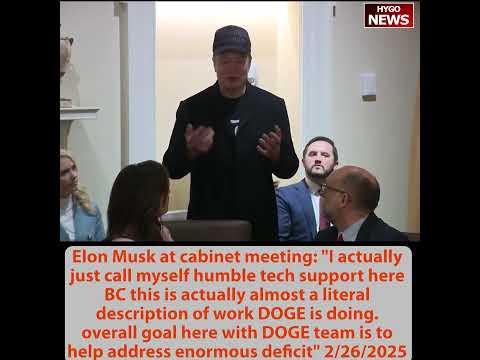
Musk at First Cabinet Meeting: “Humble Tech Support”; $1 Trillion in Savings Requires “$4 Billion Per Day”
Elon Musk attended President Trump’s first cabinet meeting on February 26, 2025, and delivered remarks that combined self-deprecating humor with an alarming assessment of the nation’s fiscal trajectory. Musk described himself as “humble tech support” and said that was “almost a literal description of the work DOGE is doing — helping fix the government computer systems.” He revealed that achieving $1 trillion in savings by the end of fiscal year 2026 would require “saving $4 billion per day, every day, from now through the end of September.” Musk warned that without action, “America will go bankrupt” because interest on the national debt already exceeded Defense Department spending. He acknowledged DOGE would make mistakes — citing a brief accidental cancellation of Ebola prevention funding — but said errors would be “fixed very quickly.”
Trump Introduces Musk to the Cabinet
Trump opened the cabinet meeting by asking Musk to speak first, acknowledging both the public enthusiasm and the personal cost of the DOGE mission.
“I’m going to ask if it’s possible to have Elon get up first and talk about DOGE, because it seems to be of great interest to everyone,” Trump said.
He connected DOGE to his electoral mandate. “I will say that there is a large group of people in this country that have such admiration for what we’re doing,” Trump said. “I got elected with a tremendous vote, winning every swing state, winning the popular vote, winning the counties by thousands of counties. I think it was 2,800 counties to 500 counties.”
Trump was explicit about the mandate: “I got elected based on taxes and based on many things — the border — but also based on balancing budgets and getting our country back into shape. And this is a big part of it.”
He praised Musk personally while acknowledging the toll the work was taking. “He’s been a tremendously successful guy. He’s really working so hard, and he’s got businesses to run,” Trump said. “And in many ways, they say, how do you do this? He’s sacrificing a lot. And getting a lot of praise, I’ll tell you, but he’s also getting hit. And we would expect that."
"Humble Tech Support”
Musk opened his remarks with the self-description that would become the defining quote of the cabinet meeting.
“I actually just call myself humble tech support,” Musk said. “As crazy as it sounds, that is almost a literal description of the work that the DOGE team is doing — helping fix the government computer systems.”
He elaborated on the technical dimension. “Many of these systems are extremely old. They don’t communicate. There are a lot of mistakes in the systems. The software doesn’t work,” Musk said. “So we are actually tech support. It’s ironic, but it’s true.”
The “tech support” framing was strategically important. It recast DOGE from the threatening, confrontational entity its critics portrayed into something mundane and necessary — the IT department fixing broken computers. The framing also explained why a technology entrepreneur was qualified for the role: the federal government’s fundamental problem was technological, and Musk’s expertise was in building and fixing technology systems at scale.
”America Will Go Bankrupt”
Musk then delivered the fiscal warning that gave urgency to everything DOGE was doing.
“The overall goal here with the DOGE team is to help address the enormous deficit,” Musk said. “We simply cannot sustain as a country a $2 trillion deficit.”
He provided the specific data point that illustrated the crisis. “Just the interest on the national debt now exceeds the Defense Department spending,” Musk said. “We spend a lot on the Defense Department, but we’re spending over a trillion dollars on interest.”
The comparison was devastating: the United States was now paying more to service its past debts than it spent to defend itself. The interest payments produced nothing — no ships, no aircraft, no soldiers, no security. They were simply the cost of previous spending decisions compounding into an ever-growing obligation.
Musk stated the consequence in the starkest possible terms. “If this continues, the country will become de facto bankrupt,” he said. “It’s not an optional thing. It is an essential thing.”
He connected the warning to his personal sacrifice. “That’s the reason I’m here, and taking a lot of flak, and getting a lot of death threats, by the way,” Musk said. “I’d like to stack them up.”
The death threats revelation was delivered with characteristic Musk understatement. The richest person in the world was receiving threats to his life for the work he was doing to reduce government waste — a detail that humanized the mission and underscored the intensity of the opposition from those who benefited from the status quo.
“But if we don’t do this, America will go bankrupt,” Musk repeated. “That’s why it has to be done.”
The $1 Trillion Target: $4 Billion Per Day
Musk then provided the most specific roadmap yet for DOGE’s fiscal ambitions.
“I’m confident at this point — knock on wood, you know, like on my wooden head, because there’s a lot of wood up there — that we can actually find a trillion dollars in savings,” Musk said. “That would be roughly 15% of the $7 trillion budget.”
He acknowledged the magnitude of what was required. “Obviously, that can only be done with the support of everyone in this room,” Musk told the assembled cabinet members. “And I’d like to thank everyone for their support.”
He clarified DOGE’s role: “DOGE is a support function for the President and for the agencies and departments to help achieve those savings, and to effectively find 15% in reduction in fraud and waste.”
Then the operational number: “To achieve a trillion-dollar deficit reduction in fiscal year 2026, it requires saving $4 billion per day, every day, from now through the end of September.”
The $4 billion per day figure was the most granular target Musk had provided. It transformed an abstract trillion-dollar goal into a daily operational metric that could be tracked, measured, and reported. Every day DOGE saved $4 billion brought the country closer to fiscal sustainability. Every day it fell short increased the deficit.
”We Bring the Receipts”
Musk addressed skeptics who questioned whether DOGE’s claims were real. “People say, well, is this real? Just go to doge.gov,” he said. “We line item by item. We specify each item.”
The transparency commitment — public documentation of every cut — was both an accountability mechanism and a political strategy. By publishing the receipts, DOGE ensured that its critics had to engage with the specific expenditures being cut rather than making generalized arguments about government services being slashed.
Mistakes Will Happen — and Be Fixed
In the most candid portion of his remarks, Musk acknowledged that DOGE’s aggressive pace would produce errors.
“I should say also, we will make mistakes. We won’t be perfect,” Musk said. “But when we make a mistake, we’ll fix it very quickly.”
He cited a specific example. “With USAID, one of the things we accidentally canceled very briefly was Ebola prevention,” Musk said. “I think we all want Ebola prevention. So we restored the Ebola prevention immediately. And there was no interruption.”
The Ebola anecdote served multiple purposes. It demonstrated that DOGE was willing to admit errors publicly. It showed that corrections happened rapidly. And it illustrated the kind of mistake that was possible when reviewing thousands of programs at speed — an accidental cancellation of a program everyone agreed should continue, caught and reversed before any real-world impact occurred.
The admission that mistakes would happen was strategically wise. By setting expectations that errors were inevitable but would be quickly corrected, Musk preempted the media strategy of finding individual DOGE errors and using them to discredit the entire mission. Every future mistake could be met with: “We told you this would happen. We fixed it. Now let us keep working.”
Key Takeaways
- Musk called himself “humble tech support” at Trump’s first cabinet meeting, saying DOGE was literally “helping fix the government computer systems” that were “extremely old” and “don’t communicate.”
- He warned that “America will go bankrupt” because interest on the national debt now exceeds Defense Department spending, calling deficit reduction “not an optional thing.”
- Musk set a target of $1 trillion in savings — 15% of the $7 trillion budget — requiring “$4 billion per day, every day, from now through the end of September.”
- He acknowledged receiving death threats over the DOGE work and admitted mistakes would happen, citing the brief accidental cancellation of Ebola prevention funding that was “restored immediately.”
- Trump connected the DOGE mission to his electoral mandate of “2,800 counties to 500 counties,” saying he was elected “based on balancing budgets and getting our country back into shape.”