 HYGO News
 Musk: DOGE Saving $150B -- 'Unemployment Insurance for People Not Born Yet'; Trump: 'Very Close' to First Trade Deal
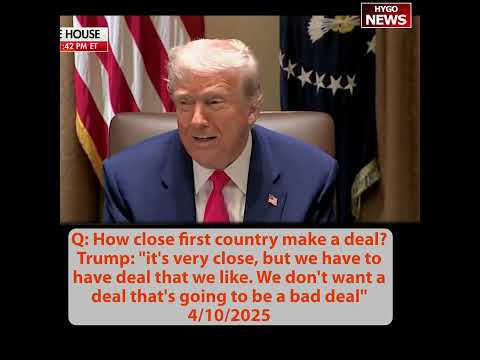
Musk: DOGE Saving $150B — “Unemployment Insurance for People Not Born Yet”; Trump: “Very Close” to First Trade Deal
Elon Musk announced at an April 2025 cabinet meeting that DOGE anticipated $150 billion in savings for fiscal year 2026 from waste and fraud reduction, citing examples like “people getting unemployment insurance who haven’t been born yet.” When asked how close the administration was to its first tariff deal, Trump said “very close, but we have to have a deal that we like — I could make every deal in one day if I wanted to.” He revealed plans to deploy major law firms to handle the volume of trade negotiations, and White House Chief of Staff Susie Wiles praised the cabinet as one that “uniquely collaborates and cooperates."
"$150 Billion” in DOGE Savings
Musk delivered the headline number from DOGE’s ongoing work.
“Thanks to your fantastic leadership, this amazing cabinet, and the very talented DOGE team,” Musk said. “I’m excited to announce that we anticipate savings in FY26 from reduction of waste and fraud by $150 billion.”
He cited the most absurd example: “And some of it is just absurd. Like people getting unemployment insurance who haven’t been born yet. I mean, I think anyone can appreciate — whether they did — I mean, come on. That’s just crazy.”
Musk described the discovery process: “So some of these things, if people ask me, ‘Well, how are you going to find waste and fraud in the government?’ I’m like, well, actually just go in any direction. That’s how you find it. It’s very common.”
He used military terminology: “As the military would say — target-rich environment.”
Musk outlined the vision: “I think we’re doing a lot of good in excellent collaboration with the cabinet to achieve these savings, and it will actually result in better services for the American people. And then we’re going to be spending their tax dollars in a way that is sensible and fair and good.”
The $150 billion figure for a single fiscal year was substantial — equivalent to the annual budgets of several cabinet-level departments combined. When added to the $22 billion in EPA grants canceled, the $830 million in Interior Department survey contracts terminated, and hundreds of other individual savings, the cumulative DOGE impact was approaching levels that could meaningfully affect the federal budget deficit.
The “unemployment insurance for people not born yet” example was the kind of detail that crystallized the waste problem. The federal government’s systems were so poorly maintained and monitored that they were issuing payments to non-existent individuals — including people who had not yet been born. The fraud was not sophisticated; it was enabled by a system that no one had bothered to audit.
Musk’s “target-rich environment” description suggested that DOGE had barely scratched the surface. If waste and fraud could be found “in any direction,” the $150 billion in identified savings was likely a fraction of the total available.
”Very Close” to First Trade Deal
A reporter asked the question the markets wanted answered.
“How close are you to the first country coming to actually make a deal with the United States on the tariffs? Is it a day? A month?”
Trump’s answer was encouraging but conditional: “I think it’s very close. But we have to have a deal that we like. We don’t want a deal that’s going to be a bad deal.”
He emphasized the ease of making deals versus the discipline of making good ones: “I could make every deal in one day if I wanted to. I could just say, ‘Here’s what we’ll do.’”
The distinction between speed and quality was the core of Trump’s negotiating philosophy. The tariffs had created enormous pressure for countries to negotiate quickly. The temptation was to accept the first deals offered and declare victory. Trump was resisting that temptation, insisting that deals had to meaningfully address trade deficits and market access — not merely provide face-saving compromises that left the underlying imbalances intact.
Law Firms for Trade Negotiations
Trump revealed an unconventional plan to handle the volume of trade negotiations.
“We have a lot of law firms that have paid me a lot of money in the form of legal fees,” Trump said, referencing the firms that had paid settlements or fees related to the various legal actions against him. “We’re going to probably use those firms to — if we can, I think we can — I’ll make a contribution to the country.”
He described the need: “The great firms, the best firms, the biggest and really the most prestigious. And we may be using them to help you guys out because you’re going to need a lot of lawyers.”
Trump joked about the alternative: “I’m not sure Pam’s going to be happy if I say, ‘Could you send over about 200,000 lawyers and work on trade.’ She’s working on criminal stuff. I think that’s going to be her focus more than anything else.”
He cited the scale: “We have the final four or five at $125 million. So I have a lot of legal fees I can give to you people.”
The proposal to deploy elite law firms for trade negotiations reflected both the scale of the undertaking — 75+ countries all wanting to negotiate simultaneously — and Trump’s instinct for using every available resource. The law firms that had been involved in the legal battles surrounding Trump’s prosecutions were among the most capable in the country. Redirecting their talent toward trade negotiations was an unconventional but potentially effective approach to a manpower problem.
Musk on the DOGE Team
Musk praised the DOGE personnel with the enthusiasm of a CEO who had found exceptional employees.
“Your people are fantastic,” Musk said to Trump. “In fact, hopefully they’ll stay around for the long haul. We’d like to keep as many as we can.”
He described their capabilities: “They’re great. Smart. Sharp. Finding things that nobody would have thought of. Very computer-savvy.”
The description of DOGE employees as “computer-savvy” reflected the tech-driven approach that differentiated DOGE from previous government efficiency efforts. Rather than conducting manual audits of paper records, DOGE’s team was using software tools, data analysis, and AI to identify patterns of waste and fraud that human reviewers would have missed — like payments to individuals who hadn’t been born.
Susie Wiles: “Uniquely Collaborates”
Chief of Staff Susie Wiles provided a rare public assessment of cabinet dynamics.
“I just wanted to make sure you know that this cabinet, I think, pretty uniquely collaborates and cooperates and works together to accomplish all that you’ve asked them to do,” Wiles said. “And they deserve a lot of credit for that.”
Trump responded: “You’re doing a great job. The chief of staff — doing a great job.”
Wiles was known as one of the most effective but least visible members of the Trump administration. Her public praise for cabinet collaboration was notable because previous Trump administrations had been characterized by infighting. The second-term cabinet, by Wiles’s assessment, was functioning as a cohesive team — a difference that she attributed to the personalities involved and the clear mandate they had been given.
Key Takeaways
- Musk announced $150 billion in projected DOGE savings for FY26, citing absurdities like “unemployment insurance for people who haven’t been born yet.”
- He described finding waste as a “target-rich environment — just go in any direction.”
- Trump said the first trade deal was “very close” but conditional: “We have to have a deal we like. I could make every deal in one day if I wanted to.”
- He plans to deploy major law firms to handle 75+ simultaneous trade negotiations: “We’re going to need a lot of lawyers.”
- Chief of Staff Susie Wiles praised the cabinet as one that “uniquely collaborates, cooperates, and works together.”