 HYGO News
 Bukele: 'The Question Is Preposterous -- How Can I Smuggle a Terrorist Into the US?'; Bondi, Miller School CNN on 9-0 SCOTUS Ruling
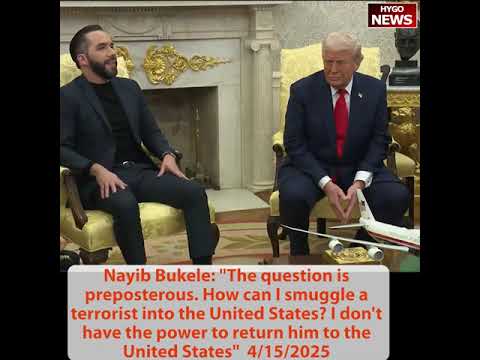
Bukele: “The Question Is Preposterous — How Can I Smuggle a Terrorist Into the US?”; Bondi, Miller School CNN on 9-0 SCOTUS Ruling
A joint press conference between President Trump and El Salvador President Nayib Bukele in April 2025 produced one of the most extraordinary exchanges of the term. When CNN asked about the allegedly mistakenly deported man, Bukele responded: “The question is preposterous. How can I smuggle a terrorist into the United States? I don’t have the power to return him.” AG Pam Bondi explained that “two courts ruled he was a member of MS-13” and that “it’s up to El Salvador if they want to return him.” Deputy Chief of Staff Stephen Miller then delivered a comprehensive legal briefing, noting the Supreme Court’s 9-0 ruling that “no district court has the power to compel the foreign policy function of the United States.”
Bukele: “The Question Is Preposterous”
El Salvador’s President Bukele addressed the question about whether he would facilitate the return of a deported individual with the exasperation of a foreign leader being asked to violate his own sovereignty.
“Well, am I supposed to suggest that I smuggle a terrorist into the United States?” Bukele said. “How can I smuggle? How can I return him to the United States?”
He continued: “If I could, I smuggle him into the United States, or whatever I do — of course, I’m not going to do it.”
Then the definitive statement: “I mean, the question is preposterous. How can I smuggle a terrorist into the United States? I don’t have the power to return him to the United States.”
Bukele’s response was devastating because it exposed the absurdity of the premise. The media was asking whether El Salvador would “return” a deported individual to the United States — but El Salvador had no legal mechanism to send a person to another country without that country’s consent. The individual in question was an El Salvadoran citizen in El Salvador. Sending him to the United States would require, as Bukele pointed out, something resembling smuggling — the very crime the immigration enforcement system was designed to prevent.
Bondi: “Two Courts Ruled He Was MS-13”
AG Pam Bondi provided the legal foundation for the deportation.
“First and foremost, he was illegally in our country,” Bondi said. “He had been illegally in our country. And in 2019, two courts — an immigration court and an appellate immigration court — ruled that he was a member of MS-13 and he was illegally in our country.”
She addressed the procedural issue: “Right now, it was additional paperwork that needed to be done.”
Bondi stated the legal reality: “That’s up to El Salvador if they want to return him. That’s not up to us. The Supreme Court ruled that if El Salvador wants to return him — this is international matters, foreign affairs — if they wanted to return him, we would facilitate it, meaning provide a plane.”
The “two courts” detail was critical. The individual had not been arbitrarily deported by the Trump administration. He had been found by an immigration court to be a member of MS-13 and ordered deported. That order was affirmed on appeal. Two independent judicial bodies had determined he was a gang member and should be removed. The media’s framing of the deportation as a “mistake” obscured the judicial record that supported it.
Miller: The Complete Legal Briefing
Deputy Chief of Staff Stephen Miller then delivered what amounted to a law school lecture aimed at the CNN reporter.
He established the starting point: “He’s a citizen of El Salvador. It’s very arrogant even for American media to suggest that we would even tell El Salvador how to handle their own citizens.”
He cited the judicial record: “Two immigration courts found that he was a member of MS-13. When President Trump declared MS-13 to be a foreign terrorist organization, that meant that he was no longer eligible under federal law — which I’m sure you know, you’re very familiar with the INA — that he was no longer eligible for any form of immigration relief in the United States.”
Miller explained the deportation order: “So he had a deportation order that was valid, which meant that under our law, he’s not even allowed to be present in the United States and had to be returned because of the foreign terrorist designation.”
He described the lower court intervention: “This issue was then by a district court judge completely inverted. And a district court judge tried to tell the administration that they had to kidnap a citizen of El Salvador and fly him back here.”
Miller revealed the Supreme Court outcome: “That issue was raised to the Supreme Court, and the Supreme Court said the district court order was unlawful. And its main components were reversed 9-0 unanimously.”
He stated what the 9-0 ruling held: “Stating clearly that neither the Secretary of State nor the President could be compelled by anybody to forcibly retrieve a citizen of El Salvador from El Salvador — who, again, is a member of MS-13.”
Miller added the practical note: “Which is — I’m sure you understand, and I can promise you, if he was your neighbor, you would move right away.”
Trump interjected: “In the Supreme Court, Steve — was it 9-0?”
“Yes,” Miller confirmed. “It was 9-0.”
“In our favor?”
“In our favor. Against the district court ruling. Saying that no district court has the power to compel the foreign policy function of the United States.”
Miller concluded by explaining what the ruling actually required: “As Pam said, the ruling solely stated that if this individual, at El Salvador’s sole discretion, was sent back to our country, that we could deport him a second time. No version of this legally ends up with him ever living here, because he is a citizen of El Salvador.”
He redirected the questioning: “That is the President of El Salvador. Your questions about it, per the court, can only be directed to him.”
Trump: “That’s Why Nobody Watches You”
Trump addressed the CNN reporter directly after the exchange.
“How long do we have to answer this question from you?” Trump said. “Why don’t you just say, ‘Isn’t it wonderful that we’re keeping criminals out of our country?’ Why can’t you say that? Why do you go over and over?”
He delivered the assessment: “And that’s why nobody watches you anymore. You know, you have no credibility.”
Later, when the reporter attempted another question, Trump shut it down: “Not you.”
He told the room: “Do you have any questions, please? Let’s not start with CNN because they’re so — they’re just so wrong.”
Key Takeaways
- Bukele called the question about returning a deported MS-13 member “preposterous”: “How can I smuggle a terrorist into the United States? I don’t have the power.”
- AG Bondi: “Two courts — an immigration court and appellate court — ruled he was MS-13. It’s up to El Salvador if they want to return him.”
- Miller cited the 9-0 Supreme Court ruling: “No district court has the power to compel the foreign policy function of the United States.”
- The ruling meant only that if El Salvador voluntarily returned the individual, the U.S. would provide a plane — “no version of this legally ends up with him living here.”
- Trump to CNN: “How long do we have to answer this? That’s why nobody watches you anymore.”