 HYGO News
 Economy BETTER THAN EXPECTED; TSMC 'hundreds of jobs open' in Arizona most advanced; Dem Mamdani
Economy BETTER THAN EXPECTED; TSMC “hundreds of jobs open” in Arizona most advanced; Dem Mamdani
Q2 GDP came in at 3.0% — better than expected and the highest level since Q3 2024. Consumer spending up 1.4%, also at the expected range. The U.S. economy continues to confound the pre-tariff predictions that tariffs would drag growth and spike inflation. TSMC’s Arizona semiconductor campus — a $165 billion investment “more than the International Space Station” — has hundreds of jobs open with $50,000 starting salaries and no college degree required. Fab #1 is producing chips now; Fab #2 is being wrapped in yellow under construction for 2028; Fab #3 is breaking ground for “the most advanced semiconductors in the world” by 2030. Rep. Julie Johnson captured the Democratic Party’s struggle with Zohran Mamdani: “We’re a big tent and we’re a party that is inclusive for all the folks … There’s room for all viewpoints” — a framing that normalizes Mamdani’s anti-police, antisemitic, communist-aligned positions within the Democratic coalition.
Q2 GDP: 3.0% Better Than Expected
The economic data. “Up 3% of 3% better than expected. That would be the highest level since the third quarter of 24 when it was up 3.1%.”
Q2 2025 real GDP up 3.0% annualized. That is strong growth. The expected figure had been lower. The actual figure exceeded expectations.
“Highest level since the third quarter of 24 when it was up 3.1%.” Q3 2024 was 3.1%. Current Q2 2025 is 3.0%. Nearly identical. Between them, the intervening quarters (Q4 2024, Q1 2025) apparently had lower readings.
“On the consumption side, up 1.4, very close to estimates. Up 1.4 would be the best since the last quarter of 24.”
Consumer spending up 1.4%, at expectations. That pace is consistent with an economy where households are spending but not dramatically expanding their consumption — suggesting savings rates are being maintained and discretionary spending is stable.
The macroeconomic pattern: strong real GDP growth, contained inflation, stable consumer spending, record markets. Those are the indicators of a healthy expansion. The Trump administration’s policies — tariffs included — are not producing the recession or inflation surge critics predicted.
”Grand Murray, Minnesota”
A brief aside from the report. “I was up in Grand Murray, Minnesota and saw someone walk out of a grocery store, just happened to be walking in. Sorry, look at her receipt, she’s looking down and she’s just no, no.”
That is a reporter observation about a grocery shopper in Minnesota. The shopper walked out looking at her receipt with “no, no” as apparent reaction — suggesting sticker shock at grocery prices despite headline inflation data.
That disconnect — between aggregate inflation data and individual consumer experience — is real. Overall inflation has declined dramatically. But specific categories (certain proteins, fresh produce, select household items) remain elevated from pre-2020 baselines. A family budget that adjusted to earlier low prices still feels the pressure of the higher current prices even when the current inflation rate is low.
Rep. Julie Johnson on “Big Tent”
Rep. Julie Johnson addressing the Mamdani question. “Democrats, we’re a big tent and we’re a party that is inclusive for all the folks. We don’t have to agree on all the issues. My folks, I come from a more moderate area and that’s why they’ve elected me to represent their values and folks that have a more left progressive wing, they may elect somebody different and that is all okay. There’s room for all viewpoints within our party and in our caucus.”
“Big tent … inclusive for all the folks … room for all viewpoints within our party.”
That is the framing Democratic members are using to accommodate Mamdani’s positions within the party. The argument: different districts elect different kinds of Democrats. Some are moderate. Some are progressive. Some are socialist. All coexist under the Democratic umbrella.
The problem with that framing, from the administration’s perspective: the specific positions Mamdani represents — defund-adjacent policing, Palestinian solidarity in terms that include “globalize the intifada” language, government-run grocery stores, sweeping rent freezes, universal bus-fare elimination — are not merely “more left” variants of mainstream Democratic positions. They are qualitatively different positions that challenge the coalition’s ability to appeal to general-election voters.
By including Mamdani in the “big tent,” Democrats associate the entire party with positions that moderate and centrist voters reject. Johnson’s framing is internally consistent for a senator maintaining party unity. It is politically problematic for the party’s broader prospects.
TSMC Arizona
The segment pivoted to TSMC’s Arizona campus. “It’s hard to really convey the size of the TSMC campus on video. These buildings are massive. The property itself stretching some two miles wide. Building is going on everywhere.”
TSMC — Taiwan Semiconductor Manufacturing Company — is the world’s leading semiconductor foundry. Its Arizona facility is the most advanced chip manufacturing site being built outside of Taiwan.
“Inside these clean rooms, humans and machines working together to build the semiconductors that are the brains of phones, computers, the internet, artificial intelligence.”
That is the operational reality. The TSMC Arizona fabs produce the chips that power virtually every computing device. The shift of this production capacity from Taiwan to Arizona is a fundamental change in the U.S. strategic position on semiconductor security.
”$165 Billion Investment”
“It’s a $165 billion investment in Arizona. I always like to make a reference. It’s just a huge amount. You know, I mean the International Space Station was about $150 billion so we’re going to be putting in an investment that’s more than the International Space Station and that’s really, really exciting.”
$165 billion. That is the TSMC investment in Arizona.
The ISS comparison is striking. The International Space Station was a collaborative effort across multiple countries, representing what was previously the benchmark for extraordinary capital deployment. TSMC’s Arizona investment exceeds that benchmark — and it is being made by a single company in a single state.
The investment is the commercial manifestation of the CHIPS Act plus subsequent Trump-era policy emphasis on domestic semiconductor manufacturing. Taiwan-based TSMC, under pressure to diversify its production outside Taiwan given China tensions, chose Arizona as the primary non-Taiwan location.
”Hundreds of Jobs Open”
“Putting up a building is one thing. Filling it with workers is the next challenge. We met these three interns today at TSMC.”
The workforce-development piece. Semiconductor manufacturing requires skilled technicians. Training those technicians at the scale TSMC needs in Arizona is itself a major project.
“We all want to be engineers here someday. This is like my dream company, like my company of all companies and that’s because I’m a double major in mechanical engineering and Chinese.”
That is an intern speaking. “Dream company” — TSMC has achieved the specific cultural positioning that attracts top engineering talent. Mechanical engineering and Chinese as a double major is the unusual combination TSMC specifically values.
Three Fabs
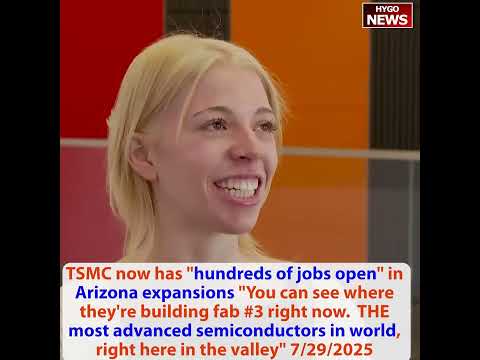
“The growth here is just incredible, not just in jobs in the actual physical growth of this plant itself. This is fab number one. It’s currently making chips. Right here you can see fab number two kind of wrapped in yellow under construction. That will start making chips in 2028. And right here you can see where they’re building fab three right now. When that’s done, about 2030 it will make the most advanced semiconductors in the world, right here in the valley.”
Three fabs. Fab #1 operational now. Fab #2 under construction for 2028. Fab #3 under construction for 2030 — producing “the most advanced semiconductors in the world.”
That is the roadmap. In five years, the U.S. will have domestic production of the most advanced chips. The strategic vulnerability — total dependence on Taiwanese chip production for cutting-edge semiconductors — will be substantially reduced.
“Looking outside right now, you see the growth happening just all around you."
"$50,000 a Year”
“But you don’t need a college degree to find that growth. TSMC says they have hundreds of jobs open right now to be technicians here. A high school diploma is all this needed to apply. No experience is necessary. They will train you in a number of different roles. The starting salary reportedly about $50,000 a year with full benefits.”
That is the workforce message. High school diploma. No experience required. $50,000 starting salary with benefits. TSMC hires and trains the technicians.
$50,000/year starting is significantly above median for entry-level positions without college degrees. For young Arizonans who have not pursued four-year college, TSMC represents a direct pathway to middle-class compensation.
“We focus locally for hiring our technicians. They don’t need a four year degree. We do have many different types of technicians available. I mean I looked last week, I think we had 100 different types of technicians available.”
“100 different types of technicians.” That is the specialization granularity. TSMC’s fabs require dozens of distinct technical roles — lithography, etching, doping, packaging, quality control, maintenance, facility operations, chemical handling. Each role is a specific trained specialty.
“But you’re hiring right now? We’re hiring right now.”
The Economic Case
The pattern across the segment: strong GDP growth, confirmed industrial investment at scale, job opportunities that do not require college degrees, and specific regional development. That is the administration’s economic case made concrete.
The Arizona investment is not theoretical. The fabs are being built. The technicians are being hired. The chips are being produced. The $165 billion is being deployed.
Whether every major tariff-driven reshoring announcement converts to actual operational results at this scale is the question the coming years will answer. TSMC Arizona is one of the largest data points on the positive side of that ledger.
Key Takeaways
- Q2 2025 GDP grew at 3.0% — better than expected, highest since Q3 2024 — with consumer spending up 1.4% at expectations.
- Rep. Julie Johnson characterized Democratic coalition as “big tent” that accommodates Mamdani: “There’s room for all viewpoints within our party and in our caucus.”
- TSMC’s Arizona campus is a $165 billion investment — “more than the International Space Station was” — two miles wide, with three fabs planned.
- Fab #1 producing chips now; Fab #2 opening 2028; Fab #3 completing 2030 to make “the most advanced semiconductors in the world.”
- TSMC Arizona has “hundreds of jobs open” — no college degree required, $50,000 starting salary with benefits, training provided for “100 different types of technicians.”