 HYGO News
 CEA Chairman Miran: 'Today's Data Prove Tariffs Work -- Investment Surged 22%'; DOGE: Postal Service Lost $9.5B; 'Only 10-15 Cents on the Dollar' Reaches Recipients
CEA Chairman Miran: “Today’s Data Prove Tariffs Work — Investment Surged 22%”; DOGE: Postal Service Lost $9.5B; “Only 10-15 Cents on the Dollar” Reaches Recipients
Council of Economic Advisors Chairman Steve Miran presented the economic case for tariffs in May 2025: “They were wrong about tariffs in Trump’s first term — they left no lasting mark but generated tons of revenue. They’re wrong again now. Today’s data prove it. Investment surged 22% — that’s not what firms do when they’re concerned. That’s what firms do when they’re going to produce more.” He noted “construction jobs added every month of Trump’s term, totally disproving the doomongering.” DOGE revealed the Postal Service had lost $9.5 billion last year and hadn’t balanced its budget since 2007. On foreign aid: the Inter-American Foundation spent $50M annually on “alpaca farming in Peru and peas in Guatemala” — but only 58% reached grantees, and the GAO estimated “only 10-15 cents on the dollar actually gets to the end recipient."
"Today’s Data Prove It”
Miran dismantled the anti-tariff arguments with specific data.
“I don’t think they were right about tariffs in President Trump’s first term, in which the tariffs left no lasting mark on the economy but generated tons of revenue that we used to help finance the president’s first historic tax cuts from 2017,” Miran said.
He assessed the current moment: “I think they’re wrong again now. Today’s data prove it. Today’s data reflect the period after the president’s announcement.”
He cited investment: “If you look at the GDP data from the first quarter, investment surged 22%. That’s not what firms do when they’re concerned about the economy. That’s not what firms do when they’re reducing their output. That’s what firms do when they’re going to produce more.”
He addressed the immigration-jobs argument: “We’ve heard lots of complaints that enforcing border security and deporting illegal migrants was going to destroy job creation and create labor scarcity. Today’s data disprove it.”
He cited specifics: “We added 11,000 construction jobs. We’ve added construction jobs every month in a row during President Trump’s term, totally disproving the panic and doomongering.”
Miran’s argument was built on two pillars. First, historical precedent: Trump’s first-term tariffs had not caused the inflation, recession, or job losses that critics predicted. They had generated revenue without lasting economic damage. Second, current data: the jobs report and investment figures from the post-Liberation Day period showed an economy that was accelerating, not contracting.
The construction jobs detail was particularly effective against the deportation-causes-labor-shortage argument. Critics had claimed that deporting illegal immigrants would devastate the construction industry, which relied heavily on immigrant labor. Instead, construction jobs had increased every month — suggesting either that the industry was adapting or that the supposed dependence on illegal labor had been overstated.
Postal Service: 18 Years of Losses
The DOGE briefing turned to the United States Postal Service.
“There’s actually a law that says the Post Office is supposed to have a balanced budget,” a DOGE team member said.
Musk reacted: “There is? I didn’t know that.”
“Well, that’s not working, is it?”
“No, it’s not. So they’re breaking the law?”
“Basically, since 2007, almost every year, they’ve lost money.”
“Last year, they lost $9.5 billion.”
“Wow. Serious money.”
The team member described the problem: “Additional regulation in 2007 essentially crippled them, put them down a path where they’re stuck in the past and bleeding money.”
The Postal Service’s $9.5 billion annual loss — in a year when it was legally required to break even — was one of the largest financial failures in the federal government. The USPS had been losing money for 18 consecutive years, accumulating losses that exceeded $100 billion over that period.
The 2007 regulation the team member referenced was the Postal Accountability and Enhancement Act, which required the USPS to pre-fund retiree health benefits decades in advance — a requirement imposed on no other federal agency. While this accounted for a portion of the losses, the fundamental problem was that the USPS was operating a 20th-century delivery model in a 21st-century economy, with volumes declining as digital communication replaced physical mail.
”Alpaca Farming in Peru”
The Inter-American Foundation segment produced DOGE’s most quotable foreign aid examples.
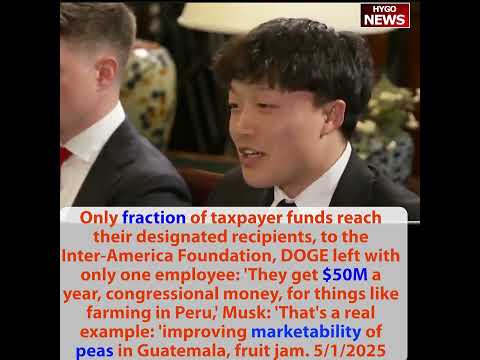
“They get $50 million a year, congressional money, for things like alpaca farming in Peru,” a DOGE team member said.
Musk confirmed: “That’s a real example.”
The team member continued: “Improving the marketability of peas in Guatemala. Fruit jam.”
He described the efficiency problem: “In the private sector, you’d expect a nonprofit to give 80 to 90% of their money to grantees. In the case of IAF, that was 58%. So the other half goes towards management, travel.”
Musk added the devastating detail: “Even if you agreed with supporting alpaca farmers in Peru, actually most of the money never made it out of D.C. It’s going into the pockets of people in the neighborhood.”
The team member cited official estimates: “The GAO estimate — not our estimate — was only 10 to 15 cents on the dollar actually gets to the end recipient, whether you agree with that cause or not.”
He described the structure: “There’s the first layer of stealing, second layer of stealing, third layer of stealing. Contractor, subcontractor, subcontractor. It’s like peeling an onion. And sometimes it’s zero — you get to the bottom of the onion, there’s nothing there.”
The “10-15 cents on the dollar” figure from the Government Accountability Office was the most damning statistic in the foreign aid debate. It meant that for every dollar Congress appropriated for foreign assistance, 85-90 cents was consumed by contractors, subcontractors, administrators, and intermediaries before any benefit reached the intended recipients. The alpaca farmers in Peru — assuming they existed and actually received anything — were getting pennies of every dollar allocated to help them.
Key Takeaways
- CEA Chairman Miran: “Today’s data prove tariffs work. Investment surged 22% — that’s what firms do when they’re going to produce more. Construction jobs added every month.”
- He debunked two narratives: tariffs don’t cause recession (first-term proof) and deportations don’t cause labor shortages (construction jobs rising).
- DOGE: Postal Service lost $9.5 billion last year — hasn’t balanced its budget since 2007, despite being legally required to.
- Inter-American Foundation: $50M/year for “alpaca farming in Peru, peas in Guatemala” — only 58% reaches grantees. GAO: “10-15 cents on the dollar reaches end recipients.”
- Musk: “Even if you support alpaca farmers, most money never left D.C. Contractor, subcontractor, subcontractor — sometimes nothing at the bottom.”