 HYGO News
 DOOCY: no client list? AG on her desk? Press Sec: all paper; Temporary Protected Status=temporary
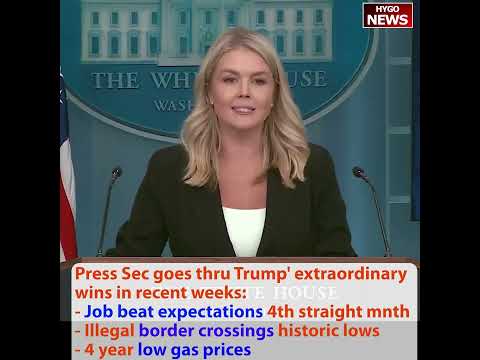
DOOCY: no client list? AG on her desk? Press Sec: all paper; Temporary Protected Status=temporary
Fox News correspondent Peter Doocy pressed Press Secretary Karoline Leavitt on the Jeffrey Epstein client list question — specifically, what happened to the list that Attorney General Pam Bondi had said was on her desk. The Department of Justice had then released a systematic review finding “no incriminating client list.” Leavitt’s response explained that Bondi was referring to the entirety of Epstein-related paperwork, not a specific client list. Leavitt then pivoted to explaining the administration’s end of Temporary Protected Status for Nicaraguans and Hondurans, noting that the program was never intended to be a permanent residency pathway. She closed with the accomplishment catalogue of the past three weeks, running through the bill passage, record low border crossings, Supreme Court rulings, NATO 5%, Operation Midnight Hammer, the Israel-Iran ceasefire, the Rwanda-Congo peace, the Pakistani Nobel Peace Prize nomination, and the blue-collar wage growth hitting its largest increase in nearly 60 years.
Doocy’s Epstein Question
Peter Doocy opened the exchange. “According to the report, this systematic review revealed no incriminating client list. So what happened to the Epstein client list that the Attorney General said she had on her desk?”
The context is the Jeffrey Epstein case — the deceased financier whose convictions for sex trafficking of minors produced substantial public interest in who else might have been involved with his operation. Various documents, accusers, and witnesses had produced speculation about specific prominent individuals who might appear on a hypothetical client list.
Attorney General Bondi, in an earlier Fox News interview, had said she had the Epstein client list on her desk for review. That statement generated expectation that a client list would eventually be released.
The DOJ’s subsequent systematic review, by contrast, found “no incriminating client list.” The apparent contradiction — Bondi saying the list was on her desk, DOJ finding no such list existed — is what Doocy is asking about.
Leavitt’s Response
Leavitt’s initial framing. “Well, I think if you go back and look at what the Attorney General said in that interview, which was on your network, on Fox News, go ahead.”
Leavitt is inviting Doocy to quote Bondi’s exact words. The framing is important because Doocy’s question paraphrases Bondi’s statement. The exact words may matter for the reconciliation between Bondi’s claim and the DOJ’s subsequent findings.
The Exact Quote
Doocy had the quote. “John Roberts said, DOJ may be releasing the list of Jeffrey Epstein’s clients. Will that really happen? And she said, it’s sitting on my desk right now to review.”
The exact exchange is revealing. John Roberts asked whether DOJ would release the client list. Bondi said “it’s sitting on my desk right now to review.” The word “it” in Bondi’s statement is ambiguous — it could refer to the client list specifically, or it could refer to the broader paperwork Roberts had referenced.
”Yes, She Was Saying The Entirety”
Leavitt’s reconciliation. “Yes, she was saying the entirety of all of the paperwork, all of the paper in relation to Jeffrey Epstein’s crimes. That’s what the Attorney General was referring to, and I’ll let her speak for that.”
Leavitt’s interpretation is that Bondi’s reference was to all Epstein-related paperwork, not specifically to a client list. The paperwork — investigative files, grand jury materials, witness statements, and various other documentation — was on her desk. From that complete body of materials, the DOJ conducted a systematic review.
The systematic review found no incriminating client list. That finding does not contradict Bondi’s earlier statement if her “it” referred to the complete paperwork rather than to a specific list.
Why The Distinction Matters
The distinction between “a client list” and “the paperwork” matters politically. Many Americans have been watching the Epstein situation with specific interest in who might appear on a client list. The possibility of such a list emerging had driven speculation, generated ongoing media interest, and shaped expectations about the administration’s handling of the case.
If no client list actually exists — as the systematic review found — those expectations were built on an inaccurate premise. Bondi’s “it’s on my desk” statement was interpreted as confirmation of a list’s existence. Leavitt’s reinterpretation is that Bondi never actually confirmed a specific list.
Whether the reinterpretation survives scrutiny depends on how Bondi’s exact words are parsed. The ambiguity in “it” allows multiple interpretations. Leavitt is defending the interpretation most favorable to the administration.
”Committed To Putting Bad People Behind Bars”
Leavitt then broadened the framing. “But again, when it comes to the FBI and the Department of Justice, they are more than committed to ensuring that bad people are put behind bars. This Attorney General and the FBI director are committed to putting bad people behind bars where they belong, that they promised an exhaustive review. That’s what they did.”
The framing shifts from the specific client list question to the broader administration commitment. The DOJ is committed to prosecuting actual crimes. The FBI is committed to investigating actual perpetrators. The systematic review was what the administration had promised — exhaustive, thorough, fair.
“Any further details, I would refer you to the Department of Justice” is the procedural handoff. Leavitt is not the appropriate source for detailed questions about specific investigative findings. Those questions belong with the DOJ directly.
TPS For Nicaragua And Honduras
Leavitt then pivoted to a separate topic. “They did end temporary protective status for Nicaraguans and Hondurans in this country because TPS, temporary protective status, is temporary by definition. It is not meant to be a permanent path to residency or citizenship here in the United States of America.”
The specific action is the administration’s end of TPS for Nicaraguans and Hondurans who had been in the United States under temporary protection. TPS is a formal immigration status that allows individuals from specific countries to remain in the United States when conditions in their home countries make return dangerous.
The status is explicitly temporary. When conditions in the home country improve, TPS is supposed to end. Individuals with TPS are supposed to either return to their home country or find a legal pathway to permanent residency.
”Since 1999”
Leavitt noted the specific history. “It was originally granted to Nicaraguans following a natural disaster in 1999. That doesn’t sound very temporary to me, and as well as Hondurans in 1999 after the impact of Hurricane Mitch in 1998.”
The TPS for these countries had been granted in 1999 following Hurricane Mitch, which had devastated Honduras and Nicaragua in late 1998. The grant was intended to give citizens of those countries time to return home when their home conditions allowed it.
“That doesn’t sound very temporary to me” captures the administration’s framing. 26 years is not temporary. Whatever conditions justified the original grant have presumably been addressed in 26 years of time. The continuing extension of TPS for these populations effectively turned a temporary status into a permanent residency pathway.
”Never Meant To Be Permanent”
Leavitt closed the TPS explanation. “And so this administration is doing what it promised to do. If individuals from these countries want to come here, they have a legal pathway to do it, but temporary protective status was never meant to be permanent. The previous administration abused this status and this parole program, essentially treating it as such, and we’re not going to tolerate that any further.”
The framing characterizes prior administration practice as abuse. Rather than managing TPS as an actually temporary status, prior administrations had extended it repeatedly, effectively creating permanent residency for populations that statute had not authorized for permanent status.
The Trump administration’s end of the TPS grants returns the statute to its original intent. Individuals from Nicaragua and Honduras who want to remain in the United States need to pursue legal pathways — family-based immigration, employment-based immigration, or asylum claims. The TPS pathway, which was never supposed to be a permanent route, is being closed.
The Three-Week Accomplishment Catalogue
Leavitt then ran through the expanded accomplishment list covering the past three weeks. “For the fourth month in a row, jobs numbers beat market expectations with nearly 150,000 good jobs created in the month of June. The American economy has now added nearly 700,000 jobs since January 2025.”
700,000 jobs added since January 2025 captures the cumulative employment growth under the second Trump administration. That figure represents sustained job creation across the first six months of the term.
“With American-born workers accounting for all job gains” is a specific distributional observation. The job growth has flowed to American-born workers. That framing contrasts with prior periods when foreign-born workers had been the primary beneficiaries of job growth.
Border Crossings At “Another Historic Low”
Leavitt continued. “President Trump drove illegal border crossings to another historic low in the month of June, and Border Patrol once again released zero illegal aliens into our country.”
Historic low border crossings in consecutive months. Zero Border Patrol releases. The operational outcomes on the border continue to exceed what any prior administration had achieved.
“Zero illegal aliens” is the specific operational outcome. Prior administrations had routinely released illegal entrants into the country pending immigration proceedings — the “catch and release” pattern that had contributed to the backlog in immigration courts. The current administration’s policy is to detain individuals pending removal rather than release them.
The Supreme Court Rulings
Leavitt included the judicial developments. “The Supreme Court stopped activist judges from imposing nationwide injunctions and cleared the way for President Trump to carry out his popular and common sense agenda.”
The nationwide injunctions ruling continues to be the signature judicial outcome. “Cleared the way for President Trump to carry out his popular and common sense agenda” is Leavitt’s characterization of the ruling’s political effect. The administration can now implement policies that had been blocked by single-judge injunctions.
UPenn Title IX
Leavitt noted the UPenn outcome. “The University of Pennsylvania agreed to all of the Trump administration’s demands and will now keep men out of women’s sports.”
“All of the Trump administration’s demands” is the comprehensive framing. UPenn did not partially comply — it agreed to every demand. Men will be excluded from women’s sports. Records will be corrected. The specific framework the administration had sought is now in place at Penn.
Vietnam Trade
Leavitt included the trade deal. “President Trump secured a trade deal with Vietnam, giving the United States total access to their markets.”
“Total access” to Vietnamese markets is substantial. American companies can now compete in Vietnam on terms that were previously restricted. That access opens opportunities across multiple sectors — technology, agriculture, manufacturing, services.
Gas Prices
Leavitt highlighted the energy outcomes. “Because of President Trump’s unleashing American energy dominance, gas prices are at four-year lows, and when adjusted for inflation, gas prices are near the lowest levels we’ve seen in the last 20 years.”
The inflation-adjusted comparison is important. Nominal gas prices can be compared across years only if inflation is accounted for. On an inflation-adjusted basis, current gas prices are near 20-year lows. That is a substantial achievement by historical standards.
“Unleashing American energy dominance” is the claimed mechanism. Increased American energy production, through reduced regulatory constraints and expanded leasing, has produced the supply that keeps prices low.
NATO 5%
The NATO commitment. “NATO members agreed to raise defense spending to 5 percent of GDP of foreign policy feats, long thought impossible until President Trump made it happen.”
The 5% commitment is the kind of diplomatic achievement that most observers would not have predicted. The fact that it occurred represents Trump’s specific capacity to produce outcomes that mainstream foreign policy analysis had considered unachievable.
”Operation Midnight Hammer”
Leavitt named the Iran operation. “The Operation Midnight Hammer obliterated Iran’s nuclear capabilities, taking out this imminent national security threat not just to the United States, but to the entire world.”
The specific operation name — Operation Midnight Hammer — has become the official military designation. The operation obliterated Iranian nuclear capabilities. The threat was, in Leavitt’s framing, imminent to not just the United States but to the entire world. That framing places the operation in the category of actions that served global rather than merely national interests.
Israel-Iran Ceasefire
Leavitt noted the diplomatic outcome. “The President secured a ceasefire between Israel and Iran, ending the 12-day war.”
“The 12 Day War” is the administration’s preferred naming for the June conflict. The naming positions the event in the historical tradition of the 1967 Six-Day War — a compressed conflict that produced transformational regional outcomes.
The Rwanda-Congo Peace
Leavitt included the African diplomatic achievement. “The President brokered a historic peace agreement between Rwanda and the Democratic Republic of Congo.”
“Historic” is the correct characterization. A three-decade conflict resolved through American mediation is an unusual diplomatic outcome.
The Pakistani Nobel Nomination
Leavitt delivered news that had not been previously widely reported. “Pakistan nominated President Trump for the Nobel Peace Prize in recognition of his decisive diplomatic intervention to prevent a nuclear war between India and Pakistan.”
Pakistan’s nomination of Trump for the Nobel Peace Prize is a formal diplomatic gesture. It acknowledges American mediation in preventing what might have escalated into nuclear confrontation between India and Pakistan.
Whether the Nobel Committee awards Trump the prize is a separate question. But the nomination itself is on the record. Combined with the Congolese Tshisekedi’s planned nomination that the Congolese reporter had referenced earlier, Trump has now received multiple Nobel Peace Prize nominations from heads of state of affected countries.
Blue-Collar Wage Growth
Leavitt closed with the economic outcome that matters most for the administration’s working-class coalition. “Blue-collar wage growth has seen its largest increase in nearly 60 years, and President Trump has defeated Joe Biden’s inflation crisis with core inflation at the lowest level since March of 2021.”
“Largest increase in nearly 60 years” is an extraordinary historical claim. If accurate, blue-collar wage growth under the Trump administration’s policies is the best in six decades. That outcome directly validates the administration’s economic policy framework.
“Core inflation at the lowest level since March 2021” captures the inflation moderation. The Biden-era inflation crisis has, according to the administration, been defeated. Americans are seeing cost of living stability that they had not experienced during the previous four years.
”Just About All Of That Has Happened In The Last Three Weeks”
Leavitt’s timeline framing. “And just about all of that has happened in the last three weeks, and I know you all know it because you’ve been very busy here covering it along with us.”
The three-week compression is the political framing. Each individual accomplishment would be a significant week on its own. The compression into three weeks reflects the administration’s claim that it is operating at extraordinary tempo.
“You’ve been very busy here covering it along with us” is the acknowledgment to the press corps. The reporters in the briefing room have been documenting the administration’s activity continuously. The compression of activity is not a political claim they are being asked to accept — it is what they have been covering.
The Integration Across Domains
The accomplishment catalogue integrates across multiple policy domains. Economic policy (jobs, wages, inflation, gas prices). Foreign policy (Iran, Ukraine indirect, Rwanda-Congo, India-Pakistan). Domestic policy (border, Title IX, TPS, Epstein investigation handling). Judicial developments (Supreme Court rulings). Trade policy (Vietnam, tariff letters). Cultural policy (University of Pennsylvania women’s sports).
Each domain is producing specific outcomes. The cumulative effect is an administration operating effectively across the full range of presidential responsibilities.
Key Takeaways
- Leavitt on the Epstein client list: Bondi’s “on my desk” referred to “the entirety of all of the paperwork, all of the paper in relation to Jeffrey Epstein’s crimes” — the DOJ’s systematic review found no incriminating client list.
- On TPS for Nicaragua and Honduras: “Temporary Protected Status — is temporary, by definition…originally granted to Nicaraguans following a natural disaster in 1999. That doesn’t sound very temporary to me.”
- The three-week accomplishment catalogue: 150,000 new jobs in June, 700,000 jobs since January, border crossings at historic lows, Supreme Court rulings, UPenn Title IX agreement, Vietnam trade deal, gas prices at 4-year lows, NATO 5% commitment, Operation Midnight Hammer, Israel-Iran ceasefire, Rwanda-Congo peace, Pakistani Nobel Peace Prize nomination, blue-collar wage growth at 60-year high, core inflation at the lowest level since March 2021.
- The Pakistani nomination: “Pakistan nominated President Trump for the Nobel Peace Prize in recognition of his decisive diplomatic intervention to prevent a nuclear war between India and Pakistan.”
- Blue-collar wage growth “has seen its largest increase in nearly 60 years.”