 HYGO News
 Don't Worry 3 steps: no inflation, inflation transitory, inflation is good
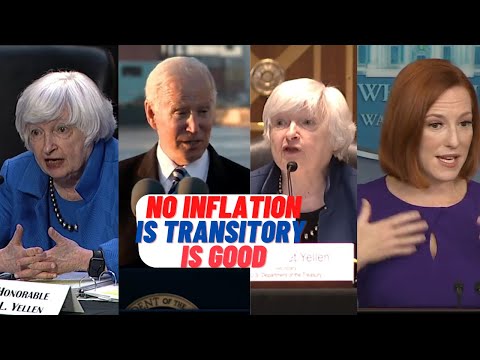
Don’t Worry, Three Steps: No Inflation, Inflation Is Transitory, Inflation Is Good
This video compilation from November 2021 documents the Biden administration’s evolving messaging on inflation through three distinct phases: first denying it was happening, then calling it transitory, and finally suggesting it was actually a positive sign of economic recovery. The compilation juxtaposes administration officials’ reassurances with warnings from former Obama/Clinton Treasury Secretary Larry Summers, Fed Chair Jerome Powell’s admission that inflation was “not at all consistent with price stability,” and other contradictions including the Pentagon saying climate change was “equally” as important as the China threat, climate czar John Kerry predicting no coal plants by 2030, and Secretary Blinken urging U.S. companies not to invest in China.
Step One: “No Inflation”
The compilation opens with the earliest phase of the administration’s messaging, when officials either denied inflation was occurring or minimized its significance. Biden himself said at the time: “There’s nobody suggesting there’s unchecked inflation on the way. No serious economists.”
The White House pressed secretary argued that “most of the price increases we’ve seen were expected and expected to be temporary.” The framing presented rising prices as a predictable and manageable byproduct of the pandemic recovery rather than a systemic economic problem.
Treasury Secretary Janet Yellen contributed to the early dismissals. When Senator Kennedy asked her in June 2021 where she expected inflation to be at year’s end, she said she believed it would come down “toward 2%.” When pressed, she revised upward: “Probably closer to 4%.”
The administration’s own budget forecast had projected 2% inflation for 2021. As Summers would later point out, actual inflation was “likely to come in three times that.”
Step Two: “Inflation Is Transitory”
As price increases became impossible to deny, the messaging shifted from “no inflation” to “transitory inflation.” Officials insisted the price increases were temporary disruptions caused by supply chain bottlenecks and pent-up demand that would resolve as the economy normalized.
Fed Chair Powell initially supported this framing but eventually acknowledged its limitations. In testimony captured in the video, Powell made a significant concession: “The level of inflation we have right now is not at all consistent with price stability.” He added: “By the way, we’re also not at maximum employment.”
Yellen echoed the transitory line when asked when inflation would return to the 2% normal range: “I expect improvement by the middle to end of next year. Second half of next year.” The timeline kept moving further out — from late 2021 to early 2022 to the “second half” of 2022 — as each previous prediction was overtaken by reality.
The White House also repeatedly cited the claim that Build Back Better was “not going to cost anything.” As one official stated: “Build Back Better is not going to cost anything for the American taxpayer.” This assertion existed alongside acknowledgments that “things costing more is a big deal” and that reducing costs was “one of our highest priorities.”
Step Three: “Inflation Is Good”
The most striking phase of the messaging evolution came when administration officials began reframing inflation as evidence of a healthy economy. One official characterized the tight labor market as positive: “Many people across the country feel this is a good time to change jobs, right? To look for a more competitive job. What I’m saying is ultimately that’s a good thing.”
When a reporter asked whether the White House viewed the situation “as a problem at all,” the official responded: “Absolutely not, because I think we’re dominating the economy.”
The framing attempted to recast worker shortages and labor market disruptions as evidence of worker empowerment rather than economic dysfunction. Critics argued this was the final step in a pattern: when you can no longer deny something is happening or claim it’s temporary, declare it was the plan all along.
Larry Summers: “Behind the Curve”
Former Treasury Secretary Larry Summers provided the sharpest counterpoint to the administration’s messaging throughout the compilation. Summers, who had served under both Obama and Clinton, offered a specific and detailed critique.
“The administration’s budget and the administration’s forecast with this stimulus was that this year we’d have 2% inflation. And it’s likely to come in three times that,” Summers said. He identified the root cause: “I think they’re just not recognizing just how much demand is being created by the tremendous wall of money, 15% of GDP in one year that they released last spring.”
Summers described the self-reinforcing nature of the problem: “The thing about inflation is you start chasing your tail. Rising inflation of inputs leads firms to raise their prices, that leads other firms to raise their prices, and the whole thing spirals.”
His verdict on the administration’s performance was damning: “I think that the policymakers in Washington unfortunately have almost every month been behind the curve. They said it was transitory. It doesn’t look so transitory. They said it was due to a few specific factors. It doesn’t look to be a few specific factors.”
Summers predicted the crisis would deepen: “I think the odds are that we’re going to have inflation of a kind we haven’t seen in 30 years until either the Fed takes some significant move with respect to monetary policy or until there’s some kind of accident.”
Climate, China, and Kerry’s Coal Prediction
The compilation also captured several other notable statements. Pentagon spokesman John Kirby was asked whether the administration considered the climate crisis or China the greater threat. His answer: “Both are equally important.”
Climate czar John Kerry made a specific prediction: “By 2030 in the United States, we will not have coal plants.” The statement reflected the administration’s aggressive climate timeline, which critics argued was driving up energy costs by signaling to fossil fuel producers that investment in new capacity would not be rewarded.
Secretary of State Blinken addressed U.S. companies doing business in China: “What I’m hearing again from company after company in the United States and around the world is a clear focus on making sure they’re not providing technology to China.” But when asked whether companies had “an obligation to speak out in a place like China,” Blinken deferred: “I’ll let businesses decide for themselves how they want to approach these issues.”
A climate advisor made one of the compilation’s most remarked-upon statements about the energy transition: “Troubled industries and firms that are in transitioning — and here what I’m thinking about is primarily coal industry and oil and gas industry — a lot of the smaller players in that industry are going to probably go bankrupt in short order. At least we want them to go bankrupt if we want to tackle climate change, right?”
Key Takeaways
- The compilation documented three phases of administration inflation messaging: denying it existed, calling it transitory, and reframing it as a positive sign of economic recovery, while Treasury Secretary Yellen’s year-end prediction moved from 2% to 4% and actual inflation ran at three times the administration’s original forecast.
- Former Obama/Clinton Treasury Secretary Larry Summers warned of “inflation of a kind we haven’t seen in 30 years” driven by a “wall of money” equal to 15% of GDP, saying policymakers had been “behind the curve” at every step and that the problem would persist until the Fed took “significant” action.
- The Pentagon called climate change “equally important” to the China threat, John Kerry predicted the U.S. would have no coal plants by 2030, and a climate advisor said the administration wanted smaller oil and gas companies to “go bankrupt” to tackle climate change — while gas prices continued to surge.