 HYGO News
 Leavitt Brings the DOGE Receipts: DEI Contracts, Climate Spending in Sri Lanka, and the $59M Migrant Hotel
Leavitt Brings the DOGE Receipts: DEI Contracts, Climate Spending in Sri Lanka, and the $59M Migrant Hotel
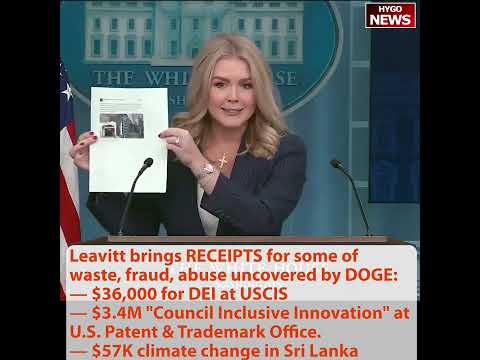
White House Press Secretary Karoline Leavitt used a February 2025 briefing to present physical screenshots of federal contracts that DOGE had identified as wasteful, including a $36,000 DEI contract at U.S. Citizenship and Immigration Services, a $3.4 million “Council for Inclusive Innovation” at the U.S. Patent and Trademark Office, and $57,000 for a climate change program in Sri Lanka. Leavitt also forcefully rejected the suggestion that Elon Musk had assumed “powers of the presidency,” warned that federal bureaucrats who obstructed Trump’s agenda would “be held accountable,” and drew a sharp contrast between $59 million spent on a migrant hotel and Americans in North Carolina and California who had not yet received FEMA disaster funding.
”I Love to Bring the Receipts”
Leavitt arrived at the podium with physical evidence in hand, making good on her promise of transparency about DOGE’s findings. “As for the actual receipts, we are happy to provide them, and I actually brought some today because all of you know I love to bring the receipts,” Leavitt told the press corps. “We have contracts upon contracts that we can send and provide this information to you. Let me be very clear, we are not trying to hide anything. We have been incredibly transparent, and we will continue to be.”
She then held up screenshots of federal contracts that DOGE had flagged during its review of agency spending. “These are screenshots of contracts that DOGE found across our government,” Leavitt said, walking reporters through several examples.
The first was a $36,000 DEI contract at U.S. Citizenship and Immigration Services. “This is a DEI contract, $36,000 for U.S. Citizenship and Immigration Services,” Leavitt said. “That is against the president’s policies in his America First agenda.”
The second was significantly larger: “This is a $3.4 million contract, a Council for Inclusive Innovation at the U.S. Patent and Trademark Office, Department of Commerce, another DEI contract that DOGE identified.”
The third drew the most pointed commentary from Leavitt: “Oh, I love this one. $57,000 for climate change in Sri Lanka. What is this doing to continue the interests of the American people? Absolutely nothing.”
The specific dollar amounts and agency names gave the briefing a level of granularity that made the abstractions of “waste, fraud, and abuse” concrete. Each contract represented real taxpayer money flowing to programs that the administration argued served no American interest.
The DOGE Daily Report and Federal Retirement System
Leavitt also revealed that the White House was producing a daily report on DOGE findings. “I also have a DOGE Daily Report, if anybody would like it, on all of the things that they are identifying and finding,” she said. “We’re happy to provide this information to you. We’re talking about it every single day.”
She highlighted one discovery that had drawn significant attention the day before, when Musk discussed it with Trump in the Oval Office: the federal employee retirement system was being processed from a mine, believed to be in Pennsylvania. “Did anybody know this was even happening in our country before Elon Musk talked about it in the Oval Office yesterday?” Leavitt asked. “A lot of Americans didn’t. So we are providing transparency and accessibility on a daily basis when it comes to DOGE.”
The detail about the retirement system being processed from a mine underscored one of DOGE’s central findings: that federal operations were often conducted using outdated systems and processes that had accumulated over decades without review. The discovery that a major government payment system was operating out of a physical mine location struck many Americans as emblematic of a federal bureaucracy that had not modernized in step with the rest of the economy.
”Does Elon Musk Have Powers of the Presidency?”
The briefing’s most contentious exchange came when a reporter asked Leavitt directly whether Musk had assumed presidential powers. The question reflected a narrative that Democrats and some media outlets had been building for weeks, with figures like Representative Jamie Raskin calling for Musk’s impeachment and critics dubbing him “President Musk.”
Leavitt’s response was immediate and sharp: “Absolutely not. That’s a ridiculous question.”
She then addressed the political dynamics driving the criticism. “Elon Musk addressed this in the Oval Office yesterday. The president addressed it as well. Elon Musk is serving at the pleasure of the president, just like everybody else on this team. He takes directives directly from the president of the United States.”
Leavitt characterized the narrative as a deliberate strategy: “I think some of the comments that you referred to are nothing more than a failed attempt from the media and from Democrats to try to sow division in this White House. We saw them do it in the first term. We’re not going to let them do it in the second term. This is a unified team who is working at the pleasure of the president to do what’s right for the American people.”
The exchange illustrated a pattern that had developed in the early weeks of Trump’s second term: critics framed DOGE’s activities as a constitutional crisis driven by Musk’s personal ambitions, while the administration framed them as an audit function operating under direct presidential authority. Leavitt’s firm dismissal of the premise was designed to shut down the “President Musk” narrative before it gained further traction.
Federal Bureaucrats “Will Be Held Accountable”
When asked what message the administration was sending to federal employees who might consider resisting the president’s agenda, Leavitt’s answer was unambiguous: “They will be held accountable.”
She framed the accountability question in democratic terms. “The president is signing executive orders daily, and he expects all officials across the administration, regardless if they are a political appointee or if they are a career bureaucrat, to adhere to the will of the American people and the 77 million Americans who reelected President Trump,” Leavitt said. “He’s here for a reason, and he is focused every day on implementing his administration’s goals.”
The warning was directed at what the administration characterized as a pattern of resistance from career officials within federal agencies. Multiple reports had described DOGE encountering pushback from agency personnel who refused to cooperate with information requests or who slow-walked responses. Leavitt’s statement put those employees on notice that the administration would not tolerate obstruction.
The $59 Million Migrant Hotel vs. FEMA
Leavitt saved her sharpest contrast for the end of the exchange, connecting wasteful spending to Americans who had been directly harmed by natural disasters.
“Sending $59 million to a migrant hotel to house illegal immigrants when there are still people in North Carolina and California who have not received FEMA funding is not something that this administration is going to tolerate,” Leavitt said.
The statement was politically devastating because it drew a direct line between two expenditures: money flowing to house illegal immigrants in a hotel, and money that was not flowing to American disaster victims. The juxtaposition forced a comparison that was difficult for critics to defend. Whether the $59 million migrant hotel and the FEMA shortfalls were legally connected was beside the point — the moral contrast between the two spending decisions was the argument, and it was one that resonated with the public.
The FEMA reference also tied into a broader narrative about federal spending priorities under the Biden administration. Both the North Carolina hurricane response and the California wildfire response had been criticized for slow and inadequate federal assistance, even as billions of dollars flowed to programs for migrants and overseas initiatives. Leavitt’s framing presented the DOGE effort not merely as a cost-cutting exercise but as a reordering of priorities to put American citizens first.
Key Takeaways
- Press Secretary Karoline Leavitt presented physical screenshots of wasteful federal contracts identified by DOGE, including $36,000 for DEI at USCIS, $3.4 million for a “Council for Inclusive Innovation” at the Patent and Trademark Office, and $57,000 for climate change in Sri Lanka.
- Leavitt rejected the claim that Elon Musk had assumed presidential powers as “a ridiculous question” and “a failed attempt from the media and from Democrats to try to sow division.”
- She announced a DOGE Daily Report available to journalists and highlighted the discovery that the federal employee retirement system was being processed from a mine in Pennsylvania.
- Leavitt warned that federal bureaucrats who obstruct Trump’s agenda “will be held accountable,” citing the mandate of 77 million voters.
- She drew a sharp contrast between $59 million spent on a migrant hotel and Americans in North Carolina and California who had not received FEMA disaster funding.