 HYGO News
 Inside DOGE's 10 PM Meeting: '$4 Billion COVID Fund -- No Receipts'; Renting Caesar's Palace and Stadiums for Parties with Tax Money
Inside DOGE’s 10 PM Meeting: “$4 Billion COVID Fund — No Receipts”; Renting Caesar’s Palace and Stadiums for Parties with Tax Money
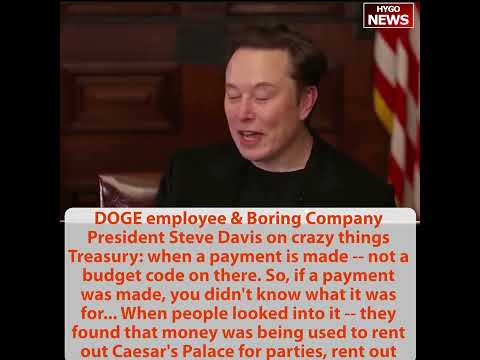
A journalist was invited to sit in on DOGE’s weekly 10 PM meeting at the Eisenhower Executive Office Building in May 2025, where Steve Davis — Boring Company president and DOGE team member — revealed staggering examples of federal fraud. “The Treasury pays about $5 trillion per year. There was formerly not a budget code on payments — you didn’t know what they were for,” Davis said. He described a $4 billion COVID fund in the Department of Education with “no receipts required — people could just draw down on it. They found money was being used to rent out Caesar’s Palace for parties, rent out stadiums.” DOGE’s fix: “We had the simple requirement that you must first upload a receipt. Nobody drew down any money anymore.” Musk’s team member added: “We didn’t even say we’d check the receipt. You could send a picture of your dog.”
The 10 PM Meeting
The journalist described the setting with visible surprise.
“Elon Musk was nice enough to invite us into the Eisenhower building last night to sit in on his weekly 10 PM DOGE meeting,” the journalist said. “Yeah, they usually meet at 10 o’clock.”
The team went around the table reporting on the week’s findings — a format that revealed DOGE’s operational culture. These were not bureaucratic meetings with prepared presentations and PowerPoint slides. They were working sessions where team members reported what they had discovered and what they had fixed.
The 10 PM meeting time itself was a statement about DOGE’s work ethic. While the rest of Washington was at dinner parties or watching television, Musk’s team was in the Eisenhower building combing through federal payment systems, identifying fraud, and implementing fixes. The contrast with normal government operating hours — which rarely extended past 5 PM — was part of DOGE’s culture.
No Budget Codes
Davis opened with a revelation that stunned the journalist.
“One of the crazy things with regards to the Treasury is that when a payment is made — and the computers at the Treasury actually pay about $5 trillion per year, like crazy amounts — there was formerly not a budget code on there,” Davis said.
He explained the implication: “So if a payment was made, you didn’t know actually what it was for. Could have been for anything.”
The absence of budget codes on federal payments was perhaps the most fundamental systemic failure DOGE had identified. The United States Treasury was processing $5 trillion in payments annually — roughly $14 billion per day — without coding that identified what each payment was for. This meant that nobody — not the Treasury, not Congress, not oversight agencies — could systematically track where federal money was going.
The lack of budget codes was not an oversight or a technical limitation. It was a feature of a system designed to operate without accountability. If payments weren’t coded, they couldn’t be analyzed. If they couldn’t be analyzed, fraud couldn’t be detected. If fraud couldn’t be detected, it would never stop.
The $4 Billion COVID Fund
Davis described a specific case that illustrated the systemic problem.
“There was a $4 billion COVID fund in the Department of Education,” Davis said. “There was no receipts required. So people could just draw down on it.”
He described what investigators found: “They found that money was being used to rent out Caesar’s Palace for parties, rent out stadiums.”
The journalist was incredulous: “They were renting Caesar’s Palace?”
Davis confirmed: “Yes, they were basically partying on the taxpayer’s money.”
The journalist pressed: “Stadiums?”
Davis: “Leasing stadiums.”
“For what?”
“For parties, basically.”
The journalist: “That’s a big party.”
Davis: “It’s a big party.”
The journalist asked: “You’d think if you were stealing, you’d start small.”
Davis explained the progression: “They do start small. But then what happens is over the years, if nobody stops the fraud, it gets more and more brazen. And every year it gets bigger until they’re literally renting out stadiums.”
The $4 billion COVID education fund with no receipt requirement was a case study in how emergency spending created fraud opportunities. During the pandemic, Congress had appropriated trillions in emergency funds with minimal oversight requirements. The justification was speed — money needed to reach schools and students quickly. The result was that billions in taxpayer money flowed into accounts with no documentation requirements, creating an open invitation to fraud.
The progression from small-scale fraud to stadium rentals demonstrated what happened when accountability was absent for years. Fraudsters tested the system with small withdrawals. When no one noticed, they increased the amounts. When no one noticed again, they increased further. By the time DOGE arrived, the fraud had escalated to the point where people were renting Las Vegas casinos and sports stadiums with taxpayer money — and nobody in the federal government had any idea.
”Just Upload a Receipt”
DOGE’s fix was almost comically simple.
“The one change that DOGE made with the Department of Education is we had the simple requirement that if you draw down money, you must first upload a receipt,” Davis said. “That was the only change that was made. You must upload your receipt.”
He described the result: “And upon doing so, nobody drew down any money anymore.”
A colleague added the devastating detail: “But we didn’t say that we’d check the receipt. You could send a fake receipt. You could send a picture of your dog. Anything.”
Davis confirmed: “As soon as we asked for anything at all, the requests were like, ‘Oh, we don’t need it anymore.’”
The receipt requirement story was DOGE’s most powerful illustration of the difference between fraud-enabling and fraud-preventing systems. The previous system required nothing — no documentation, no justification, no accountability. DOGE added a single requirement: upload something. Not a verified receipt, not an audited document, not a sworn statement — just anything at all.
The fact that this minimal requirement — so minimal that a picture of a dog would have sufficed — was enough to stop all fraudulent withdrawals proved that the people drawing down the money knew they were committing fraud. They weren’t confused about rules or making honest mistakes. They were stealing, and they stopped the moment there was any chance of a record connecting them to the theft.
”Numb to It”
The journalist asked how DOGE team members reacted to discovering fraud.
“When you find these things, do you guys get mad?” the journalist asked.
The answer was revealing: “I got numb to it, unfortunately. By the 100th time you’ve heard it, it’s hard not to get a little numb. By the 200th time, you’re like, well, okay. It’s just another day at the office.”
The numbness described by the DOGE team member was itself an indicator of the scale of federal waste and fraud. When a team had encountered so many instances of fraud — hundreds of cases — that the discovery of a new one no longer provoked an emotional response, the problem was not isolated incidents but systemic rot.
Key Takeaways
- DOGE revealed: Treasury processes $5 trillion/year in payments that had no budget codes — “you didn’t know what they were for.”
- A $4 billion Education Department COVID fund required no receipts: money was used to “rent out Caesar’s Palace for parties, rent out stadiums.”
- DOGE’s fix: “Upload a receipt — any receipt.” Result: “Nobody drew down any money anymore.” Even a picture of a dog would have counted.
- Davis on fraud escalation: “It starts small. If nobody stops it, every year it gets bigger until they’re literally renting stadiums.”
- DOGE team member: “By the 200th time you find fraud, you get numb to it. Just another day at the office.”