 HYGO News
 Al Gore Launches Clinton's 'Revolution in Government': Fortune 500 CEO, Quality Revolution, and the DOGE Precedent
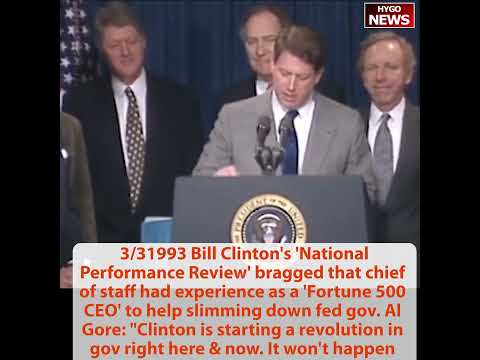
Al Gore Launches Clinton’s “Revolution in Government”: Fortune 500 CEO, Quality Revolution, and the DOGE Precedent
On March 3, 1993, Vice President Al Gore stood at the White House and declared that “President Clinton is starting a revolution in government, right here and now.” Gore announced the National Performance Review, a sweeping initiative to bring the “quality revolution” to the federal government, and boasted that White House Chief of Staff Mack McLarty’s experience leading a Fortune 500 company would be instrumental in the effort. The footage resurfaced in February 2025 as Democrats attacked Trump’s DOGE initiative as “unprecedented” — despite the Clinton administration having pursued nearly identical goals, using private-sector executives, and cutting hundreds of thousands of federal jobs three decades earlier.
”A Revolution in Government, Right Here and Now”
Gore’s announcement was delivered with the urgency and grandeur of a major policy launch. “President Clinton is starting a revolution in government, right here and now,” Gore declared. “It won’t happen overnight, and it won’t be easy. But it will fundamentally change the way our government works, for the people it serves and the people it employs.”
Gore framed the initiative as both a personal mission and a shared commitment. “For me, leading this effort represents a challenge I sought and a commitment we share to make our government work better, harder, and smarter for the American people,” he said. The vice president was positioning himself as the operational leader of the review, much as JD Vance would publicly support Elon Musk’s DOGE efforts decades later.
Gore was unapologetic about the scale of the ambition. “Our announcement today is revolutionary, but shouldn’t be surprising,” he said, arguing that Clinton had already begun the work from day one. “He has reorganized the White House, told his cabinet to park the limos, pair the parks, and cut the bureaucracy by 100,000 positions. And he’s ordered a 14% reduction in administrative costs altogether. That’s $16 billion in savings right there.”
The numbers were striking: 100,000 federal positions eliminated and $16 billion in savings from administrative cost reductions alone — all within the first weeks of the Clinton presidency. These figures provided historical context for the DOGE initiative’s similar goals in 2025.
The Fortune 500 CEO in the White House
One of the most pointed details in Gore’s announcement was his emphasis on the private-sector credentials that the Clinton team brought to the effort. “The President’s Chief of Staff, Mack McLarty, knows from his experience leading a Fortune 500 company how important these techniques are,” Gore said. “And he’s putting that experience to work here.”
McLarty had served as CEO of Arkla, Inc., a natural gas company listed on the Fortune 500. Clinton had chosen McLarty in part because of his business management experience, which the administration viewed as essential to the kind of operational overhaul it was attempting across the federal government.
The parallel to DOGE was obvious. In 2025, Democrats and media critics attacked the involvement of Elon Musk — a private-sector billionaire — in government operations as “unprecedented” and potentially unconstitutional. Yet in 1993, the Clinton White House had openly boasted about having a Fortune 500 CEO’s expertise available for the same purpose. The only difference was that McLarty operated from within the formal government structure as Chief of Staff, while Musk operated through an advisory role with DOGE.
Gore also cited the broader trend in the private sector as justification for the government initiative. “Business people know about the quality revolution. It’s changed the way they do business, and it’s kept them in business,” Gore said. “Somehow the quality revolution, which swept American business over the last 15 years, simply bypassed the federal government. We’re going to bring the quality revolution right into the federal government."
"The Customer Comes First”
Gore introduced a concept that was relatively novel for government in 1993: treating citizens as customers. “Today President Clinton is making sure that government knows what every business already knows,” Gore said. “The customer comes first. And if you can’t serve your customers efficiently, effectively, and responsibly, then you’re not doing your job.”
The customer-service framing was a deliberate effort to shift the culture of federal agencies from one of bureaucratic process to one of service delivery. Gore argued that the “total quality management” revolution that had transformed American corporations needed to be applied to government operations.
He described the approach in terms borrowed directly from corporate management theory: “Listen carefully to those who work where the rubber meets the road. Ask for their cooperation in concentrating on how to make the entire enterprise more efficient and more successful. Harvest their ideas, pay attention to them, sift through them, weed out the ones that won’t work, but implement the ones that will, and then carefully measure and monitor the progress that you expect to get as a result.”
Cutting Red Tape and Inviting Public Participation
Gore’s announcement included a call for public participation that anticipated the crowdsourced approach DOGE would later employ through social media. “If you spot waste or fraud or abuse, call one of the 1-800 numbers located throughout the government and let us know,” Gore said. “If you have an idea of how we can do a better job or if you spot a problem that needs fixing, write to me here at the White House. Mark your envelope ‘reinventing government.’ You will get a response. Your idea will be evaluated.”
The vice president also delivered the kind of cultural declaration that reformers in every era have made: “It’s time we took out of our vocabulary the words, ‘well, we’ve always done it that way.’”
Gore acknowledged that the government’s greatest untapped resource was its own workforce. “The greatest untapped resource we have is their ingenuity, their brain power, and their experience,” he said of federal employees. The appeal to workers was a softer approach than DOGE’s more confrontational stance with agencies that resisted cooperation in 2025.
The “Unprecedented” Irony
The resurfacing of this footage in February 2025 was driven by the irony of Democratic politicians and media commentators describing Trump’s DOGE initiative as “unprecedented.” The historical record showed that the Clinton administration had:
- Cut 100,000 federal positions in the first weeks of the presidency, with an eventual reduction of over 300,000
- Ordered a 14% reduction in administrative costs, saving $16 billion
- Used a Fortune 500 CEO (Chief of Staff Mack McLarty) to bring private-sector efficiency techniques to government
- Declared a “revolution in government” aimed at eliminating waste, fraud, and abuse
- Invited public participation through hotlines and mail-in suggestions
- Described the effort in terms nearly identical to DOGE’s stated mission
Democrats under Clinton had not only pursued government efficiency — they had celebrated it as a signature achievement. Gore had personally led the effort and had subsequently written a bestselling book, “Creating a Government That Works Better and Costs Less,” about the results. The fact that the same party was now characterizing a similar effort as dangerous and unprecedented suggested that the objection was to who was leading the reform rather than to the reform itself.
Key Takeaways
- On March 3, 1993, VP Al Gore announced Clinton’s National Performance Review as “a revolution in government,” promising to “fundamentally change the way our government works.”
- Gore boasted that White House Chief of Staff Mack McLarty’s experience as a Fortune 500 CEO was being used to bring private-sector efficiency to government — paralleling Democratic criticism of Elon Musk’s involvement in DOGE.
- Clinton cut 100,000 federal positions and ordered a 14% reduction in administrative costs, saving $16 billion in the first weeks of his presidency.
- Gore declared it was time to bring the “quality revolution” that had transformed American business into the federal government, using language nearly identical to DOGE’s stated mission.
- The footage resurfaced in 2025 as Democrats labeled Trump’s DOGE initiative “unprecedented,” despite the Clinton administration having pursued the same goals with similar methods thirty years earlier.