 HYGO News
 Did not know? KJP Refuses To Say If Biden Knew Documents Were There, Only That He Was “Surprised”
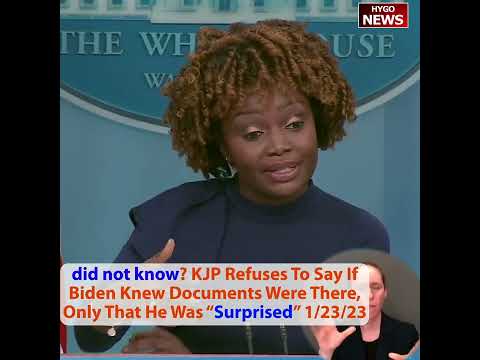
KJP Won’t Say Biden Didn’t Know Documents Were There — Only That He Was “Surprised” — Crucial Legal Distinction
In January 2023, a reporter pressed White House Press Secretary Karine Jean-Pierre on a crucial distinction in President Biden’s public statements: did Biden actually say he didn’t know the classified documents were there, or only that he was surprised? “You just said the president said that he did not know the documents were there. I’m not actually sure he has said that clearly. Are you saying the president did not know that he was there?” the reporter asked. KJP’s response was revealing: “Well, he said he was surprised. He said he was surprised. He said he was surprised. I’m just going to leave it there and I’m going to refer you to the White House Counsel’s office.” Throughout further questioning, KJP would only say Biden was “surprised” — never confirming he didn’t know. This distinction was legally significant, as knowledge vs. surprise were different states with different implications.
The Crucial Distinction
The reporter identified legally significant distinction:
“Did not know” — Strong denial of awareness.
“Surprised” — Reaction to discovery.
Different states — Legally.
Knowledge vs. reaction — Categorical.
Legal implications — Significant.
The difference mattered. A person could be surprised to find something even if they had known it existed but forgotten. Surprise didn’t necessarily mean absence of prior knowledge. The distinction affected potential legal exposure.
The Reporter’s Precision
The reporter was precise. “You just said the president said that he did not know the documents were there. I’m not actually sure he has said that clearly. Are you saying the president did not know that he was there?” the reporter asked.
The precision:
Catching KJP’s words — Exactly.
Fact-checking — Claim.
Specific request — For confirmation.
Legal relevance — Implicit.
Professional engagement — High level.
The reporter was catching KJP using more definite language than Biden had actually used. By asking for confirmation of “did not know,” the reporter was testing whether administration would make claims Biden himself hadn’t made.
”He Said He Was Surprised”
KJP’s response was revealing. “Well, he said he was surprised. He said he was surprised. He said he was surprised,” KJP said.
The three-fold repetition:
“Surprised” three times — Emphatic.
Not answering differently — Despite pressure.
Careful word choice — Deliberate.
Sticking to Biden’s actual words — Technical.
Not confirming “did not know” — Notable.
The triple repetition of “surprised” was careful language choice. KJP was sticking to a specific Biden quote rather than elaborating into broader “did not know” territory. This was legally careful messaging.
The Legal Calculation
The word choice reflected legal calculation:
“Did not know” — Could be falsified if evidence showed otherwise.
“Surprised” — Subjective state, hard to disprove.
Deliberate ambiguity — Protected.
Attorney advice — Likely.
Future legal proceedings — Anticipated.
Biden’s lawyers probably advised against flat “did not know” claims. Such claims could be contradicted by evidence of prior knowledge. “Surprised” was less falsifiable because it described reaction rather than prior state.
The Reporter’s Push
The reporter pressed. “I’m just repeating what he said. I want to know what you just said. He said he did not know the documents were there,” the reporter said.
The push:
Clarification demand — Persistent.
Distinction emphasized — Between statements.
KJP accountability — Sought.
Direct engagement — With word choice.
Professional journalism — At work.
The reporter was essentially holding KJP accountable for her own words versus what Biden had actually said. This was close attention to administrative messaging precision.
”He Said He Was Surprised That the Documents Were There”
KJP elaborated slightly. “He said he was surprised that the documents were there. He said that and that he takes this very seriously,” KJP said.
The elaboration:
“Surprised that” — Specific phrasing.
Documents existence — Acknowledged.
Reaction characterization — Biden’s.
“Takes seriously” — Template added.
No “did not know” — Still.
By saying Biden was “surprised that the documents were there,” KJP was closer to the reporter’s interpretation but still careful. The phrase didn’t definitively say Biden didn’t know — just that he was surprised about their being there.
”I’m Just Referring to People Who Might Question That”
KJP pivoted to external skeptics. “I’m just referring to people who might question that,” KJP said.
The reference:
Skeptics existence — Acknowledged.
External doubt — Recognized.
Biden claims — Being questioned.
Administrative awareness — Of doubt.
Defensive framing — Against skeptics.
Acknowledging that some might question Biden’s claims was interesting. This was implicit recognition that the administration’s messaging wasn’t being universally accepted. The skeptics had reasons — repeated discoveries undermined single-incident framing.
The Repeated Discoveries
The reporter noted the pattern. “Given that you keep every few days it seems that you are finding that more documents have been found at his house,” the reporter said.
The observation:
Ongoing discoveries — Pattern.
“Every few days” — Frequency.
Cumulative effect — Credibility strain.
Public perception — Affected.
Legitimate concern — Journalistic.
The ongoing discoveries were straining administration credibility. Each new find undermined the “isolated incident” framing. The pattern was suggesting either more incidents or more hidden material being discovered over time.
The Template Default
KJP defaulted to template. “What I’m telling you is what the president has said, which is he takes this very seriously,” KJP said.
The default:
“Takes seriously” — Return to template.
No new information — Provided.
Repeated assertion — Without substance.
Standard response — Pattern.
Evasion mechanism — Effective.
When pressed, KJP’s default was the “takes seriously” template. Whatever question was asked, this template could be deployed. Its empty content allowed it to serve many deflection purposes.
”Refer You to Detailed Explanations”
KJP referenced outside statements. “I will refer you to detailed explanations from statements that have come from his personal lawyer,” KJP said.
The referral:
Personal lawyer — Bob Bauer likely.
Prior statements — Already issued.
“Detailed explanations” — Characterization.
Outside briefing room — For details.
Information available — Elsewhere.
Biden’s personal lawyer Bob Bauer had issued various statements. KJP was directing reporters to those statements rather than addressing the question herself. This was typical pattern of deflecting to external communications.
The Attorney Statements
Bauer’s statements had been carefully crafted:
Timeline explanations — Provided.
Discovery circumstances — Described.
Cooperation claims — Made.
Legal framing — Throughout.
Limited scope — Intentional.
The attorney statements were carefully limited. They provided some information but avoided sweeping claims. This careful messaging was legally appropriate but politically unsatisfying for those seeking comprehensive explanation.
”Anything Further on This, My Colleague”
KJP concluded with deflection. “Again, anything further on this, my colleague is going to be…,” KJP said, before transcript cut off.
The deflection:
“My colleague” — Unspecified referral.
“Anything further” — Scope.
Transcript end — At crucial moment.
Likely Ian Sams — Relevant spokesperson.
Pattern maintained — Of referral.
Ian Sams was being deployed as Biden’s classified documents spokesperson. The referral was probably to him. This was Administrative specialization — KJP handled general briefings while Sams handled document-specific questions.
The Legal Implications
The word choice had legal implications:
Perjury risk — For false claims.
Investigation exposure — To lies.
Criminal liability — For deliberate concealment.
Attorney advice — About language.
Careful messaging — Required.
The careful distinction between “did not know” and “surprised” reflected legal reality. Biden’s actual statements would be examined by investigators. Administrative statements that went beyond Biden’s careful language could create exposure.
The Belief vs. Knowledge Distinction
Philosophically and legally:
Knowledge — Justified true belief.
Belief — Subjective state.
Surprise — Reaction to unexpected.
Awareness — State of knowing.
Recognition — Of previously known.
These distinctions mattered legally. Biden could genuinely not know documents were there while having known they existed earlier and forgotten. Or he could know documents existed but not at specific locations. Various states were possible.
The Administration Messaging Tightrope
The administration was walking messaging tightrope:
Too strong — Risk false statements.
Too weak — Admit potential issues.
Just right — Protected but reassuring.
Legal review — Of statements.
Political balance — Needed.
Each administration statement had to balance political needs against legal risks. The “surprised” language was carefully chosen. KJP’s reluctance to strengthen to “did not know” showed awareness of this balance.
The Credibility Impact
The careful language had credibility costs:
Public confusion — Over specifics.
Skepticism — Growing.
Media coverage — Focusing on distinctions.
Accountability gap — Widening.
Trust erosion — Gradually.
When administrations couldn’t make strong clear claims, credibility suffered. Each hedge suggested there was something to hedge about. The carefully limited “surprised” framing invited questions about what the fuller truth might be.
The Past Trump Comparison
Trump’s classified documents case had similar dynamics:
Knowledge questions — Central.
Trump claims — Various.
Legal process — Ongoing.
Political framing — Intense.
Parallel patterns — Between cases.
Biden’s careful language paralleled what Trump’s team had done in their case. Both sides were managing legal exposure through careful word choice. The parallel was politically awkward for administration.
The Ongoing Investigation
Special Counsel Hur’s investigation would examine:
Biden’s actual knowledge — Through interviews.
Timeline — Of events.
Document handling — History.
Intent — If relevant.
Eventual report — Public.
The careful messaging wouldn’t control investigation outcome. Hur’s team would develop own understanding based on evidence. Administrative word choice was about public messaging, not investigative reality.
The Eventual Hur Report
Hur’s eventual report (February 2024) would address knowledge:
“Elderly man with poor memory” — Famous characterization.
No charges — Decision.
Knowledge questions — Addressed.
Report narrative — Complex.
Political implications — Significant.
The Hur report’s language about Biden’s memory would become major political story. The careful “surprised” framing of January 2023 would look different in retrospect given later characterizations.
The 2023 Messaging Challenges
The January 2023 messaging challenges were:
Repeated discoveries — Daily pressure.
Media attention — Intense.
Legal constraints — On language.
Political stakes — High.
Narrative control — Difficult.
KJP’s press briefings were frontline of this challenge. Every day brought new developments. Every statement had to be carefully calibrated. The pressure was intense and sustained.
Key Takeaways
- A reporter identified crucial distinction: KJP had said Biden “did not know the documents were there,” but Biden himself had only said he was “surprised.”
- KJP carefully stuck to “surprised” language: “Well, he said he was surprised. He said he was surprised. He said he was surprised.”
- She would not confirm Biden “did not know” — a legally significant distinction from being surprised.
- KJP’s triple repetition of “surprised” reflected careful legal/political word choice.
- She pivoted to standard template: “What I’m telling you is what the president has said, which is he takes this very seriously.”
- The careful messaging reflected legal calculations about what could be verifiably said versus what might expose Biden to future complications.
Transcript Highlights
The following is transcribed from the video audio (unverified — AI-generated from audio).
- You just said the president said that he did not know the documents were there. I’m not actually sure he has said that clearly.
- Are you saying the president did not know that he was there?
- Well, he said he was surprised. He said he was surprised. He said he was surprised.
- He said he was surprised that the documents were there. He said that and that he takes this very seriously.
- Given that you keep every few days it seems that you are finding that more documents have been found at his house.
- What I’m telling you is what the president has said, which is he takes this very seriously. I will refer you to detailed explanations from statements that have come from his personal lawyer.
Full transcript: 209 words transcribed via Whisper AI.