 HYGO News
 Rubio to Rep. Jayapal: 'Yes, PROUDLY -- We're Going to Do More. We Will Revoke the Visa of Anyone Who's Here as a Guest Who's Here to Stir Trouble'; EPA Admin Zeldin to Sen. Whitehouse: 'You Don't Care About Wasting Money, But Trump Admin Does'
Rubio to Rep. Jayapal: “Yes, PROUDLY — We’re Going to Do More. We Will Revoke the Visa of Anyone Who’s Here as a Guest Who’s Here to Stir Trouble”; EPA Admin Zeldin to Sen. Whitehouse: “You Don’t Care About Wasting Money, But Trump Admin Does”
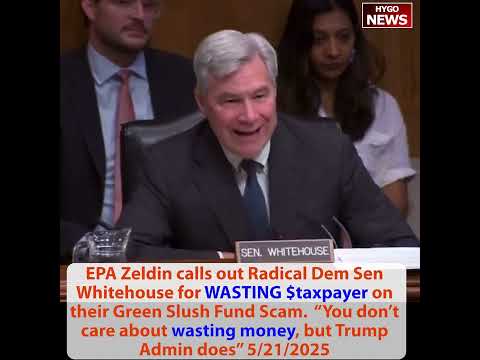
Two memorable May 2025 congressional exchanges demonstrated the Trump administration’s aggressive approach to defending its priorities. Secretary of State Marco Rubio was challenged by Rep. Pramila Jayapal (D-WA) on the revocation of a student visa after an op-ed. Rubio: “No one’s entitled to a student visa… You revoked her student visa. Yes, PROUDLY. And we’re going to do more! Anyone who’s in this country as a guest who’s here to stir trouble — we will revoke their visa. I’m looking to get crazy people out of our country.” Separately, EPA Administrator Lee Zeldin clashed with Sen. Sheldon Whitehouse (D-RI) over the cancellation of 781 Green New Deal grants: “We have a zero tolerance policy towards wasting dollars. You don’t care about wasting money, but the Trump administration does, Senator. The American taxpayers put President Trump in office because of people like you."
"No One’s Entitled to a Student Visa”
The Jayapal-Rubio exchange concerned a student visa revocation apparently triggered by an op-ed.
Rubio opened with the foundational principle: “No one’s entitled to a student visa.”
Jayapal was incredulous: “So you revoked her student visa based on an op-ed, which trumps the supreme law of the land, which is the Constitution?”
Rubio explained the criterion: “Someone’s coming up here to stir up problems on our campus. We’re going to revoke their visa.”
Jayapal objected to the characterization: “She didn’t do any of that. She wrote an op-ed. She wrote an op-ed.”
Rubio addressed the specific case: “And I’m talking to you about her particular case. That’s her lawyer’s claims and your claims. Those are not the facts.”
The “no one’s entitled to a student visa” principle was legally correct. Student visas (F-1 visas) are discretionary. Foreign nationals are not entitled to student visas as a matter of right; visas are granted based on a combination of eligibility criteria and discretionary considerations. The State Department retains broad authority to revoke visas at any time when the recipient’s presence in the United States is deemed inconsistent with national interest.
The “based on an op-ed” framing was Jayapal’s rhetorical gambit. By reducing the case to “she wrote an op-ed,” Jayapal was framing the visa revocation as punishment for speech — which would raise constitutional concerns. Rubio’s response was that the underlying conduct was not mere speech but rather organized trouble-making on campuses.
The specific case was not named in the exchange, but likely referenced a foreign student who had been involved in pro-Hamas protests on American university campuses. After October 7, 2023, American universities had experienced extensive protests involving foreign students, some of whom had advocated violence, endorsed terrorist organizations, or engaged in physical disruption. The Trump administration had begun systematically reviewing such cases and revoking visas of foreign nationals involved in problematic conduct.
”Yes, PROUDLY”
The key Rubio statement came next.
Jayapal pressed: “Reclaiming my time, you revoked her student visa.”
Rubio’s response was direct: “Yes, PROUDLY.”
He elaborated: “Because she wrote an op-ed. Would you revoke? We’re going to do more. We were revoked a visa. Anyone who’s in this country as a guest, are you going to revoke the visa of somebody who made that statement?”
He stated the principle: “I’m looking to get crazy people out of our country.”
The “proudly” framing was politically important. Rather than defending the visa revocation as reluctant necessity or procedural compliance, Rubio was affirmatively embracing the policy. This was a deliberate rejection of the apologetic tone that Democratic officials often brought to immigration enforcement.
The “guest” framing was legally precise. Foreign students on visas were guests in the United States, present at American discretion. Unlike American citizens, they had no inherent right to remain. If they engaged in conduct inconsistent with their guest status, their visas could be revoked.
The “going to do more” commitment extended beyond individual cases. Rubio was signaling policy expansion: more systematic review of foreign student conduct, more aggressive visa revocations, more rigorous enforcement of the terms of foreign presence in the United States.
”Hiding Their Identities”
Jayapal pivoted to a different criticism.
“If these are legitimate law enforcement agents carrying out proper arrest,” Jayapal asked, “why are they hiding their identities?”
Rubio’s response was blunt: “Because then radical crazies will try to hurt them.”
The “hiding identities” concern was about ICE agents wearing masks and operating in unmarked vehicles. Democratic critics had been emphasizing this as evidence of “Gestapo-like” tactics. The administration’s response was that federal officers needed identity protection because of documented threats and violence against them.
The context supported Rubio’s framing. Since 2020, ICE officers had faced:
- Doxxing campaigns where their names, addresses, and family members were published online
- Physical attacks at their homes
- Social media harassment of their families
- Pressure on their neighbors and churches
- In some cases, assaults in public settings
The operational reality was that officers who could be identified and located could be targeted. Keeping identities protected was standard law enforcement practice for undercover and sensitive operations, now extended to immigration enforcement due to the hostile political environment.
The EPA Grant Review
The Zeldin-Whitehouse exchange concerned EPA’s review of IRA grants.
Whitehouse challenged: “So you’ve conducted an individual review of everything. And that kind of doesn’t work for you. When did you conduct an individualized review of 781 grants?”
Zeldin responded: “We have a zero tolerance policy towards wasting dollars. We inherit something you care about wasting money.”
Whitehouse demanded schedule documentation: “Will you show me your schedule?”
Zeldin pushed back: “You don’t care about wasting money, but the Trump administration does, Senator.”
Whitehouse repeated: “Will you show me your schedule to prove your assertion that you did an individualized review of 781?”
Zeldin’s answer was pointed: “I’m under oath telling you that I was reviewing this stuff and working on it almost every single day.”
The Ricketts Commitment
Zeldin explained the rationale for aggressive grant review.
“When I was before this committee, I was asked by Senator Ricketts,” Zeldin said, “if confirmed, would I immediately make this the top priority to go through all the grant funding going through EPA to make sure that we are cracking down on every waste, every aspect of abuse.”
He explained the accountability: “Because I have to come back here in front of Senator Ricketts today.”
He stated the moral framing: “And even though you don’t care about wasting tax dollars, Senator Ricketts does.”
The Ricketts reference was to Senator Pete Ricketts (R-NE), a fiscal conservative who had pressed Zeldin during his confirmation hearings on waste reduction. Zeldin had committed to aggressive review of EPA grants during confirmation; his review of 781 grants represented delivery on that commitment.
The structure of accountability Zeldin described was significant. He was not acting on his own authority or political preferences. He was fulfilling specific commitments made during Senate confirmation, with specific senators monitoring whether he delivered on those commitments. This was democratic accountability functioning properly: senators making specific requests, nominees committing to specific actions, and follow-up oversight ensuring delivery.
”I’m Going to Do My Job”
Zeldin laid out the core of his position.
“And I’m going to do my job because the American public cares about us not wasting tax dollars,” Zeldin said.
Whitehouse then made a more serious accusation: “The problem with your assertion here today is that it is belied by your own employees, sworn statements in court, and by the decision of the Department of Justice to admit that what you say isn’t true.”
Zeldin challenged the premise: “So you’re not grasping the fact that we would have multiple employees looking at these grants. That concept just escapes you like that’s even a possibility.”
Whitehouse: “The only thing about that is that that’s not true.”
Zeldin: “And you don’t care about 99% of the story. That’s not true according to your own employees’ testimony. You don’t, you’re not grasping it, Senator. I don’t know what to say to you."
"Multiple Employees”
The substantive disagreement concerned who had done the review work.
Whitehouse’s position was that Zeldin himself had claimed to personally review 781 grants — which would have been physically impossible in the time available. If Zeldin had actually done what he claimed, his claim would contradict the time available. Therefore he must not have actually done what he claimed.
Zeldin’s response was that the review had been conducted by multiple employees working over multiple months, coordinated by and reviewed by Zeldin. The process had involved:
- Initial identification of potentially wasteful grants by EPA staff
- Detailed review by grant management teams
- Legal review by EPA Office of General Counsel
- Management decisions by Zeldin and senior political appointees
- Documentation and notification processes for affected grant recipients
This was the normal institutional review process. A senior official like Zeldin directed the process and took accountability for its outcomes without personally reviewing every document. To claim Zeldin personally had to review every page was to fundamentally misunderstand how federal administration worked.
”American Taxpayers Put President Trump in Office”
Zeldin closed with the political framing.
“We’re not going to waste dollars just because you insist on EPA lighting taxpayer dollars on fire,” Zeldin said.
He explained the electoral context: “The American taxpayers, they put President Trump in office because of people like you.”
He extended to Congress: “They have Republicans in charge of the House and Senate because of people like you. Because you don’t care about 99% of the story.”
Zeldin was offering to present evidence: “You don’t want me to go through the list of all the evidence of waste and abuse.”
Whitehouse tried to redirect: “No, what I want you to do. In conflicts of interest. What I want you to do.”
Zeldin: “You don’t care about qualified recipients. You don’t care about what I want you to do.”
The “put Trump in office because of people like you” framing captured a broader political dynamic. The 2024 election had been partly driven by voter frustration with Democratic policies perceived as wasteful, ideological, or disconnected from practical concerns. When Democratic senators like Whitehouse aggressively defended clean energy grant programs against waste scrutiny — and appeared unwilling to accept that any grants might be wasteful — they reinforced the perception that Democrats cared more about favored interest groups than about taxpayer interests.
The “Green Slush Fund” Framing
The Hygo framing of Zeldin’s work as attacking a “Green Slush Fund Scam” captured the conservative view of the IRA grant programs:
Scale: The IRA had authorized approximately $370 billion for clean energy programs over a decade. This was an enormous sum of money flowing through various grant programs.
Political connection: Many grant recipients were connected to Democratic political networks — environmental non-profits, friendly academic institutions, politically-connected corporations, labor unions with green energy focus.
Lax oversight: Much of the money had been obligated quickly with limited verification of grantee capability, project feasibility, or waste prevention. Some grants were going to organizations that barely existed or that had minimal capacity to execute the funded projects.
Ideological flow: The funding flowed disproportionately to progressive causes, from environmental justice to renewable energy evangelism, rather than to objective clean energy production.
Waste indicators: Various grants had been identified with specific problems: overpayment relative to market rates, duplication with other federal programs, payments to foreign recipients, and funding for activities that seemed unrelated to clean energy.
The Trump administration’s approach was systematic review to identify and terminate grants that did not meet legitimate program purposes. The 781 grants Zeldin had reviewed represented the first pass of this review.
Key Takeaways
- Rubio to Rep. Jayapal: “Yes, PROUDLY. We’re going to do more. We will revoke the visa of anyone here as a guest who’s here to stir trouble.”
- Rubio: “I’m looking to get crazy people out of our country. No one’s entitled to a student visa.”
- EPA’s Zeldin to Sen. Whitehouse: “You don’t care about wasting money, but the Trump administration does, Senator.”
- Zeldin reviewing 781 IRA grants to crack down on Green Slush Fund waste and abuse.
- Zeldin: “American taxpayers put Trump in office because of people like you. Don’t care about 99% of the story.”