 HYGO News
 Dem Sen Welch on Obamacare: We did fail; Trump: denuclearization, Kazakhstan agreed Abraham Accords
Dem Sen Welch on Obamacare: We did fail; Trump: denuclearization, Kazakhstan agreed Abraham Accords
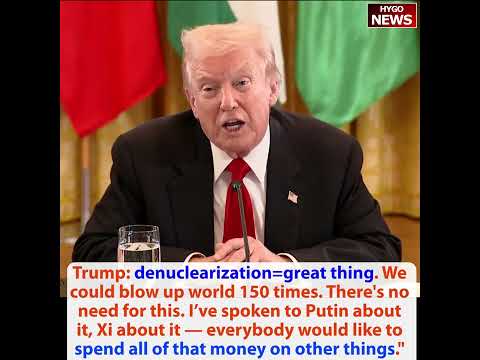
Three distinct news items from the same day. Democratic Sen. Peter Welch (VT) made an extraordinary public admission while defending ACA subsidy extension: “We did fail to bring down the cost of healthcare” — acknowledging Obamacare failed at its central promise (affordability). President Trump unveiled his “denuclearization doctrine” — the U.S., Russia, and China all have enough nuclear weapons to “blow up the world 150 times,” and Trump had discussed denuclearization with both Putin and Xi. Trump noted his tariff-earned investment flows could be better deployed than nuclear arms race spending. Trump also announced Kazakhstan officially joined the Abraham Accords 15 minutes earlier — adding a Central Asian Muslim-majority nation to the Israeli normalization framework. Trump hosted the C5 (five Central Asian presidents) for bilateral meetings, framing the region as sitting “at the historical and geographic crossroads of the world” along the ancient Silk Road, and criticizing “previous American presidents [who] neglected this region completely.” Sen. Ed Markey (D-MA) declared Democrats would vote no on reopening the government “without dealing with the health care crisis.” Welch: “I owe you an answer on why it is I’m standing here today asking to extend something that was temporary. And here’s the reason. We did fail to bring down the cost of healthcare.” Trump: “I think that denuclearization would be a great thing. We could blow up the world 150 times. There’s no need for this.” On Kazakhstan: “Kazakhstan has officially agreed, and that’s official now, as of about 15 minutes ago … has officially joined the Abraham Accords.”
Welch’s Obamacare Admission
Democratic Sen. Peter Welch (VT) opened with a remarkable admission while defending extended ACA subsidies. “I owe you an answer on why it is I’m standing here today asking to extend something that was temporary. And here’s the reason. We did fail to bring down the cost of healthcare.”
The admission is substantial. Obamacare’s central promise — “bend the cost curve” — was making healthcare more affordable. Welch’s position: the law failed at that promise, therefore the temporary enhanced subsidies must continue to mask the failure.
The logic is revealing:
- ACA was supposed to make healthcare affordable
- ACA did not make healthcare affordable (Welch’s admission)
- Therefore government must permanently subsidize premiums
- Because the underlying costs remain high
Republicans have long argued that the ACA doesn’t actually reduce healthcare costs — it shifts them. Welch’s admission effectively confirms the Republican framework.
Denuclearization Doctrine
Trump then pivoted to nuclear policy. “We had a tremendous meeting, as you know, with President Xi and China. And my doctrine would be denuclearization because we have enough nuclear.”
Trump met with Xi in South Korea earlier. Among topics: nuclear weapons. Trump’s framework: all major powers have too many nuclear weapons. Denuclearization is rational.
“We’re number one, Russia’s number two, China’s number three, way behind, but they’ll be even in four or five years.”
The nuclear hierarchy:
- U.S.: approximately 5,000+ warheads
- Russia: approximately 6,000+ warheads
- China: 500-600 warheads (rapidly expanding)
Russia actually has more warheads than the U.S. but Trump’s “number one” may refer to operational readiness or capability. China is indeed rapidly expanding — from 260 warheads in 2020 to projected 1,500 by 2035.
“You know, working overtime on nuclear weapons.”
China’s expansion is the most dynamic element. New ICBM silo fields, submarine programs, tactical nuclear developments. Trump’s “even in four or five years” suggests China could match U.S. and Russia within a half-decade.
”Blow Up the World 150 Times”
“I think that denuclearization would be a great thing. We could blow up the world 150 times. There’s no need for this.”
Current arsenal scale:
- Combined global arsenal: ~12,000 warheads
- Average warhead yield: 100-500 kilotons
- Hiroshima was 15 kilotons, killed 140,000
- Arithmetic: 150x destructive capacity of all world population
Trump’s framework: diminishing returns past some threshold. Neither more U.S., Russian, nor Chinese warheads increases security. Everyone would be better with fewer.
“I’ve spoken to President Putin about it. I’ve spoken to President Xi about it.”
Both leaders received Trump’s denuclearization pitch. Neither publicly committed, but private conversations reportedly found receptivity.
“Everybody would like to spend all of that money on other things, you know, things that can benefit people now.”
The fiscal argument: nuclear arsenal maintenance costs hundreds of billions annually. Redirected to infrastructure, healthcare, education, or tax relief would benefit populations directly.
“I think something like that could happen, the denuclearization.”
Trump expressed actual optimism. This isn’t campaign rhetoric — he’s signaling active diplomatic effort.
”Peace Through Strength”
“It’s really, I want peace. I want peace through strength, but we want peace all over the world. We’re very close to getting it.”
Trump’s framework: his peace pursuit isn’t weakness. Military strength enables peace through deterrence. The combination is Reagan’s formulation — Trump’s version adjusted for current global conditions.
“We had a lot of wars raging that people didn’t know about. Now they’re not raging anymore. We have one left and we’re going to hopefully get that taken care of.”
The “one left” is likely Russia-Ukraine — the only remaining major conflict Trump hasn’t closed. Despite eight wars ended, the big one remains.
Kazakhstan Joins Abraham Accords
“And this evening, I’m also delighted to report that Kazakhstan has officially agreed, and that’s official now, as of about 15 minutes ago, a tremendous country with a tremendous leader, has officially joined the Abraham Accords.”
The announcement was immediate — 15 minutes old when Trump shared it. Kazakhstan’s accession to the Abraham Accords is significant.
The Abraham Accords framework:
- Started under Trump’s first term in 2020
- Original signatories: UAE, Bahrain, Morocco, Sudan (plus Israel)
- Israel-Saudi Arabia normalization in progress
- Kazakhstan is the first Central Asian nation to join
Kazakhstan’s addition:
- Muslim-majority nation (Sunni, ~70%)
- Population ~20 million
- Strategic location between Russia and China
- Energy-rich (oil, gas, uranium)
- Secular governance tradition
The accession broadens the Accords beyond the Middle East proper into Central Asia — a potential model for further expansion to other Central Asian states (Uzbekistan, Kyrgyzstan, Tajikistan, Turkmenistan).
“And I just want to thank you, Mr. President. It’s a great honor. It’s a tremendous honor to have you. Really great.”
Trump addressing Kazakhstan’s President Tokayev directly.
Democrats Still No
The transcript included Sen. Ed Markey (D-MA) asserting Democrats would continue the shutdown. “When John Thune brings that vote out tomorrow morning to open up the government without dealing with the health care crisis, we are going to vote no once again. We are united in our opposition.”
Markey’s framework:
- Thune will call another CR vote
- Democrats will vote no again (14th time)
- “United in our opposition”
The unity framework despite CNN reports of a dozen Democrats privately willing to deal. Leadership framework remained defiant even as soldiers were defecting.
C5 Central Asia Meeting
“Well, I’ve just completed a series of outstanding bilateral meetings with these leaders in the Oval Office to discuss our ties with this very important part of the universe.”
Whisper garbled “part of the world” to “part of the universe.” Trump met with Central Asian leaders — the C5 group: Kazakhstan, Uzbekistan, Kyrgyzstan, Tajikistan, Turkmenistan.
“We’re strengthening our economic partnerships, improving our security cooperation and expanding our overall bonds.”
The three prongs:
- Economic (trade, investment)
- Security (military, counter-terrorism)
- Bonds (cultural, educational, diplomatic)
Trade Commitments
“A tremendous amounts of trade was done just in the last little while. Lots of great products, military products, and otherwise are being bought from the United States. We make the best military equipment by far in the world, and they understood it.”
Central Asian nations have historically bought Russian and Chinese military equipment. Trump’s framework: shift those purchases to U.S. equipment. The “just in the last little while” suggests contracts signed during the bilateral meetings.
“Really, they’ve understood it for a while, ever since I’ve been in office, what we rebuilt completely, our military.”
Trump’s military rebuilding claim. Defense budget, modernization, specific capabilities like F-35, F-47, hypersonic weapons, nuclear modernization.
Silk Road Reference
“I want to thank all of the leaders for being here and for their dedication to a strong relationship with the USA. The nations of Central Asia, known as the C5, sit at the historical and geographic crossroads of the world. These nations were once home to the ancient Silk Road, connecting East and West. Great history, tremendous, beautiful history.”
The Silk Road — the ancient trade route between China and Europe through Central Asia. The cities of Samarkand, Bukhara, Almaty sat along critical nodes. Central Asian culture developed through centuries of trade mediation.
“Today, their location in the heart of Eurasia gives them incredible importance and unbelievable potential.”
The geographic argument: Central Asia sits between Russia, China, Iran, Afghanistan, and the Caspian. Critical strategic location. Both China’s Belt and Road Initiative and Russia’s sphere of influence run through these nations.
”Previous Presidents Neglected”
“Sadly, previous American presidents neglected this region completely. It’s an unbelievable region, and by the way, it happens to be an extremely wealthy region too, but we are fixing that mistake, and I’m committed to making America’s partnership with each of these countries stronger than ever before.”
Trump’s critique: the Central Asian nations were undervalued by previous administrations. After Soviet breakup in 1991, U.S. engagement was minimal. China filled the vacuum through Belt and Road. Russia attempted resurgence through the CSTO and Eurasian Economic Union.
Trump’s framework: reverse the neglect. Build U.S.-Central Asian partnerships on multiple dimensions.
The wealth reference is material — Kazakhstan alone has substantial oil, gas, uranium, and rare earth deposits. Uzbekistan has gold, gas, and cotton. Turkmenistan has vast gas reserves. Combined regional resource wealth is substantial.
Significance
The day’s news items represented the full range of Trump’s approach:
- Democratic admission of policy failure (Welch on Obamacare)
- Global peace initiative (denuclearization)
- Major diplomatic win (Kazakhstan-Abraham Accords)
- Strategic repositioning (C5 engagement)
- Continued domestic political confrontation (Markey, shutdown)
Each operates on different time scales. Welch’s admission is immediately politically relevant. Denuclearization is multi-year. Kazakhstan-Abraham Accords is generational. C5 engagement is strategic-decades. Shutdown is daily-weekly.
Trump’s ability to operate simultaneously on all these fronts — while Democrats remained locked in shutdown tactical mode — was a striking operational tempo difference.
Key Takeaways
- Welch’s admission: “I owe you an answer on why it is I’m standing here today asking to extend something that was temporary. And here’s the reason. We did fail to bring down the cost of healthcare.”
- Trump on denuclearization: “I think that denuclearization would be a great thing. We could blow up the world 150 times. There’s no need for this. I’ve spoken to President Putin about it. I’ve spoken to President Xi about it. Everybody would like to spend all of that money on other things.”
- Trump on Kazakhstan: “This evening, I’m also delighted to report that Kazakhstan has officially agreed, and that’s official now, as of about 15 minutes ago, a tremendous country with a tremendous leader, has officially joined the Abraham Accords.”
- Markey on shutdown: “When John Thune brings that vote out tomorrow morning to open up the government without dealing with the health care crisis, we are going to vote no once again. We are united in our opposition.”
- Trump on C5: “The nations of Central Asia, known as the C5, sit at the historical and geographic crossroads of the world … Previous American presidents neglected this region completely … It’s an unbelievable region, and by the way, it happens to be an extremely wealthy region too.”