 HYGO News
 Rubio Destroys Van Hollen: 'Your Regret Confirms I'm Doing a Good Job -- You Had Margarita with a Human Trafficker'; Trump on Rep. LaMonica: 'Out of Control, Days of That Crap Over'; Putin: 'They Like Melania Better'
Rubio Destroys Van Hollen: “Your Regret Confirms I’m Doing a Good Job — You Had Margarita with a Human Trafficker”; Trump on Rep. LaMonica: “Out of Control, Days of That Crap Over”; Putin: “They Like Melania Better”
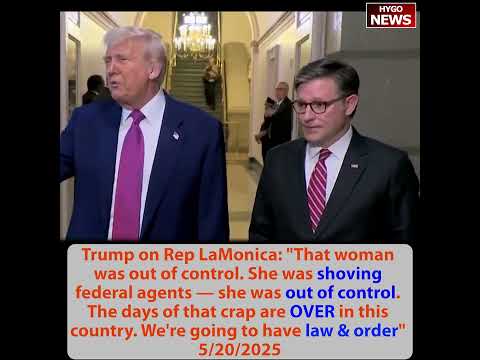
Multiple May 2025 stories converged. Secretary of State Marco Rubio delivered a devastating response to Senator Chris Van Hollen’s confession: “I regret voting for you for Secretary of State.” Rubio: “Your regret for voting for me confirms I’m doing a good job based on what I know.” He then destroyed Van Hollen on the El Salvador deportation case: “We deported gang members — including the one you had a margarita with. That guy is a human trafficker. That guy is a gangbanger. The evidence is going to be clear in the days to come.” Trump weighed in on Rep. LaMonica McIver’s conduct at Delaney Hall: “That woman was out of control. She was shoving federal agents. The days of that crap are OVER in this country. We’re going to have law and order.” On Medicaid: “We’re not touching anything. All I want is three words: waste, fraud, or abuse.” On Putin: “2.5 hours talking. Some progress made. Putin just said they respect your wife a lot. I said, ‘What about me?’ They like Melania better."
"Your Regret Confirms I’m Doing a Good Job”
The Van Hollen-Rubio exchange was the political highlight of the Senate Foreign Relations Committee hearing.
Senator Chris Van Hollen (D-MD) delivered the personal attack: “And I have to tell you directly and personally that I regret voting for you for Secretary of State. I yield back.”
Rubio’s response was characteristic — turning the intended insult into a compliment: “Well, first of all, your regret for voting for me confirms I’m doing a good job based on what I know.”
Van Hollen pushed back: “That’s just a flippant statement, Mr. Secretary.”
The Chairman intervened as Van Hollen tried to continue the exchange: “Senator, please let the Secretary up before.”
Van Hollen: “I’d be happy to, but then I can respond to his response.”
The Chairman was blunt: “Your time’s up, Senator, and woefully used, I might add.”
The exchange demonstrated several characteristic features of Washington politics:
Confirmation regret: During confirmation processes, senators sometimes vote for nominees of the opposing party as a courtesy or as reflection of presidential prerogatives. Once nominees take office and implement policies the senators oppose, “regret voting for you” becomes a common rhetorical device.
Rhetorical inversion: Rubio’s response inverted the intended attack. If Van Hollen — a Democrat with different foreign policy preferences — now regretted his vote, that meant Rubio was implementing policies different from those Van Hollen would prefer. Since Van Hollen’s policy preferences differed from the administration’s, Rubio pursuing the administration’s priorities would logically cause Van Hollen to regret his vote.
Chairman intervention: The Chairman (Senator Jim Risch of Idaho, presumably) used his procedural authority to shut down Van Hollen’s attempt to continue arguing. The “woefully used” commentary was unusually pointed for a committee chairman.
”The One You Had a Margarita With”
Rubio then destroyed Van Hollen on the El Salvador deportation issue.
Rubio had been given the floor to respond: “Well, in the case of El Salvador, absolutely. We deported gang members, gang members, including the one you had a margarita with.”
He named the specific accusations: “And that guy is a human trafficker and that guy is a gangbanger and that and the evidence is going to be clear in the days to come.”
He referenced the planned documentation: “You’re going to see who you went to the door.”
Van Hollen’s trip to El Salvador had been politically controversial. The Senator had traveled to El Salvador to advocate for Kilmar Abrego Garcia, an illegal immigrant who had been deported to CECOT (the high-security prison in El Salvador). Van Hollen had been photographed in what appeared to be a cordial setting with Abrego Garcia, with what looked like margaritas in the photographs.
The margarita imagery had become iconic. Van Hollen’s apparent comfort sharing drinks with a deportee had undermined his moral framing of the case. If Abrego Garcia was indeed a “human trafficker” and “gangbanger” as the administration claimed — with evidence forthcoming — then Van Hollen’s social photograph would become politically devastating.
Rubio’s confident assertion that “the evidence is going to be clear in the days to come” was a commitment that administration officials would release additional documentation supporting the deportation decision. If this evidence materialized, Van Hollen would be left defending his socializing with someone the evidence would show to be a serious criminal.
Van Hollen protested: “Chairman, he can’t make unsubstantiated comments like that.”
The Chairman was unmoved: “Secretary Rubio has the floor. You had your time.”
Van Hollen continued: “Secretary Rubio should take that testimony to the federal court in the United States because he hasn’t done it under oath.”
Rubio’s institutional response addressed the separation of powers: “There is a division in our government between the federal branch and the judicial branch. No judge and the judicial branch cannot tell me or the president how to conduct foreign policy. Give me a break.”
The institutional point was important. Federal courts had been increasingly asserting authority over immigration enforcement and deportation decisions. The administration’s position was that foreign policy decisions — including diplomatic agreements with foreign governments about the handling of deported individuals — were executive branch authorities that courts could not direct.
”That Woman Was Out of Control”
Trump addressed Rep. LaMonica McIver’s conduct at Delaney Hall.
A reporter had asked about the incident: “Did you see her? She was out of control.”
Trump had apparently not seen the specific footage: “No, I didn’t.”
Asked to clarify: “The days of what are over?”
Trump elaborated: “That woman, I don’t, I have no idea who she is. That woman was out of control. She was shoving federal agents. She was out of control. The days of that crap are over in this country. We’re going to have law and order.”
The Delaney Hall incident had been extensively documented. Rep. LaMonica McIver (D-NJ), along with Reps. Bonnie Watson Coleman and Rob Menendez, had physically confronted federal immigration officers during what they described as a congressional oversight visit to the Delaney Hall detention facility in Newark. Body camera footage showed McIver pushing and striking an officer. Secretary Kristi Noem had described the assaults in congressional testimony. Federal prosecutors had been evaluating potential charges.
Trump’s “days of that crap are over” framing captured the shift in administration approach. Under previous administrations, congressional Democrats had frequently engaged in provocative behavior at immigration facilities without significant consequences. Under Trump, the administration was making clear that physical confrontation with federal officers would face legal consequences regardless of congressional status.
The “law and order” framing was consistent with Trump’s broader political messaging. If Democratic members of Congress could physically assault federal officers without consequences, then the rule of law was meaningless. Equal application of criminal law required that physical assault of federal officers be prosecuted regardless of the assailant’s political position.
OBBB and Medicaid
Trump pivoted to the One Big Beautiful Bill and Medicaid specifically.
“It’s important for the country,” Trump said. “It’s not important for me. It’s important for the country.”
He described the scale: “I think it’s the most important bill this country has just about has ever done in terms of size and scope. That’s why we call it the great, big, beautiful deal.”
He described the content: “The bill is, I think it’s going to be one of the most important. It’s the biggest tax reduction in history. Biggest regulation reduction in history.”
He described the entitlement treatment: “Incredible for Medicaid and Medicare. The only thing we’re going to leave it exactly as it was other than for, obviously, waste, fraud, and abuse. We’re strengthening it. We’re going to make these things even stronger.”
He made the political contrast: “The Democrats are going to destroy Medicare, Medicaid, and Social Security. And we’re going to keep them, but even make them strong.”
He laid out the Medicaid principle: “Here’s what I want on Medicaid. We’re not touching anything. All I want is one thing. Three words. We don’t want any waste, fraud, or abuse. Very simple. Waste, fraud, abuse. Other than that, we’re leaving it.”
The “three words” framing was Trump’s characteristic simplification of complex policy. The OBBB Medicaid provisions were not merely about “waste, fraud, and abuse” in the narrow sense. The bill included:
- Work requirements for able-bodied adults
- Eligibility verification improvements
- Provider payment reforms
- State flexibility provisions
- Reduced federal matching for certain populations
But Trump’s framing captured the political essence. The Medicaid reforms were not designed to harm people who legitimately needed coverage — pregnant women, children, the disabled, the elderly. They were designed to ensure program integrity by:
- Preventing ineligible people from receiving benefits
- Requiring able-bodied adults to work, seek work, or volunteer
- Eliminating fraudulent provider practices
- Recapturing improper payments
Democrats’ framing — that any reform would “destroy” Medicaid — was both politically calculated and factually strained. The CBO baseline for Medicaid had projected substantial spending growth under current law. The OBBB reforms would reduce the growth rate somewhat but would not cut actual spending below current levels.
”They Like Melania Better”
Trump closed with the Putin conversation.
“Well, I want to thank everybody,” Trump said. “We just spent two and a half hours talking to Vladimir Putin. And I think some progress has been made.”
He described the scope: “It’s a terrible situation going on over there. 5,000 young people every single week are being killed.”
He described the European coordination: “We also spoke to the heads of most of the European nations. And we’re trying to get that whole thing wrapped up.”
He delivered the lamentation: “What a shame that it ever started in the first place.”
The “5,000 young people every single week” casualty figure was at the upper end of estimates but consistent with some Russian casualty reports. The actual casualties were intensely debated and politically weaponized by both sides. Ukrainian sources tended to emphasize high Russian casualties; Russian sources tended to minimize them. Independent estimates varied widely, but the war was undeniably producing substantial casualties on both sides.
Trump then transitioned to Melania’s role: “I want to thank Melania. And for your leadership in this very important issue, it’s an amazing issue. America is blessed to have such a dedicated and compassionate first lady.”
He delivered the final anecdote: “In fact, if you look at just what I heard, Putin just said, they respect your wife a lot. I said, ‘What about me?’ You know, they’re well. They like Melania better.”
He added the wry commentary: “That wasn’t good. I don’t know if that was good. I’m okay with it. I’m okay.”
The Melania anecdote was vintage Trump humor. By revealing that Putin had specifically mentioned respect for Melania — and then pretending to ask “what about me?” — Trump was both complimenting his wife and making light of the diplomatic dynamic. The underlying substance (Putin expressing respect for Melania) was also noteworthy: it suggested that Putin’s view of the Trump family was positive across generations and included non-principal figures like the First Lady.
Melania’s Slovenian background likely played a role. Slovenia had been part of Yugoslavia during the Cold War, and Slavic cultural affinity might have contributed to Putin’s expression of respect. Melania had also conducted herself during her time as First Lady with a reserved, dignified style that likely appealed to Putin’s aesthetic preferences for diplomatic consorts.
Key Takeaways
- Rubio to Van Hollen: “Your regret for voting for me confirms I’m doing a good job.”
- Rubio on El Salvador margarita photo: “We deported gang members — including the one you had a margarita with. Human trafficker. Gangbanger.”
- Trump on Rep. McIver: “That woman was out of control. Shoving federal agents. Days of that crap are over. Law and order.”
- Trump on OBBB: “Biggest tax reduction in history. Biggest regulation reduction. Incredible for Medicaid — three words: waste, fraud, abuse.”
- Putin call (2.5 hours): “Some progress made. Putin said they respect Melania a lot. I said, ‘What about me?’ They like Melania better.”