 HYGO News
 Dem Tells Musk 'Go Back to South Africa'; VA Sec: 'We Finished More Claims Than Ever'; $1.7T in Investment
Dem Tells Musk “Go Back to South Africa”; VA Sec: “We Finished More Claims Than Ever”; $1.7T in Investment
A March 2025 compilation captured the political spectrum in a single day. Rep. Nydia Velazquez (D-NY) told Elon Musk to “go back to South Africa” in remarks critics called xenophobic. VA Secretary Doug Collins rebutted claims that veterans’ benefits were being cut, saying “just last week, we finished more veteran benefits disability claims earlier in the year than we ever have — a million claims.” Press Secretary Leavitt announced that total foreign investment had reached “$1.7 trillion in one month since President Trump took office,” compared to Biden’s “$1 trillion in four years.” Crypto Czar David Sacks called TSMC’s chips “literally the most important products in the world.” And Peter Navarro outlined the “Three D’s” anti-inflation strategy: “Deregulation, DOGE, and Drill Baby Drill."
"Go Back to South Africa”
Rep. Nydia Velazquez (D-NY) delivered remarks about Elon Musk that immediately drew accusations of xenophobia from critics.
“My question to Elon Musk: What the hell are you doing here in America?” Velazquez said. “Go back to South Africa!”
The statement was seized upon by conservative commentators who noted the irony of a Democratic congresswoman — from a party that championed immigrant rights — telling a naturalized American citizen to leave the country based on his national origin. Musk had immigrated to the United States from South Africa, become a citizen, and built several of the most consequential technology companies in the world on American soil.
The “go back” formulation had been considered a hallmark of xenophobic rhetoric when directed at immigrants and minorities. When Trump had used similar language about Democratic congresswomen in 2019, it was universally condemned by Democrats and media as racist. Velazquez’s use of the same framing toward Musk received considerably less media scrutiny, reinforcing the administration’s argument about double standards in coverage.
VA Secretary: “Let’s Deal in Facts”
VA Secretary Doug Collins appeared on social media to directly rebut Democratic claims that the administration was cutting veterans’ healthcare and benefits.
“I’ve had a lot of senators and some House members as well from the other side make claims that are not true,” Collins said. “When they tell us there’s a possibility of healthcare delays for veterans, when they say that we’re hurting veterans in certain areas, when benefits are getting cut — and yet they have no actual experience in it or have no actual examples of it — then all they’re doing is putting fear into the veterans.”
Collins spoke with personal conviction: “As a child of a veteran, that’s just not something that should be done. It’s inexcusable.”
He then delivered the rebuttal in the form of a factual catalogue. “Let’s deal in facts,” Collins said. “Facts are, we’re not cutting healthcare. Facts are, we’re not cutting benefits. Facts are, we’re working to make it more streamlined.”
He cited a specific performance metric that undermined the critics’ narrative: “Just last week, we finished more veteran benefits disability claims earlier in the year than we ever have — a million claims.”
The one-million-claims figure was powerful because it demonstrated that the administration was not merely maintaining service levels but improving them. If the VA was processing disability claims faster than ever before, the argument that DOGE was degrading veteran services collapsed.
“So quit trying to scare people, quit trying to ideologue this, and let’s get to work on the real issues,” Collins concluded.
$1.7 Trillion in One Month
Press Secretary Leavitt placed the TSMC investment in the context of the administration’s total investment scorecard.
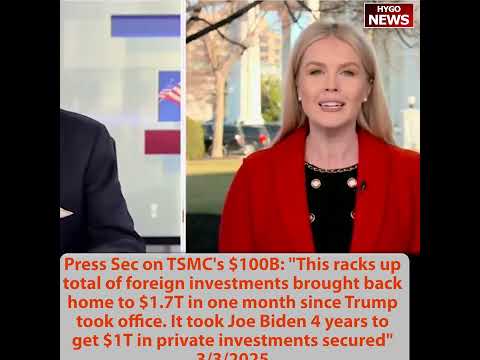
“This racks up the total of foreign investments brought back home to $1.7 trillion in one month since President Trump took office,” Leavitt said. “It took Joe Biden four years to get $1 trillion in private investments secured.”
She drew the comparison: “President Trump has already surpassed what Joe Biden did in four years — in one month. And that’s why he’s the greatest president we’ve ever had. And America is open for business, and the world knows it.”
The $1.7 trillion figure represented the cumulative total of announced investments: TSMC ($100B), Apple ($500B), SoftBank ($100-200B), DAMAC ($40B), the Oracle-OpenAI-SoftBank AI consortium ($500B), and numerous smaller commitments. Whether all of these investments would be fully realized over their announced timeframes remained to be seen, but the volume of commitments was unprecedented and reflected a level of corporate confidence in the American business environment that had not existed under Biden.
Sacks: “The Most Important Products in the World”
Crypto Czar David Sacks provided the strategic context for why the TSMC investment mattered beyond the headline dollar figure.
“TSMC makes literally the most important products in the world,” Sacks said. “These advanced chips power everything. They power AI. They power your phone. They power your cars. And without them, the whole modern economy would stop.”
He emphasized the geographic significance. “But they’re not made in the United States,” Sacks said. “So for TSMC to move here is a huge, huge development. And we owe that to President Trump’s leadership on the economy and Secretary Lutnick as well.”
The national security dimension that Sacks highlighted was the argument that made the TSMC investment more than just an economic achievement. A world in which advanced semiconductors were manufactured primarily in Taiwan was a world in which a Chinese invasion of Taiwan could cripple the global technology infrastructure. Moving a substantial portion of that manufacturing to the United States eliminated the single point of failure that represented one of America’s most serious strategic vulnerabilities.
Navarro: “The Three D’s”
Senior Counselor Peter Navarro provided the most concise summary of the administration’s anti-inflation strategy.
“Don’t forget the Three D’s,” Navarro said. “Deregulation, DOGE, and Drill Baby Drill. That’s the Trump strategy to bring down inflation dramatically. And anything that happens with tariffs is second-order small.”
He cited first-term experience as evidence. “Our experience in the first term was very clear. We did not have inflation. We had price stability when we put the tariffs on China, steel, aluminum, solar, dishwashers, and all of that. No inflation,” Navarro said.
He explained the mechanism: “The exporting countries, which are dependent on our markets, absorb a large share of the tariffs. And then you have the supply chain effects moving around. When our trade deficit goes down, the dollar goes up, imports are cheaper.”
Navarro described the long-term vision: “In the limit, and this is where President Trump wants to go, we have more and more investment here that raises productivity and real wages. And that mutes inflation as well.”
The “Three D’s” framework was designed to be memorable and repeatable: Deregulation freed businesses to produce more. DOGE reduced wasteful government spending that fueled demand-side inflation. And “Drill Baby Drill” lowered energy costs that fed into every sector of the economy. Together, they addressed inflation from multiple angles simultaneously, making the tariff impact — “second-order small” in Navarro’s telling — manageable within the broader deflationary framework.
Key Takeaways
- Rep. Velazquez (D-NY) told Elon Musk to “go back to South Africa,” drawing accusations of xenophobia and double standards from critics.
- VA Secretary Collins rebutted claims of benefit cuts: “Facts are, we’re not cutting healthcare. Facts are, we’re not cutting benefits” — and cited a record one million disability claims processed.
- Total foreign investment reached $1.7 trillion in one month under Trump, compared to Biden’s $1 trillion over four years.
- David Sacks called TSMC’s chips “the most important products in the world” and said the company’s U.S. move was “a huge development” for national security.
- Navarro outlined the “Three D’s” anti-inflation strategy: Deregulation, DOGE, and Drill Baby Drill — with tariff effects being “second-order small.”