 HYGO News
 DEI KJP Gaffes, Noble Prize, $70 per GALLON, Korean ARMTIS, INFRASTRUCTURE Reduction & Nord STROM
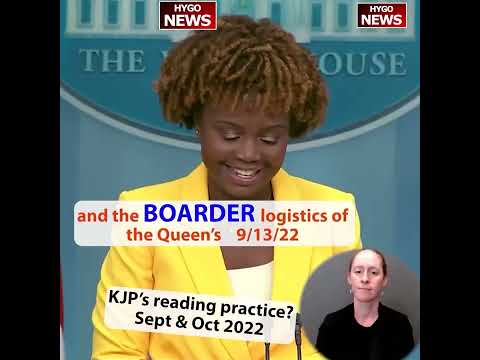
The Complete Collection of Karine Jean-Pierre’s Most Embarrassing Briefing Room Gaffes
Throughout her tenure as White House press secretary, Karine Jean-Pierre compiled a remarkable record of verbal stumbles, mispronunciations, and factual errors delivered from the most prominent podium in American government. While every press secretary misspeaks occasionally, the frequency and nature of Jean-Pierre’s gaffes raised persistent questions about her preparation, subject-matter knowledge, and fitness for a role that demands precision in every word. This compilation spans from September 2022 through late November of that year — a period of barely three months that produced an astonishing catalog of errors.
”Noble Prize”: Five Consecutive Mispronunciations
On November 28, 2022, Jean-Pierre announced that President Biden had met with three American winners of the 2022 Nobel Prize. The problem was that she pronounced “Nobel” as “Noble” — not once, not twice, but five consecutive times without self-correction.
“President Biden met with three U.S. winners of the 2022 Noble Prize: Dr. Carolyn Bertozzi, who won the Noble Prize in Chemistry; Dr. John Clauser, who won the Noble Prize in Physics; and Dr. Douglas Diamond, who won the Noble Prize in Economic Sciences,” she read from her prepared remarks. “The President is restarting an important tradition that just like he does for winning sports teams, the President meets with U.S. winners of the Noble Prize.”
The Nobel Prize, named after Swedish inventor Alfred Nobel, is arguably the most prestigious award in the world. Its correct pronunciation is fundamental general knowledge, and the word appeared in Jean-Pierre’s written remarks — meaning she had the correct spelling directly in front of her while repeatedly saying it wrong. The fact that no one in the briefing room corrected her in real time only added to the surreal quality of the moment.
During the same briefing, Jean-Pierre also said she was going to “go out of school for a second” — apparently meaning “go off-script” or perhaps “speak out of turn” — a malapropism that went entirely unacknowledged.
”$70 per Gallon”: A $2,940 Barrel of Oil
On October 19, 2022, while discussing the administration’s energy policy and the Strategic Petroleum Reserve, Jean-Pierre announced that “the administration intends to repurchase oil for the SPR when prices are around $70 per gallon.”
The standard unit for crude oil pricing is per barrel, not per gallon. A standard U.S. barrel contains 42 gallons. At $70 per gallon, the government would be paying $2,940 per barrel — a figure roughly 40 times the market price at the time. For a press secretary speaking about one of the administration’s most politically sensitive policies — energy costs that directly affected every American household — the error was not merely cosmetic. It demonstrated a fundamental unfamiliarity with the subject matter she was tasked with communicating.
In the same briefing, Jean-Pierre also said that oil companies were “ranking in record profits” instead of “raking in record profits,” a malapropism that slipped past without correction.
”Korean ARMTIS” and Other Foreign Policy Fumbles
The mispronunciations were not limited to domestic policy. On September 28, 2022, while announcing Vice President Harris’s visit to the Korean Demilitarized Zone, Jean-Pierre referred to the “Korean armtis” — her attempt at “armistice,” the 1953 agreement that ended active hostilities in the Korean War. For a White House discussing one of America’s most consequential military alliances, the inability to pronounce the foundational agreement of that alliance was notable.
On September 6, 2022, she referred to the Nord Stream pipeline as “Nord Strom” — apparently conflating the name of a major geopolitical flashpoint with the American department store chain Nordstrom. This came during a discussion of European energy security, one of the most critical foreign policy issues of that period, as Russia had been weaponizing gas supplies in the context of its invasion of Ukraine.
”INFRASTRUCTURE Reduction Act”
Perhaps the most ironic gaffe came on September 13, 2022, when Jean-Pierre referred to the Inflation Reduction Act — one of the Biden administration’s signature legislative achievements — as the “Infrastructure Reduction Act.” The error was doubly embarrassing because the administration had spent months trying to distinguish between two separate pieces of legislation: the Bipartisan Infrastructure Law (passed in 2021) and the Inflation Reduction Act (passed in 2022). By combining the names into a nonsensical hybrid, Jean-Pierre undermined the very messaging effort the White House had been conducting.
In the same briefing, she cited “$1.7 billion in deficit deduction under this administration,” mangling “reduction” into “deduction” — a word with an entirely different meaning, particularly in the context of fiscal policy.
Systemic Errors in Energy and Foreign Policy Briefings
The gaffes followed a pattern. On September 7, 2022, while discussing European energy security, Jean-Pierre said that “Europe gas shortage will be full by the critical winter heating season” and “Germany will reach their target gas shortage.” In both cases, she said “shortage” when she meant “storage” — words that are literal opposites in this context. Gas storage being full would be good news; a gas shortage being “full” is meaningless.
Later, on the same topic, she stated that U.S. sanctions “do stand in the way of the pipeline continuing operating” — which was the opposite of the U.S. government’s actual position. The United States had maintained that its sanctions on Russia were not designed to block European energy supplies, only to punish Russian aggression. Jean-Pierre’s statement accidentally endorsed the Russian framing of the situation.
On October 4, 2022, discussing President Biden’s visit to hurricane-stricken Florida, she said he would be “talking to the respondents on the ground” — meaning “first responders,” a term that is standard vocabulary for any discussion of disaster response.
The DEI Context
The compilation is framed by Jean-Pierre’s own emphasis on the diversity credentials of the Biden cabinet. In one clip, she proudly noted that “the cabinet is majority people of color,” “the cabinet is majority female,” “40% identify as part of the racially diverse communities,” and “a record seven assistants to the president are openly LGBTQ+.”
Critics pointed to this emphasis as evidence that the administration prioritized demographic representation over competence in its staffing decisions. Whether or not that characterization is fair in the broader context of the administration, the juxtaposition of diversity boasting with a highlight reel of basic errors in pronunciation, geography, policy terminology, and factual accuracy provided powerful ammunition for that argument.
Why Preparation Matters at the Podium
The White House press secretary speaks on behalf of the President of the United States. Every word from that podium is recorded, transcribed, analyzed, and archived. Foreign governments monitor briefings for signals about American policy. Markets react to statements about economic policy. Military allies parse language about defense commitments.
In that context, mispronouncing “Nobel” five times, confusing gallons with barrels, calling the Korean Armistice the “Korean armtis,” renaming the Inflation Reduction Act, and saying the opposite of official U.S. policy on sanctions are not trivial stumbles. They represent a pattern of inadequate preparation for a role that demands nothing less than total command of the material.
Key Takeaways
- Jean-Pierre mispronounced “Nobel” as “Noble” five consecutive times while reading from prepared remarks about President Biden meeting Nobel Prize winners on November 28, 2022.
- She said the administration would repurchase oil at “$70 per gallon” instead of per barrel, which would have meant paying $2,940 per barrel — roughly 40 times the market price.
- She called the Korean Armistice the “Korean armtis,” the Nord Stream pipeline “Nord Strom,” and the Inflation Reduction Act the “Infrastructure Reduction Act” — all core policy terms for the administration she represented.
- She repeatedly said European gas “shortage” would be full when she meant “storage,” and stated that U.S. sanctions “do stand in the way” of pipeline operations, which was the opposite of official U.S. policy.
- The pattern of errors spanned domestic energy policy, foreign affairs, fiscal policy, and basic vocabulary, raising persistent questions about the level of preparation brought to the most important podium in American government.