 HYGO News
 D.C. resident who lost her grandson: Thank God for this President. Nobody cared. nobody heard me—Dem
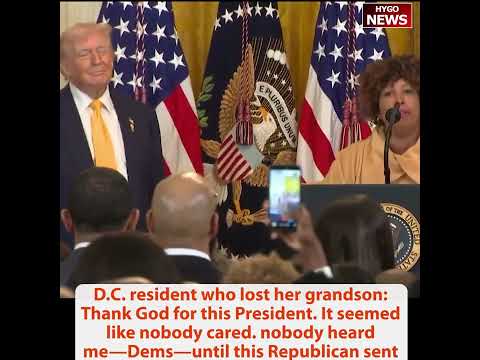
D.C. resident who lost her grandson: Thank God for this President. Nobody cared. nobody heard me—Dem
The White House Black History Month event featured a powerful testimony from a D.C. resident and grandmother whose grandson was murdered. She spoke directly of how Democratic officials had ignored her activism for years, while Republicans eventually sent staff to her home to hear her story. The grandmother described marching, rallying, and pulling other D.C. families with murdered children to demand answers — and being heard by no one until the Trump administration engaged. She endorsed Congressional testimony she had provided on Trump’s crime bill, stated the principle “you take a life, you do life,” and praised Trump for bringing in the National Guard to address D.C. crime. Trump then spoke about African American military service — nearly 10,000 African Americans fought for the Patriot cause in the Revolutionary War, and from the Buffalo Soldiers through the Tuskegee Airmen, Black Americans have defended the flag in every generation. Trump celebrated African American contributions to music from jazz and blues to rock and roll and rap — namechecking Chuck Berry, Muddy Waters, and Nicki Minaj, whose recent White House visit Trump praised warmly. Trump concluded with Frederick Douglass and Martin Luther King Jr. as Black leaders who “made our country freer” and “made life more just.” The grandmother: “Thank God for this President. I am filled my cup running over because he allowed his constituents, his people, to come to my house to interview me to talk about the murder of my grandson. It seemed like nobody cared.”
The Grandmother’s Testimony
“One thing I like about him, he keeps it real just like Grandma. I appreciate that because I can trust him because he tells exactly how he feels and what he thinks.”
The grandmother opened with her Trump framework. Authenticity matters. Trump’s directness earned her trust.
“Thank God for this President.”
The emphatic declaration. The audience understood the depth of gratitude from someone whose grandson was murdered.
“I am filled my cup running over because he allowed his constituents, his people, to come to my house to interview me to talk about the murder of my grandson.”
Trump administration staff — “his constituents, his people” — went to her home. Not a formal hearing. Not a distant phone call. Personal presence to hear her story.
”Nobody Cared”
“It seemed like nobody cared. I’m an advocate for murder.”
“I’m an advocate for murder [victims]” — the context incomplete but clear. She became an activist after her grandson’s murder.
“I marched. I rallied. I pulled out other families in the District of Columbia that had murders and did not have answers.”
Her activism:
- Marches in D.C.
- Rallies for justice
- Outreach to other victim families
- Demands for answers about unsolved murders
D.C. has among the highest urban murder rates in America. Many cases remain unsolved. Families without answers form a shadow community of grief.
“We marched and we rallied and nobody heard me, Democrats.”
The Democratic Party controls D.C. politics entirely. The mayor is Democratic. The Council is Democratic. Federal oversight has been under Democratic administrations for much of recent history. Yet she was not heard.
“Get mad at me. Until this Republican sent his constituents, his people out there, to interview me in my home.”
The reversal — Republicans heard her. Democrats did not. She is willing to face Democratic criticism for endorsing Trump.
Congressional Testimony
“Have you ever heard of a thing? When they invited me twice before Congress to testify for the beautiful bill that’s going to change crime in the District.”
She testified twice before Congress in support of Trump’s “beautiful bill” — the OBBB crime provisions or related D.C. crime legislation.
“If you kill somebody, okay, you take a life, you do life. Just as simple.”
Her principle: murder conviction = life sentence. Automatic, predictable, certain.
“If you do a harsh crime, you do harsh time. Just as simple.”
Proportionality through severity. Serious crimes warrant serious punishment.
National Guard
“And then we need National Guard and what we did years ago, he brought it on.”
Trump deployed the National Guard to D.C. She credits Trump with the deployment she and other victim families had requested.
The National Guard deployment in Washington D.C. — restoring order in the nation’s capital — became one of the signature Trump actions addressing crime.
“I love him. I don’t want to hear nothing. You got to say about their racist stuff.”
Her preemptive rejection of racism accusations against Trump. She is a Black grandmother supporting Trump because Trump actually helped while Democrats ignored her.
“And don’t be looking at me on the news. Hating on me because I’m standing up for somebody that deserves to be standing up for.”
Her message to critics — don’t attack her for endorsing Trump. She earned her opinion through her grief and her activism.
“Get off the man’s back. Let him do his job. He’s doing the right thing. Back up off of him. And grandma said it.”
“Grandma said it” — her signature close. Authority from her role as grandmother, victim, activist.
Trump on African American Military Service
Trump continued with the Black History Month framework. “Nearly 10,000 African Americans fought for the Patriot cause and the Revolutionary War. Did you know that?”
The historical fact — African Americans fighting for American independence from the founding. Estimates range from 5,000 to 10,000 Black patriots in the Revolutionary War.
“10,000 actually a number, even, I’ve heard even higher than that, helping secure our independence.”
Trump’s acknowledgment that some estimates are higher. The historical contribution substantial.
Every Generation
“In every generation since from the Buffalo soldiers to the Tuskegee airmen, black Americans have stepped forward to defend the flag and to defend our country.”
Historical units:
- Buffalo Soldiers — post-Civil War Black Army regiments (9th, 10th Cavalry; 24th, 25th Infantry)
- Frontier service in the West
- Spanish-American War participation
- Philippine-American War service
Tuskegee Airmen — WWII Black fighter pilots:
- 332nd Fighter Group
- Outstanding combat record
- Bomber escort missions
- Breaking racial barriers in the military
“Like few others really, like few others. And you’ve never really been given the recognition that you should get for that.”
Trump’s framework — African American military service under-recognized. Acknowledgment owed.
Music Legacy
“From jazz to the blues, that you know, that you do get recognition for. Jazz, the blues, from rock and roll to rap.”
The musical genres — each with deep African American roots:
- Jazz — from New Orleans, Black American origin
- Blues — from the Mississippi Delta, Black American origin
- Rock and roll — from rhythm and blues, Black American origin
- Rap/hip-hop — from the Bronx, Black American origin
“Black artists like Chuck Berry, Muddy Waters.”
Chuck Berry — rock and roll pioneer. “Johnny B. Goode,” “Roll Over Beethoven,” foundational to the genre.
Muddy Waters — blues legend. “Hoochie Coochie Man,” “Mannish Boy,” foundational to Chicago blues and thus rock.
Nicki Minaj
“How about Nicki Minaj? We love Nicki Minaj. I love Nicki Minaj. She was here a couple of weeks ago.”
Nicki Minaj had visited the White House previously. Trump expressed warm appreciation.
“So beautiful. Her skin so beautiful.”
Trump’s physical appreciation.
“I said, Nicki is so beautiful. Her nails, her nails are like that long. I said, Nicki are they real? She said, she didn’t want to get into that.”
Trump’s personal exchange with Nicki Minaj. The nail question — her signature long nails visible in her public appearances. Minaj diplomatically avoided the real/fake question.
“But she was so beautiful. It’s so great. And she gets it. And more importantly, frankly, she gets it.”
“She gets it” — Minaj understands Trump’s framework. Her political support has been public since her earlier visit to thank Trump for the OBBB provisions affecting her industry.
Black Leaders
“But black leaders from Frederick Douglass to Martin Luther King, right? Little relative over here have made our country freer.”
The historical arc:
-
Frederick Douglass — escaped slave, abolitionist, orator, statesman
-
Republican Party co-founder era
-
Representative to Haiti under Republican administration
-
Martin Luther King Jr. — civil rights leader
-
“I Have a Dream” speech
-
Nobel Peace Prize
-
Assassinated 1968
“Little relative over here” — unclear reference, perhaps to a King family member present.
“And really what they’ve really done is made life more just.”
Trump’s framework — Black leadership made American life more just. Historical acknowledgment.
Significance
The White House Black History Month event captured multiple themes:
- Direct testimony from Black supporters — the grandmother’s testimony powerful beyond political framing
- Historical acknowledgment — African American contributions to American military and cultural history
- Cross-partisan coalition building — Trump reaching African American voters through authentic engagement
- Policy substance — crime legislation, National Guard deployment, Trump Accounts, HBCU funding
The grandmother’s testimony — “Democrats, nobody heard me” — captured the political realignment occurring in Black communities frustrated with Democratic urban governance failures.
Nicki Minaj’s endorsement reflected celebrity culture support that extends Trump’s reach into demographics traditionally considered Democratic strongholds.
Key Takeaways
- Grandmother’s testimony: “Thank God for this President. I am filled my cup running over because he allowed his constituents, his people, to come to my house to interview me to talk about the murder of my grandson. It seemed like nobody cared.”
- Grandmother on Democratic silence: “I marched. I rallied. I pulled out other families in the District of Columbia that had murders and did not have answers. We marched and we rallied and nobody heard me, Democrats. Until this Republican sent his constituents, his people out there, to interview me in my home.”
- Grandmother on crime policy: “If you kill somebody, okay, you take a life, you do life. Just as simple. If you do a harsh crime, you do harsh time. Just as simple. And then we need National Guard and what we did years ago, he brought it on.”
- Trump on military service: “Nearly 10,000 African Americans fought for the Patriot cause and the Revolutionary War … from the Buffalo soldiers to the Tuskegee airmen, black Americans have stepped forward to defend the flag and to defend our country. Like few others really, like few others.”
- Trump on cultural contributions: “From jazz to the blues … from rock and roll to rap black artists like Chuck Berry, Muddy Waters. How about Nicki Minaj? We love Nicki Minaj … But black leaders from Frederick Douglass to Martin Luther King … have made our country freer. And really what they’ve really done is made life more just.”