 HYGO News
 cut deficit: misleading because COVID spending ended. Biden signing increase federal spending
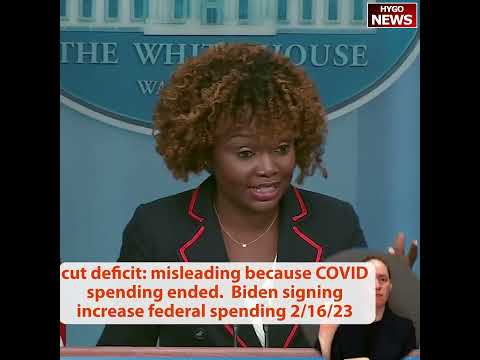
Reporter Confronts KJP: Isn’t Biden’s Deficit Claim Misleading? CBO Projects $1.4T 2023 Deficit
In February 2023, a reporter challenged White House Press Secretary Karine Jean-Pierre on Biden’s repeated deficit reduction claims. “The president said that he has cut the deficit over the past two years, but isn’t that misleading for Americans because it was the COVID spending that ended that really brought that money down as well as the president signing an increase in ongoing federal spending. And now the CBO is saying the federal deficit this year is $1.4 trillion and averaging $2 trillion until 2033,” the reporter challenged. KJP defended Biden’s fiscal framing: “The president has long made reducing the deficit and being fiscally responsible as a priority. And I think look no further than his speech yesterday, look no further also, I guess, his speech, the State of the Union, where he said that he’s going to continue to cut the deficit by $2 trillion. But here’s the thing, you have congressional Republicans who want to increase the deficit by $3 trillion.” When pressed on how to accomplish this through spending cuts and tax increases, KJP deflected: “I’m not going to get ahead of the president. I’m just saying what he laid out to all of you yesterday, $2 trillion. He’s going to lower the deficit.”
The Reporter’s Substantive Challenge
Challenge:
Misleading claim — Alleged.
COVID spending — Identified.
Expiration mechanical — Noted.
Biden spending — Cited.
CBO data — Used.
The reporter’s substantive challenge identified Biden’s deficit claim as potentially misleading because COVID spending expiration was mechanical reduction, while Biden signed ongoing increases. CBO data supported critique.
The COVID Spending Expiration
COVID spending:
Pandemic emergency — Temporary.
Programs expired — Naturally.
Deficit reduction — Mechanical.
Not policy choice — Primarily.
Credit — Disputed.
COVID spending expiration was pandemic emergency naturally expiring. Deficit reduction mechanical consequence. Not primarily policy choice requiring Biden credit. Credit for the reduction was disputed fact-check issue.
The Ongoing Spending Increases
Ongoing increases:
ARP — $1.9T.
Infrastructure — $1T+.
IRA — Various.
CHIPS Act — Major.
Net effect — Increases.
Ongoing spending increases Biden signed included American Rescue Plan ($1.9T), Infrastructure ($1T+), Inflation Reduction Act, CHIPS Act. Net effect was substantial ongoing spending increases despite deficit claims.
The CBO Data Authoritative
CBO:
Congressional Budget Office — Nonpartisan.
$1.4T deficit — 2023 projected.
$2T average — Through 2033.
Authoritative — Source.
Contradicts — Administration claim.
The CBO Congressional Budget Office data was nonpartisan authoritative source. $1.4T deficit projection for 2023 and $2T average through 2033. This contradicted administration deficit reduction narrative substantively.
”$1.4 Trillion” Current
Current:
2023 projection — Large.
Historical high — By standards.
Peace time — High.
Concerning — To fiscal conservatives.
Real — Problem.
CBO’s $1.4 trillion current year projection was large by historical standards. Peace time high. Concerning to fiscal conservatives. Real ongoing problem contradicting Biden’s fiscal responsibility messaging.
”Averaging $2 Trillion Until 2033”
Long-term:
10-year average — Projection.
$2 trillion annually — Substantial.
Structural — Problem.
Long-term — Issue.
Increasing — Trend.
The CBO’s $2 trillion average annual deficit projection through 2033 showed substantial structural problem as long-term issue. Increasing trend concerning for fiscal sustainability long-term.
”Long Made Reducing the Deficit Priority”
KJP defense:
Priority — Claimed.
Historical — Frame.
Biden commitment — Asserted.
Standard — Defense.
Record-based — Attempt.
KJP’s “president has long made reducing the deficit and being fiscally responsible as a priority” was claimed priority historical frame. Biden commitment asserted. Standard defense approach record-based attempt.
”Look No Further Than His Speech”
Reference:
Speech yesterday — Cited.
SOTU — Reference.
Written commitment — Claimed.
Rhetoric-based — Evidence.
Standard — Defense.
KJP’s “look no further than his speech yesterday” and SOTU reference offered rhetoric-based evidence rather than policy analysis. Standard defense citing speech rhetoric as substance.
”$2 Trillion” Future Promise
Future:
$2 trillion cut — Promised.
SOTU commitment — Made.
Future action — Required.
Implementation — Pending.
Political — Marker.
The $2 trillion future deficit cut promise was SOTU commitment requiring future action. Implementation pending. Political marker set but accomplishment unverified until implemented.
”Congressional Republicans Want to Increase Deficit by $3 Trillion”
GOP attack:
Counter-narrative — Constructed.
$3 trillion — Specific.
GOP blame — Deployed.
Partisan — Frame.
Defensive — Strategy.
KJP’s “congressional Republicans who want to increase the deficit by $3 trillion” constructed counter-narrative. Specific $3T number. GOP blame deployed. Partisan frame as defensive strategy.
The GOP Fiscal Agenda Reality
GOP reality:
Tax cut extensions — TCJA.
Defense spending — Protected.
Entitlement — Untouched.
Cuts demanded — On others.
Complex — Politics.
GOP fiscal agenda reality had TCJA tax cut extensions, protected defense spending, largely untouched entitlements, cuts demanded on other programs. Complex politics contradicting simple “cut government” framing.
The IRA Repeal Context
IRA repeal:
Republicans proposed — Yes.
Revenue loss — Real.
Climate investment — Lost.
Democratic defense — Strong.
Partisan — Battle.
The “repealing the Inflation Reduction Act” context was Republicans had proposed this with real revenue loss, climate investment lost. Democratic defense of IRA strong. Partisan battle over legislation.
”I’m Not Going to Get Ahead”
Deflection:
Future policy — Deferred.
Spending cuts specifics — Avoided.
Tax increases specifics — Avoided.
Budget release — Pending.
Standard — Deflection.
KJP’s “I’m not going to get ahead” deflection deferred future policy details on spending cuts and tax increases. Budget release pending. Standard deflection on specifics until release.
”Just Saying What He Laid Out”
Reference:
Prior statement — Referenced.
Rhetoric — Cited.
Policy specifics — Deferred.
Budget coming — Implied.
Standard — Response.
“Just saying what he laid out to all of you yesterday” referenced prior statement of $2T cut rhetoric. Policy specifics deferred. Budget coming implied. Standard political response pattern.
”$2 Trillion. He’s Going to Lower the Deficit”
Restatement:
Number repeated — $2T.
Promise restated — Future action.
Rhetoric — Primary.
Specifics — Avoided.
Commitment — Stated.
The $2 trillion restatement as promise with commitment stated was rhetoric primary with specifics avoided. Future action claimed as core framework for fiscal response narrative.
The Deficit Reduction Fact-Check
Fact-check:
$1.7T reduction — Claim.
COVID expiration — Real cause.
Biden credit — Limited.
Mixed analysis — Resulted.
Complex — Reality.
Deficit reduction fact-check of $1.7T reduction claim showed COVID expiration as real cause. Biden’s direct credit limited. Mixed analysis resulted from detailed examination. Complex reality behind simple claim.
The Emergency Spending Natural End
End:
Pandemic programs — Expired.
CARES Act — Ended.
Unemployment — Reduced.
Recovery mechanical — Yes.
Policy — Limited role.
Emergency spending natural end was pandemic programs expiring, CARES Act ending, unemployment benefits reduced. Recovery was mechanical largely. Policy role limited in this reduction portion.
The Biden Spending Increases
Increases:
American Rescue Plan — $1.9T.
Infrastructure — $1T+.
IRA — Various.
CHIPS Act — Major.
Adds to — Deficit.
Biden’s spending increases with American Rescue Plan ($1.9T), Infrastructure ($1T+), IRA, CHIPS Act added substantially to deficit pressures. Specific Biden policy contributed to deficit structure.
The 10-Year Budget Projections
Projections:
CBO long-term — Baseline.
Growing deficits — Forecast.
Interest cost — Rising.
Entitlements — Increasing.
Structural — Challenge.
CBO 10-year budget projections showed baseline growing deficits, rising interest costs, increasing entitlement pressures. Structural challenge requiring substantial policy response.
The Political Framing vs. Reality
Framing:
Biden claim — Credit for reduction.
Reality — COVID mechanical.
Gap — Significant.
Messaging — Distortion.
Accountability — Through press.
Biden’s political framing of credit for deficit reduction gap with COVID mechanical reality was significant messaging distortion. Accountability function through press questioning substantive.
The 2024 Campaign Implications
Campaign:
Fiscal record — Mixed.
Defense required — Strong.
Attack vulnerability — Real.
Messaging discipline — Needed.
Strategy — Evolving.
2024 campaign implications had fiscal record mixed, defense required strong, attack vulnerability real, messaging discipline needed. Strategy evolving to address fiscal narrative challenges.
The Structural Fiscal Challenge Real
Challenge:
Entitlements — Growing.
Interest costs — Rising.
Demographics — Aging.
Revenue — Insufficient.
Reform needed — Structural.
Structural fiscal challenge was real with growing entitlements, rising interest costs, aging demographics, insufficient revenue. Structural reform needed but politically difficult.
The Social Security and Medicare Third Rails
Third rails:
Politically untouchable — Usually.
Demographic — Pressure building.
Reform needed — Substantive.
Political — Difficult.
Both parties — Protect.
Social Security and Medicare third rails were politically untouchable usually despite building demographic pressure. Substantive reform needed but politically difficult. Both parties publicly protect programs.
The Tax Policy Debate
Tax policy:
TCJA expiration — 2025.
Biden proposed — Higher rates wealthy.
Republicans — Extend cuts.
Revenue — Contested.
Major — Policy battle.
Tax policy debate with TCJA expiration in 2025 loomed. Biden proposed higher rates on wealthy. Republicans wanted extensions. Revenue contested. Major policy battle forming.
The Wealthy Tax Proposals
Proposals:
Billionaire minimum — Tax.
Corporate increase — Rates.
Stock buyback — Tax.
Loophole closing — Various.
Revenue substantial — If enacted.
Biden’s wealthy tax proposals included billionaire minimum tax, corporate rate increases, stock buyback tax, various loophole closing. Revenue substantial if enacted but facing Republican opposition.
The Economic Sustainability Question
Sustainability:
Long-term — Challenge.
Debt-to-GDP — Rising.
Interest ratio — Climbing.
Reserve currency — Status advantageous.
Reckoning — Eventual.
Economic sustainability question had long-term challenge with rising debt-to-GDP, climbing interest-to-revenue ratio, reserve currency status providing some advantage. Eventual reckoning if not addressed.
The Press Accountability Function
Accountability:
Data-based — Questions.
Fact-checking — Active.
Substantive — Inquiries.
Professional — Approach.
Quality — Journalism.
Press accountability function through data-based questions, active fact-checking, substantive inquiries, professional approach showed quality journalism on fiscal policy issues.
The Reporter’s Professional Work
Work:
CBO data — Cited.
Specific numbers — Used.
Substantive — Question.
Accountability — Sought.
Quality — Inquiry.
Reporter’s professional work with CBO data citation, specific number usage, substantive question, accountability seeking demonstrated quality inquiry. Strong preparation.
The Administrative Messaging Limits
Limits:
Rhetoric — Primary defense.
Reality — Often contradicts.
Credibility — At stake.
Press — Scrutinizing.
Strategy — Challenging.
Administrative messaging limits with rhetoric as primary defense often contradicting reality created credibility stake. Press scrutinizing. Strategy challenging to maintain.
The March 2023 Budget Release
Release:
Coming soon — Planned.
Details revealed — Would be.
Scrutiny — Intense expected.
Policy substance — Provided.
Benchmark — Set.
March 2023 budget release coming soon would reveal details. Intense scrutiny expected. Policy substance provided. Benchmark set for fiscal debate. Opportunity for substantive engagement.
The Biden $2T Plan Scrutiny
$2T plan scrutiny:
Specifics awaited — Budget.
Plausibility — Assessed.
Tax increases — Expected.
Spending cuts — Limited.
Revenue focus — Likely.
Biden’s $2T plan scrutiny awaited budget specifics. Plausibility assessed when details emerged. Tax increases expected as primary mechanism. Spending cuts limited politically. Revenue focus likely.
The Political Communication Choice
Choice:
Simple claim — Deficit cut.
Complex reality — Acknowledged less.
Short-term wins — Messaging.
Long-term cost — Credibility.
Trade-off — Strategic.
Political communication choice of simple deficit cut claim over complex reality acknowledgment had short-term messaging wins but long-term credibility costs. Strategic trade-off made.
The KJP Deflection Pattern
Pattern:
Template responses — Used.
Substance limited — Typically.
Questions avoided — Often.
Rhetoric rehashed — Regularly.
Consistent — Approach.
KJP deflection pattern used template responses with limited substance, avoided questions often, rehashed rhetoric regularly. Consistent approach across briefings.
The Long-Term Fiscal Politics
Politics:
2024 campaign — Immediate.
2025 tax expiration — Major.
Entitlement crisis — Building.
Reform difficult — Politically.
Long-term — Challenge.
Long-term fiscal politics had 2024 campaign immediate, 2025 tax expiration major flashpoint, building entitlement crisis, politically difficult reform. Long-term strategic challenge.
Key Takeaways
- A reporter challenged KJP: “Isn’t that misleading for Americans because it was the COVID spending that ended that really brought that money down?”
- She cited CBO: “The federal deficit this year is $1.4 trillion and averaging $2 trillion until 2033.”
- KJP defended: “The president has long made reducing the deficit and being fiscally responsible as a priority.”
- She cited speech: “He said that he’s going to continue to cut the deficit by $2 trillion.”
- She counter-attacked: “You have congressional Republicans who want to increase the deficit by $3 trillion.”
- She deflected on specifics: “I’m not going to get ahead of the president. I’m just saying what he laid out to all of you yesterday, $2 trillion.”
Transcript Highlights
The following is transcribed from the video audio (unverified — AI-generated from audio).
- The president said that he has cut the deficit over the past two years, but isn’t that misleading for Americans because it was the COVID spending that ended that really brought that money down as well as the president signing an increase in ongoing federal spending.
- And now the CBO is saying the federal deficit this year is $1.4 trillion and averaging $2 trillion until 2033.
- The president has long made reducing the deficit and being fiscally responsible as a priority.
- Look no further than his speech yesterday, look no further also, I guess, his speech, the State of the Union, where he said that he’s going to continue to cut the deficit by $2 trillion.
- You have congressional Republicans who want to increase the deficit by $3 trillion.
- I’m not going to get ahead of the president. I’m just saying what he laid out to all of you yesterday, $2 trillion. He’s going to lower the deficit.
Full transcript: 192 words transcribed via Whisper AI.