 HYGO News
 Crown Prince & PM Bahrain: $17B deals, aren't fake deals; negotiation with Iran necessary?
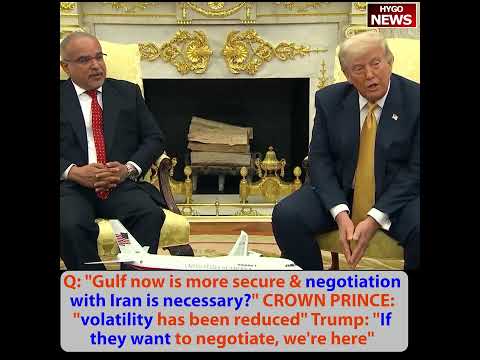
Crown Prince & PM Bahrain: $17B deals, aren’t fake deals; negotiation with Iran necessary?
Prince Salman bin Hamad Al Khalifa, Crown Prince and Prime Minister of the Kingdom of Bahrain, met with President Trump at the White House to announce $17 billion in deals — emphasizing, pointedly, “this is real … It’s real money. These aren’t fake deals. These are real deals. They don’t have to borrow the money. We don’t have to borrow it. It’s coming in.” The Crown Prince noted the U.S.-Bahrain relationship dates to 1893 civilly and 1948 formally. On Iran, Trump assessed: “the volatility of the situation has been reduced. We didn’t know where it was going to go on the Sunday. We were very glad when we found out on the Monday” — referring to the Iran strike. “If they want to negotiate, we’re here. We’re in no rush because we could have made a deal … And then we bombed the hell out of their various places.” Trump then pivoted to Homer City, noting the Pennsylvania Energy Project figure “is actually going over. So it’ll be over a hundred billion dollars."
"These Aren’t Fake Deals”
The Crown Prince opened with a striking disclaimer. “We’re very happy to be announcing 17 billion dollars worth deals that are coming to the United States. And this is real, Cisund. It’s real money. These aren’t fake deals. These are real deals. They don’t have to borrow the money. We don’t have to borrow it. It’s coming in.”
The “aren’t fake deals” line is unusual in diplomatic language. It responds directly to a critique that has circulated during the administration’s deal-by-deal investment tallies: that some of the announced figures represent aspirational commitments or re-labeled existing flows rather than new capital formation. The Crown Prince’s insistence that Bahrain’s $17 billion is “real money” is the sovereign-wealth-state’s version of providing proof of funds at closing.
“It’s coming in” is the operational verb. Not “has been committed.” Not “has been discussed.” Coming in — funds moving from Bahrain’s financial system into the U.S. financial system, hitting American corporate balance sheets and American government receipts.
1893: The Civil Relationship
The Crown Prince positioned the deal within a century-plus of relations. “It only builds upon a legacy that we’re very proud of. We have had a relationship in the civil side between our two countries since 1893 and formally since 1948. So may it long continue and we look forward to many, many or more years of productive partnership.”
1893 is when Bahrain began hosting the American Mission Hospital, one of the earliest American institutions in the Gulf. Formal U.S.-Bahrain diplomatic ties began in 1948. For most of the subsequent decades, Bahrain has been one of the most reliably pro-American Gulf states — hosting the U.S. Fifth Fleet, signing on to the Abraham Accords, and maintaining consistent security cooperation.
“May it long continue” is the kind of line that reads as boilerplate but means something when backed by a $17 billion commitment. Diplomatic relationships are always being renegotiated. Bahrain’s choice to announce this scale of investment on U.S. soil, during Trump’s second term, is a statement about which way the relationship is moving.
”The Volatility Has Been Reduced”
The reporter asked the strategic question. “Do you think that the Gulf area now is more secure and do you believe that a negotiation with Iran is necessary at this stage?”
The Crown Prince’s answer was measured but affirmative on the stability point. “Well, I definitely believe that the volatility of the situation has been reduced. We didn’t know where it was going to go on the Sunday. We were very glad when we found out on the Monday. Let me put it that way.”
“The Sunday” and “the Monday” are references to the U.S. strike on Iranian nuclear facilities and the initial regional response. The Crown Prince’s framing — that Gulf states did not know whether the aftermath would spiral into wider conflict, and were relieved when the regional temperature did not escalate — is a diplomatic way of saying the Trump administration’s Iran action achieved its strategic objective without the feared escalation.
For Bahrain, which sits directly across the Gulf from Iran and houses the U.S. Fifth Fleet, that assessment carries weight. Bahrain has more at stake in regional stability than almost any other state.
”The Ball Is in Their Court”
Trump took the Iran question head-on. “And should the Iranians want to negotiate, I believe the bulls in their court. That is the true reality of where we stand today. They are the ones that stand to benefit from a negotiation. And they do. They want to negotiate. They want to negotiate badly.”
“They want to negotiate badly” is Trump’s assessment of Iranian positioning post-strike. The argument: Iran’s nuclear program has been materially degraded, Iranian deterrence has been damaged, the regional balance has shifted, and Iran’s only path back to relevant international standing runs through the kind of negotiated deal Trump has been signaling since early in the term.
“We’re in no rush because we could have made a deal. They should have made a deal. And then we bombed the hell out of their various places. We’re in no rush. But if they want to negotiate, we’re here.”
That is the posture of a party that has no pressing need to close. The leverage has shifted. Iran needs the deal more than the U.S. does. Trump can afford to wait.
”We Bombed the Hell Out of Their Various Places”
Trump’s phrasing on the strike is characteristic. “Bombed the hell out of” is not the language diplomats use to describe a military action. It is the language a president uses to make sure his base understands the scale of what happened and to signal to adversaries that the president has no squeamishness about the use of force.
The strike on Iranian nuclear facilities — which targeted Fordow, Natanz, and related sites — produced damage assessments that remain the subject of ongoing intelligence review. Trump’s framing is that the damage was substantial enough that Iran’s negotiating position has been materially weakened.
”Homer City” Revisited
The reporter then pivoted to a domestic follow-up. “So you were in Pennsylvania yesterday and you unveiled $92 billion worth of investments. One of those jumped out to $15 billion in Homer City to build the largest natural gas power plant ever. I was at the rally where you told Homer City residents you would not forget them when the biggest coal plant in Pennsylvania closed down. You delivered for them yesterday. What message do you have for those residents?”
Trump: “Well, I’m happy. Homer City, I was there and I said, I’m going to produce something. I don’t know what because they had shut down this massive coal plant. One of the biggest in the country.”
The “I don’t know what” framing is honest. When Trump made the campaign promise to Homer City residents, the specific replacement was not known. He was committing to the outcome — restored economic activity — without committing to the exact mechanism. The mechanism turned out to be Knighthead Capital’s $15 billion investment to rebuild the site as a natural gas plant.
”One of the Biggest in the Country”
Trump then praised the investor. “It was just purchased by the gentleman that you met yesterday. A very substantial man. I don’t know if he says maybe not as substantial as you. I’m not sure. But he’s pretty substantial. I don’t know who I’m talking about.”
The reference is to Thomas Wagner, the co-founder of Knighthead Capital Management, whose firm committed the $15 billion. Trump’s description — “pretty substantial” — is his standard framing for billionaire capital allocators who he respects.
“They’re going to spend billions of dollars on rebuilding it. And it’s going to be the largest plant of its kind in the world, I believe. Actually, in the world. It’s going to be great.”
“Largest plant of its kind in the world.” That claim ratchets up from “largest in North America” (Trump’s earlier framing) to “largest in the world.” At $15 billion in rebuild cost, serving the AI data-center buildout across the region, the facility would be unprecedented in scale for natural gas generation.
The Pennsylvania Debt
Trump acknowledged the specific political debt he felt to Pennsylvania. “So we really fulfill that promise to Homer City. But it’s to Pennsylvania, basically. We won Pennsylvania. Very conclusively won Pennsylvania. So I owe them a big debt of gratitude. But thank you for bringing that up.”
That is characteristic Trump accountability. He won Pennsylvania in 2024 after losing it in 2020, and the victory was, by any margin assessment, conclusive. “I owe them a big debt of gratitude” acknowledges that the state’s decision to flip matters and that delivering for Pennsylvania post-election is part of how that debt gets honored.
”Over a Hundred Billion Dollars”
Trump updated the Pennsylvania investment number. “We raised 92. It’s actually going over. So it’ll be over a hundred billion dollars to be invested in Pennsylvania. It was Pennsylvania Energy Project. So we had everybody was there. Larry Fink was there. Everybody was there and done a great job. The senator did a great job. We were very proud. That was a great meeting yesterday.”
Over $100 billion, up from the $92 billion announced the day before. That kind of upward revision within 24 hours of an announcement suggests either additional commitments that materialized overnight or re-counting of existing commitments that were initially under-counted.
“Larry Fink was there.” The BlackRock CEO’s presence at the Pennsylvania Energy Summit is a significant data point. BlackRock — the world’s largest asset manager — bringing its CEO to a Trump administration investment event is the kind of signal that registers in capital markets. Fink’s positioning on Trump-era policy has evolved. His appearance at the summit is the public version of that evolution.
Two Partnerships on Display
The day’s two announcements — Bahrain and Homer City — are linked by the same theme: foreign and domestic capital flowing into the United States at scale. Bahrain commits $17 billion in bilateral deals. Knighthead Capital commits $15 billion to rebuild a Pennsylvania coal site. Other investors push the Pennsylvania total past $100 billion. The pattern is the same across multiple jurisdictions and asset classes: capital is choosing the U.S. as the destination.
Combined with the broader cumulative figures — $15 trillion in total investment commitments, $3 trillion in new investment specifically, $5 billion weekly in tariff collections — the administration is making the case that the fiscal and economic foundations of the second term are stronger than critics predicted and stronger than the first term.
The Iran question is the strategic overlay. Negotiation remains possible. Trump is “in no rush.” Iran “wants to negotiate badly.” The next move, by the administration’s framing, is Tehran’s.
Key Takeaways
- Prince Salman bin Hamad Al Khalifa, Crown Prince and PM of Bahrain, announced “$17 billion worth of deals coming to the United States” — emphasizing “this is real … These aren’t fake deals. These are real deals” — building on U.S.-Bahrain relations since 1893.
- On Iran and Gulf security, the Crown Prince said: “the volatility of the situation has been reduced. We didn’t know where it was going to go on the Sunday. We were very glad when we found out on the Monday.”
- Trump on Iran negotiations: “The ball’s in their court … They want to negotiate badly. We’re in no rush because we could have made a deal … And then we bombed the hell out of their various places.”
- Trump delivered on his Homer City campaign promise: “I’m going to produce something” — resulting in a $15 billion Knighthead Capital investment to build what he called “the largest plant of its kind in the world.”
- Pennsylvania Energy Project total rose from $92 billion to “over a hundred billion dollars” in 24 hours, with BlackRock’s Larry Fink attending the summit.