 HYGO News
 Signal Hearing: Cotton Confirms 'No Classified Info'; King and Ossoff Push Back; Gabbard Defers to Defense Secretary
Signal Hearing: Cotton Confirms “No Classified Info”; King and Ossoff Push Back; Gabbard Defers to Defense Secretary
A contentious Senate Intelligence Committee hearing in March 2025 produced a sharp partisan divide over the Signal messaging controversy. Chairman Tom Cotton confirmed with CIA Director Ratcliffe and DNI Gabbard that “there’s no intelligence community classified information” in the chat — both affirmed under oath. Senator Angus King challenged Gabbard on whether “attack sequencing, timing, weapons, and targets” should have been classified, to which she responded “I defer to the Secretary of Defense.” Senator Jon Ossoff called the incident “an embarrassment” and “utterly unprofessional,” warning “your testimony will be measured carefully against its content.”
Cotton: “Is That Correct?”
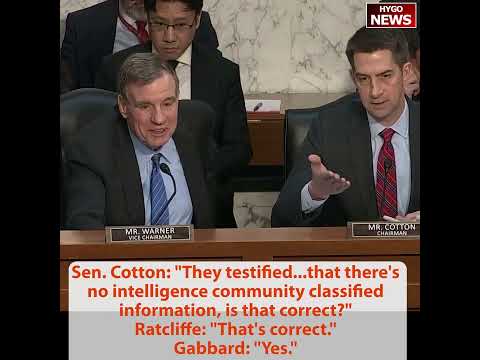
Senate Intelligence Committee Chairman Tom Cotton used his questioning time to establish the administration’s position on the record.
“They testified, as my understanding — correct me if I’m wrong — that there’s no intelligence community classified information,” Cotton said. “Is that correct?”
Ratcliffe’s answer was unequivocal: “That’s correct.”
Cotton turned to Gabbard: “Is that correct, Director Gabbard?”
“Yes, Chairman,” Gabbard confirmed.
The exchange was designed to create a clean, quotable record: the two most senior intelligence officials in the government, under oath before the Senate Intelligence Committee, both confirmed that no classified intelligence community information had been shared in the Signal group chat. Whatever the chat had contained, it did not include the kind of classified intelligence product that the CIA, NSA, or other intelligence agencies produced.
The distinction between “intelligence community classified information” and other forms of sensitive information was at the heart of the controversy. The intelligence community had specific definitions of classified information — material that had been formally classified by an original classification authority under established procedures. Whether operational military details like timing and targets constituted “classified” information under these definitions depended on which agency had original classification authority — a question that, as Gabbard would explain, belonged to the Department of Defense, not the intelligence community.
King: “You Can’t Have It Both Ways”
Senator Angus King of Maine, an independent who caucused with Democrats, directly challenged the witnesses’ framing.
“That’s not correct!” King interjected after Cotton’s exchange. “She said repeatedly there’s nothing classified. Period.”
Senator Mark Warner echoed: “Period.”
King pressed the contradiction he perceived: “And the notion there’s not even acknowledgement of, ‘Hey, gosh, we screwed up’ is stunning to me. And the idea somehow, well, none of this was classified, but we can’t talk about it here — you can’t have it both ways.”
He addressed the authenticity question: “Unless, as Senator Bennet said, this reporter is somehow making this all up. And I think the White House has acknowledged that the text chain that he submitted was authentic.”
King imagined the reverse scenario: “It strains my mind to think — and it strains my mind if the shoe had been on the other foot — what my colleagues would be saying about this.”
He noted the absence of contrition: “I appreciate your comments, but you guys have both testified under oath. There’s nothing classified in that information. And there’s nothing — in a sense, I’ve not heard either one of you say, ‘Gosh, we screwed up.’”
King’s argument was that the witnesses were drawing an artificial distinction between “intelligence community classified information” (which they denied sharing) and operationally sensitive military information (which the chat appeared to contain). If information about attack timing, weapons, and targets was not classified, then it should be released publicly. If it could not be released publicly, then by definition it was sensitive enough that sharing it with a journalist was a serious breach.
Gabbard: “I Defer to the Secretary of Defense”
The most legally precise moment came when King challenged Gabbard directly on the content of the messages.
“So the attack sequencing and timing and weapons and targets — you don’t consider that to have been classified?” King asked.
Gabbard’s answer was carefully constructed: “I defer to the Secretary of Defense and the National Security Council on that question.”
King pushed back: “Well, you’re the head of the intelligence community, and you’re supposed to know about classifications.”
He restated his conclusion: “So your testimony very clearly today is that nothing was in that set of texts that was classified.”
King then made his request: “If that’s the case, please release that whole text stream so that the public can have a view of it.”
Gabbard’s deferral to the Secretary of Defense was legally precise even if politically unsatisfying. As DNI, her classification authority extended to intelligence community products. Military operational details — attack timing, weapons selection, target identification — fell under the Department of Defense’s classification authority. She was not evading the question; she was identifying the correct authority to answer it. Whether the distinction satisfied the committee was another matter.
Ratcliffe: “The Answer Is No”
When Senator Ossoff asked Ratcliffe directly whether the incident was “a huge mistake,” the CIA Director pushed back.
“Director Ratcliffe, this was a huge mistake. Correct?” Ossoff asked.
“No,” Ratcliffe replied.
Ossoff pressed: “A national political reporter—”
Ratcliffe interrupted: “Hold on. Let me answer.”
He explained his reasoning: “The reason I say no — if I agree with that characterization…”
Ossoff continued: “A national political reporter was made privy to sensitive information about imminent military operations against a foreign terrorist organization. An inadvertent mistake of adding a reporter. And that wasn’t a huge mistake?”
Ratcliffe maintained: “I think the — they characterized it as a mistake.”
The exchange revealed the different frameworks the two sides were using. Democrats wanted the administration officials to characterize the incident as a catastrophic security failure. The officials were willing to acknowledge it as an inadvertent error — a reporter was accidentally added to a chat — but were not willing to characterize the content as classified or the incident as having compromised national security.
Ossoff: “Utterly Unprofessional”
Senator Jon Ossoff of Georgia delivered the most pointed Democratic statement.
“This is an embarrassment,” Ossoff said. “This is utterly unprofessional. There’s been no apology. There has been no recognition of the gravity of this error.”
He concluded with a warning: “And by the way, we will get the full transcript of this chain, and your testimony will be measured carefully against its content.”
The warning that testimony would be “measured against the content” was an explicit threat: if the full transcript revealed information that contradicted the witnesses’ sworn statements about classification, the consequences could include perjury referrals.
The Classification Divide
The hearing crystallized the legal and political divide. The administration’s position was precise: no intelligence community classified information was shared; the use of Signal was permissible under existing CIA policies; any operational military details fell under DoD’s classification authority, not the intelligence community’s. The Democratic position was that the distinction between types of classified information was a technicality, that operational military details were obviously sensitive regardless of which agency held classification authority, and that the absence of an apology demonstrated a cavalier attitude toward national security.
Whether the full transcript, when eventually released, would vindicate the administration’s position or undermine it remained the open question that both sides knew would determine the controversy’s final chapter.
Key Takeaways
- Under oath, CIA Director Ratcliffe and DNI Gabbard both confirmed “no intelligence community classified information” was in the Signal chat.
- Senator King challenged: “Attack sequencing, timing, weapons, targets — you don’t consider that classified?” Gabbard deferred to the Secretary of Defense on military classification authority.
- King demanded release of the full transcript: “If it’s not classified, release it so the public can have a view.”
- Ratcliffe refused to call the incident “a huge mistake,” maintaining the chat was “permissible and lawful.”
- Ossoff warned: “We will get the full transcript and your testimony will be measured carefully against its content.”