 HYGO News
 Connect to McDonald's to "hear", No "persistent inflation", "expected," "temporary," Harris French
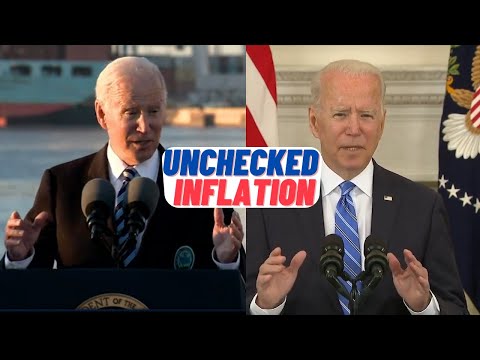
Biden: No “Persistent Inflation,” Prices Are “Expected” and “Temporary” — While Admitting Gas and Bread Cost More
In November 2021, President Biden delivered remarks that simultaneously acknowledged Americans were paying more for “everything from a gallon of gas to a loaf of bread” while insisting there was “nobody suggesting there’s unchecked inflation on the way.” The video captures Biden making his case that price increases were “expected” and “temporary,” that his Build Back Better bill would “ease inflationary pressures,” and that the infrastructure bill would transform the economy. It also includes Biden’s anecdote about families driving to McDonald’s parking lots to use the Wi-Fi so their children could participate in remote schooling, as well as clips of Vice President Harris speaking to French scientists and a Pentagon spokesman being pressed on Americans still stranded in Afghanistan.
”Nobody Suggesting Unchecked Inflation”
Biden addressed rising prices directly, though his framing sought to reassure rather than alarm. He acknowledged the reality that Americans were experiencing: “Everything from a gallon of gas to a loaf of bread costs more. And it’s worrisome, even though wages are going up.”
He then asked his audience a pointed question: “Do you ever think you’d be paying this much for a gallon of gas? In some parts of California they’re paying four dollars fifty cents a gallon.”
But Biden argued the price increases did not signal a lasting problem. “There’s nobody suggesting there’s unchecked inflation on the way. No serious economists,” he said. He characterized rising prices as a predictable consequence of the economic recovery: “Our experts believe, and the data shows, that most of the price increases we’ve seen were expected and expected to be temporary.”
He added a conditional warning: “My administration understands that if we were to ever experience unchecked inflation over the long term, that would pose a real challenge to our economy.” The phrasing — “if we were to ever experience” — presented persistent inflation as a hypothetical rather than an emerging reality, even as the Consumer Price Index was running at 6.2 percent year-over-year.
The McDonald’s Wi-Fi Anecdote
Biden used a personal anecdote that had become one of his recurring stories about the digital divide. He described families who lacked broadband internet access resorting to fast-food parking lots for connectivity.
“How many times if you don’t live in an area where you have high-speed internet you can afford, how many times you’ve driven your kids to the parking lot of McDonald’s and sat there going off the McDonald’s internet so you could hear,” Biden said. “No, I’m not joking.”
The story was meant to illustrate the need for broadband investment in the infrastructure bill. Biden argued the legislation would bring high-speed internet to communities that had been left behind, along with 500,000 electric vehicle charging stations and investments in roads, bridges, and other physical infrastructure.
He touted the bill with visible enthusiasm: “Infrastructure week has finally arrived. How many times you heard over the last five years, ‘infrastructure week is coming.’ Yeah.”
The Supply Chain Explanation
Biden devoted a significant portion of his remarks to explaining the supply chain crisis to his audience, acknowledging that the issue was complex and not well understood by the public.
“You hear a lot about the supply chains in the news, but frankly, not a lot of people have a clear understanding, whether they have a PhD or they didn’t go to school, about how a supply chain works,” Biden said.
He offered a simplified explanation: “The irony is people have more money now because of the first major piece of legislation I passed. You got checks for $1,400. If you’re a mom and you have kids under the age of seven, you’re getting $300 a month.” He acknowledged the consequence: “But what happens if there’s nothing to buy? You got more money, you compete for getting it there, it creates a real problem.”
Biden described the dynamic in economic terms: “With more people with money buying product and less product to buy, what happens? Prices go up.”
He cited progress on the port crisis, saying he had “reached a deal with two of the largest ports in America” — Los Angeles and Long Beach — to operate “24 hours a day, seven days a week.” He claimed “it’s already paying off. Last week the number of container ships at the docks for more than nine days fell by over 20%.” However, critics noted that the total number of ships waiting offshore remained at or near record levels at the time.
Build Back Better: “Not Going to Raise Taxes One Single Cent”
Biden made his standard pitch for the Build Back Better legislation, repeating the claims that had become central to the administration’s economic argument. “That’s in the Build Back Better bill, which is not going to raise taxes one single cent. It’s totally paid for, totally paid for by making taxes work for people who make over 400 grand and just do their fair share,” he said.
He again cited the 17 Nobel laureate economists: “They wrote a letter to me about 10 days ago saying this is going to affect bringing inflation down, not up.”
Biden characterized himself as a capitalist and rejected the notion that the bill represented an ideological expansion of government: “I’m a capitalist, man.” He argued the bill would deliver tangible benefits like reduced childcare costs, universal pre-K, and the child tax credit that was already “changing people’s lives.”
Afghanistan Families Still Unaccounted For
The video also included a clip from a Pentagon briefing where a spokesman was pressed on the number of immediate family members of U.S. service members still in Afghanistan more than two months after the withdrawal.
When asked for an updated count, the spokesman said: “I don’t have a whole number on that.” He estimated the number was “certainly most likely in the dozens.”
A reporter pressed: “The withdrawal ended on August 30th. Today is November 10th. How is it possible that the department doesn’t know how many immediate family members are still left?”
The spokesman pushed back: “I didn’t say we didn’t know. I said I don’t have a number for you. We believe it’s certainly most likely in the dozens. But it’s a dynamic thing.”
The reporter persisted: “Don’t you think this should have been a priority to begin with?”
“It was a priority,” the spokesman replied.
The exchange highlighted the ongoing fallout from the chaotic Afghanistan withdrawal, with service members’ family connections to the country continuing to create accountability questions for the administration months after the last American troops departed.
Key Takeaways
- Biden acknowledged Americans were paying more for “everything from a gallon of gas to a loaf of bread” while insisting there was “nobody suggesting there’s unchecked inflation on the way” and that price increases were “expected” and “temporary” — even as CPI ran at 6.2% year-over-year.
- He explained that the supply chain crisis was driven by Americans having “more money” from stimulus checks while there was “less product to buy,” creating the price pressures he simultaneously characterized as not being persistent inflation.
- A Pentagon spokesman could not provide the number of U.S. service members’ immediate family members still in Afghanistan more than two months after the withdrawal, estimating the count was “most likely in the dozens” while insisting the issue had been “a priority.”