 HYGO News
 Concerned heating winter homes? Tax credit if install expensive upgrade or solar panels
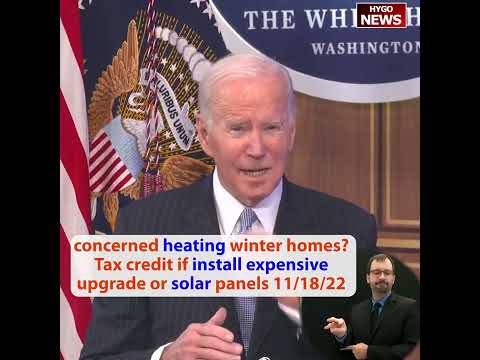
Biden’s Winter Heating Advice: Spend Thousands on Windows, Heat Pumps, Solar Panels to Get Back Hundreds in Tax Credits
On 11/21/2022, President Biden addressed American concerns about heating costs going into winter — by advertising Inflation Reduction Act tax credits that required families to spend thousands on home upgrades to receive hundreds back. “Starting January 1, you can get up to $3,200 tax credit to make your home more energy efficient,” Biden said. The list included “$600 tax credit for new windows, 500 for new doors, 2,000 install a heat pump, 600 to replace electric panels.” Biden claimed a homeowner with drafty windows could save “up to $1,100 in the cost of replacing them” — a claim that required families to spend significantly more on the replacement than the credit would cover, and to have the upfront cash to make the investment in the first place. For families struggling with immediate heating bills, the advice to undertake expensive renovations offered no near-term relief.
”Up to $3,200 Tax Credit”
Biden led with the headline number. “Starting January 1, you can get up to $3,200 tax credit to make your home more energy efficient,” Biden said.
The “$3,200 tax credit” figure was the maximum annual amount available under the Inflation Reduction Act for various residential energy efficiency improvements. To actually receive $3,200, a homeowner would need to undertake multiple substantial home improvement projects simultaneously — replacing windows, doors, HVAC systems, electrical panels, and insulation all in the same year.
The “up to” qualifier was doing significant work. Most families wouldn’t qualify for anywhere near the full $3,200 because they couldn’t afford to undertake that much work in a single year. The realistic credit for most families would be a fraction of the advertised maximum.
Moreover, tax credits required upfront spending that had to be recovered at tax time. A family that spent $10,000 on home improvements in December 2022 wouldn’t see their $3,200 credit until they filed their 2023 tax return in early 2024 — more than a year later. In the meantime, they would need to have had the $10,000 available to spend.
The Math of Tax Credits vs. Investment Costs
Biden’s list of specific credits revealed how the math actually worked:
$600 for new windows: A typical window replacement project for an entire home costs $8,000 to $25,000 depending on the house size, window type, and installation complexity. A $600 credit covered less than 10% of most projects.
$500 for new doors: Exterior door replacement typically costs $500 to $2,000 per door. For most homeowners replacing multiple doors, the credit might cover one door’s cost while they paid for the rest out of pocket.
$2,000 for installing a heat pump: Heat pump installation typically costs $5,000 to $15,000 depending on the system size and existing infrastructure. The credit covered 15-40% of the typical project cost.
$600 to replace electric panels: Electrical panel replacement typically costs $1,500 to $5,000 for a full upgrade. The credit covered a fraction of the project cost.
In every case, the credit was a small portion of the total investment required. Families couldn’t “save money on their energy bills” by claiming tax credits; they saved money on projects they were paying for anyway, and only if they had the capital to make those investments in the first place.
”Save Up to $1,100”
Biden’s most specific claim was about window replacement savings. “If you’re living in a home with drafty windows and doors starting January 1, you’ll be able to save up to $1,100 in the cost of replacing them,” Biden said.
The “$1,100 savings” figure apparently combined the $600 window credit with the $500 door credit — assuming the family replaced both windows and doors simultaneously. But even this combined credit was a fraction of the actual replacement cost.
A family replacing all the windows in a typical 2,000-square-foot home might spend $15,000. With a $600 credit, they would still pay $14,400. Calling this “saving $600” was technically accurate but misleading. The family wasn’t saving $600 — they were spending $14,400 that they could have spent on other things. The $600 was a discount on a major expense, not money they wouldn’t have otherwise spent.
The Solar Panel Pitch
Biden then repeated his solar panel talking point. “If you want to install solar panels on the roof, you can get a tax credit for 30% of the cost. It’ll bring down the cost of insulation by about $7,500,” Biden said.
The phrase “cost of insulation” appeared to be a verbal slip — Biden likely meant “cost of installation.” The $7,500 figure was based on an assumed $25,000 solar panel system cost. A 30% federal tax credit on $25,000 was $7,500 — arithmetic Biden got correct if the underlying assumption about system cost held.
But $25,000 was still $17,500 more than the credit. Families needed to have $25,000 available to invest before they could claim the $7,500 credit. For families worried about whether they could afford heating oil for the winter, the advice to invest $17,500 in solar panels was not useful guidance.
The Heat Pump Recommendation
“If you switch to electric heat pump to heat your home, you get a tax credit covering up to $2,000 of the cost,” Biden said.
Heat pumps had become Biden’s favorite winter heating recommendation. The technology was more energy-efficient than traditional furnaces and aligned with the administration’s electrification goals. Every Biden speech about winter heating seemed to include a heat pump plug.
But heat pump installation had significant practical barriers:
Cost: $5,000 to $15,000 for installation, with $2,000 credit covering only a portion.
Home compatibility: Heat pumps work best in newer, well-insulated homes. Older homes might need additional insulation and ductwork upgrades to accommodate heat pumps effectively.
Climate limitations: Traditional heat pumps lose efficiency in very cold temperatures. Cold-climate heat pumps exist but cost more and might require supplemental heating.
Installation availability: The supply of qualified heat pump installers was limited, particularly during peak demand. Families trying to install heat pumps before winter might find contractors booked for months.
None of these practical limitations appeared in Biden’s pitch. He presented heat pumps as a straightforward solution to winter heating costs, ignoring the significant investment, planning, and compatibility requirements.
The Disconnect From Immediate Needs
The fundamental problem with Biden’s winter heating pitch was the timing mismatch between the problem and the solution. Families were concerned about heating bills that they would pay in November, December, January, and February 2022-2023. These bills would be due immediately, with no option to defer them.
Biden’s solution — tax credits for home improvements — required:
- Immediate cash investment (thousands of dollars upfront)
- Time to complete improvements (weeks to months)
- Ability to wait for the credit (until tax filing, potentially a year later)
None of these matched the immediate needs of families facing winter heating bills. A family that couldn’t afford November’s heating bill also couldn’t afford to invest $15,000 in new windows. A family that had $15,000 to invest probably wasn’t worried about heating costs in the first place.
The advice to “save money on energy bills” through capital investment was appropriate for middle-class and affluent homeowners with disposable income and long-term planning horizons. It was not useful advice for the families facing the sharpest winter cost pressures.
Key Takeaways
- Biden offered winter heating advice centered on IRA tax credits: $3,200 maximum for energy efficiency improvements.
- The credits required families to spend thousands on home improvements to receive hundreds in credits.
- Window replacement ($600 credit) typically cost $8,000-$25,000; door replacement ($500 credit) was $500-$2,000 per door; heat pump installation ($2,000 credit) was $5,000-$15,000.
- Solar panels (30% credit) required roughly $25,000 upfront investment to claim a $7,500 credit.
- The advice offered no near-term relief to families facing immediate winter heating bills — the credits couldn’t be claimed until 2023 tax filing.
Transcript Highlights
The following is transcribed from the video audio (unverified — AI-generated from audio).
- Starting January 1, you can get up to $3,200 tax credit to make your home more energy efficient.
- $600 tax credit for new windows, 500 for new doors, 2,000 install a heat pump, 600 to replace electric panels.
- If you’re living in a home with drafty windows and doors, you’ll be able to save up to $1,100 in the cost of replacing them.
- If you want to install solar panels on the roof, you can get a tax credit for 30% of the cost.
- If you switch to electric heat pump to heat your home, you get a tax credit covering up to $2,000 of the cost.
- We’re talking about real money here for safety.
Full transcript: 161 words transcribed via Whisper AI.