 HYGO News
 CNBC: welcome news; Trump: Newsom worst-run; Schumer new lie; $taxpayer Sesame Street in Iraq funny
CNBC: welcome news; Trump: Newsom worst-run; Schumer new lie; $taxpayer Sesame Street in Iraq funny
A single news cycle produced four distinct political stories that, taken together, explain the administration’s current operating posture. President Trump offered his assessment of Gavin Newsom as California burns and a high-speed rail project stalls. CNBC, hardly a reliable administration cheerleader, conceded that the latest inflation data is “welcome news.” Senate Democratic Leader Chuck Schumer launched what the administration describes as “a laughable new lie” about the One Big Beautiful Bill and energy policy. And House Democratic leaders telegraphed open opposition to a rescissions package that would cut federal waste, including the now-infamous taxpayer funding of Sesame Street programming in Iraq. Each thread is independently significant. Together they reveal how the administration is trying to box in its political opposition on economics, energy, and spending simultaneously.
”All I Want Him To Do Is Do A Good Job”
Trump’s comments on Newsom came wrapped in a gesture of magnanimity that doubled as a trap. “All I want him to do is do a good job. I’d rather have him do a good job than a bad job, even though politically, I guess you could take the other extreme.” The aside — “politically, I guess you could take the other extreme” — is Trump acknowledging the incentive structure while pretending not to act on it. The subtext: some politicians would rather see a rival governor fail, because failure helps their party. Trump is saying he is not that kind of politician, even as he catalogues Newsom’s failures in the next breath.
“He’s doing a poor job. He’s doing a poor job with the train.” The pivot from magnanimity to criticism takes a single sentence. The “train” is California’s long-beleaguered high-speed rail project, a signature Newsom-era commitment that has become a durable symbol of public-sector cost overruns.
The California High-Speed Rail Indictment
Trump then delivered one of his sharpest lines. “How about the train that’s costing like 40 times more than it was supposed to? Yeah. Did you talk about that? And doesn’t go. Yeah, I always mention it doesn’t go to. It doesn’t go to San Francisco or Los Angeles. It’s way short because it was too expensive to go in. The whole thing is crazy.”
The criticism is rhetorically effective because its components are factually true in the main. The project’s budget has escalated massively from its original estimates. Its scope has been reduced, and the current build-out does not reach either anchor city the project was designed to connect. Trump compresses those facts into a single scathing takedown — a train that costs far more than promised and doesn’t go to the cities it was supposed to serve — and uses it as a stand-in for his broader critique of California governance.
”One Of The Worst Run Places”
Trump’s summary judgment: “It is the worst run, one of the worst run places. We have a lot of them in almost all cases run by Democrats.” The parenthetical caveat — “one of the worst run places” rather than “the worst” — is a rare Trumpian hedge, but the broader assertion is unambiguous. California, in his telling, is the poster child for Democratic governance failures, and California’s problems are not unique but representative.
The argument is politically pointed because it ties governance quality to party. Trump is not claiming Republicans never fail. He is claiming that the places that fail most visibly tend to be the places Democrats run. Whether one agrees with that characterization or not, it is a theme he returns to in multiple contexts, and the California rail project gives the theme a concrete exhibit.
CNBC: “No Way To Look At These Numbers And Say They’re Not Welcome News”
The inflation segment carried particular weight because of the source. CNBC is a business-news outlet with no ideological allegiance to the administration. Its analyst’s concession was striking: “There’s no way to look at these numbers and say they’re not welcome news.”
“No way” is a strong framing. It forecloses the usual move of finding a dark lining in bright data. The implication is that the inflation report is favorable on its face, and attempting to spin it otherwise would be analytically dishonest.
The Tariff Test
The next line from the CNBC discussion addressed the single most common prediction about tariffs — that they would inflate consumer prices. “I mean, a downside surprise to core core goods is where people were looking for potentially tariff effects and maybe except for isolated areas that Steve mentioned. You’re not quite getting that. So I think it’s all it’s all net.”
“Core core goods” is industry shorthand for the narrowest, most tariff-exposed category. That is the category where economists would most expect to see price increases if tariffs were flowing through to consumers. Instead, the category showed a “downside surprise” — coming in lower than forecast. The analyst’s conclusion: except for isolated pockets, the predicted tariff inflation is not appearing in the data.
The administration has been waiting for exactly this kind of acknowledgment from mainstream financial press. The thesis critics raised about tariffs — that they would damage consumers — is being provisionally rejected by the data, and financial reporters are saying so on camera.
Schumer’s “Laughable New Lie”
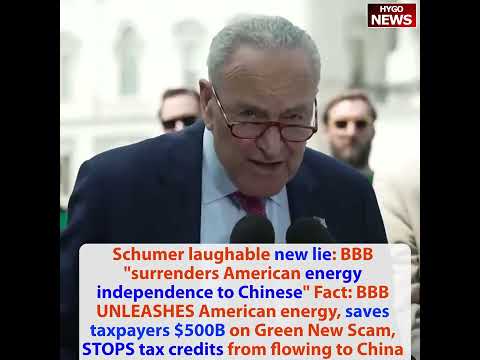
The third thread is Schumer’s attack on the One Big Beautiful Bill’s energy provisions. In his framing, the legislation “surrenders American independence and energy independence to the Chinese Communist Party and to the Chinese government.”
Schumer built the argument around solar policy. “This is it. Look, no further than this bill. China’s gaining in solar wants to dominate. If we cut off all solar production, China will dominate and our children and grandchildren and even many of us will be at China’s whim. At China, we China will have a grip on our energy policy. We’ll be outrageous, outrageous.”
His logic: the bill cuts subsidies and tax credits that have supported U.S. solar manufacturing. Without those supports, Schumer argues, U.S. solar production will atrophy, and China — already dominant in solar manufacturing globally — will consolidate a near-monopoly position. The concern, in Schumer’s telling, is not abstract; it is generational.
The Administration’s Counter: “UNLEASHES American Energy”
The administration’s response is that Schumer’s frame inverts the actual mechanics of the bill. The One Big Beautiful Bill, as the administration describes it, does not cut energy investment. It redirects it. It ends what supporters call “Green New Scam” tax credits that, in the administration’s telling, were subsidizing Chinese supply chains regardless of where the subsidy dollars landed on paper. And it replaces those with domestic fossil and infrastructure incentives.
The rhetorical framing — the bill “UNLEASHES American energy, saves taxpayers $500B on the Green New Scam, and STOPS tax credits from flowing to China” — is the administration’s counter-narrative in one sentence. Readers will have to decide which frame maps onto reality, but the stakes of the disagreement are real. Roughly half a trillion dollars in credited energy spending is the difference between the two sides.
Jeffries And Schumer: Killing The Rescissions Bill
The fourth thread comes from House Democratic Leader Hakeem Jeffries and Senate Democratic Leader Chuck Schumer, who are coordinating opposition to a rescissions package that would cut waste, fraud, and abuse in the federal government.
The transcript captures their argument: “If you think any Democrats in the House might vote for the recisions package, whenever it comes up, I think it’s going to be strong democratic opposition here in the House. We’re going to work hard to kill the legislation here in the House of Representatives. This recisions bill, which is, you know, doing Elon Musk’s bidding in terms of devastating cuts to our ability as a country to protect our national security interests all across the world.”
The Democratic framing positions the rescissions bill as a Musk-inspired austerity measure that will weaken national security abroad. “And then at the same time, assaulting, you know, Bert Ernie, Big Bird, Elmo and all of the people connected to Sesame Street. That’s extraordinary. I mean, who are these people?”
The Sesame Street In Iraq Example
That line — invoking Bert, Ernie, Big Bird, and Elmo — is where the administration counters with the specific program the bill would cut: taxpayer funding for Sesame Street programming in Iraq. The administration’s question is not whether children’s educational content is valuable. It is whether U.S. taxpayers should be underwriting Sesame Street production for foreign audiences at the same time domestic households are navigating inflation and domestic programs face funding pressures.
The administration’s rhetorical move is to convert a generic “cuts to waste” proposal into a specific, memorable example. Most voters do not track rescissions packages closely. Most voters can form an opinion quickly about whether U.S. taxpayer dollars should fund Sesame Street production in Iraq. The administration is betting that the answer, for most voters, is no.
Secretary Rollins Closes The Day
Agriculture Secretary Brooke Rollins closed out the day with her own pitch for the One Big Beautiful Bill. “Well, here we are at the White House at the end of the day. It’s almost eight p.m. We’ve been running really hard all day from firefighting and our wildland firefighting force to snap and the snap waivers we signed to everything in the middle.”
Her enumeration of the bill’s agricultural benefits was precise. “Whether it’s permanent tax cuts and an increase of $13,000 per American family. And for the farmers and the ranchers, saving two million of our family farms from being subject to the death tax, which means they have to give their farm away because they can’t afford it, whether it means an additional $10 billion in tax cuts for our farmers and ranchers or a $3.8 billion increase in our farmers and ranchers income.”
The Death Tax And Family Farms
The estate tax — what Rollins calls “the death tax” — is a particular concern in agriculture because farms are asset-heavy and cash-poor. A family farm valued at several million dollars may have modest annual income. When an owner dies and the farm passes to the next generation, the estate tax bill can force a sale of land simply to satisfy the tax.
Rollins’s claim — saving “two million of our family farms” from that fate — is the administration’s core agricultural pitch. Two million is a large number relative to the universe of American family farms. The provision is designed to keep generational farms generational.
”One Thing After Another”
Rollins closed with the exhaustion line that political staffers recognize. “Y’all, it’s one thing after another. We’ve got to get this bill done. We’ve got to continue to effectuate President Trump’s vision of making America great again and for me, helping to lead on making agriculture here in America great again, too.” The honesty is rare in a political pitch — an acknowledgment that the pace is punishing, that the agenda is expansive, and that the policymakers moving it forward are running hard to keep up.
Key Takeaways
- Trump on Newsom’s rail project: “costing like 40 times more than it was supposed to. And doesn’t go. It doesn’t go to San Francisco or Los Angeles. It’s way short because it was too expensive to go in.”
- CNBC concedes: “There’s no way to look at these numbers and say they’re not welcome news,” with “downside surprise to core core goods” contradicting the predicted tariff inflation.
- Schumer claims the One Big Beautiful Bill “surrenders American independence and energy independence to the Chinese Communist Party” — the administration’s response: the bill “UNLEASHES American energy” and saves $500B.
- Jeffries and Schumer pledge to “work hard to kill” the rescissions bill while defending funding for “Bert Ernie, Big Bird, Elmo” — a specific target being taxpayer-funded Sesame Street production in Iraq.
- Ag Secretary Rollins highlights One Big Beautiful Bill provisions: $13,000 per family in permanent tax cuts, saving 2 million family farms from the death tax, $10 billion in farmer tax cuts, and a $3.8 billion income increase.