 HYGO News
 CNBC: real turnaround BC you didn't want to vote for Trump! Bessent: Wall Street economists wrong
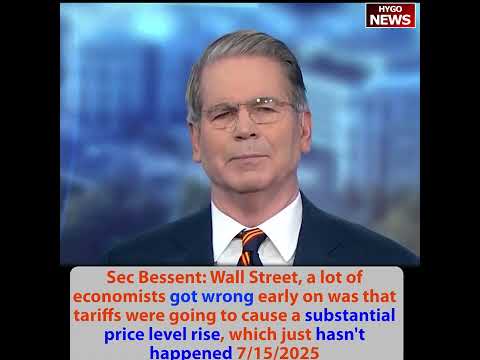
CNBC: real turnaround BC you didn’t want to vote for Trump! Bessent: Wall Street economists wrong
A remarkable on-air conversion. Home Depot co-founder Ken Langone, long ambivalent about Trump, declared on CNBC: “I am sold on Trump. In fact, I’ll say this. I think if you had a good shot at going down in history, it’s one of our best presidents ever” — prompting the anchor to note “that is a real turnaround because you didn’t want to vote for him.” Langone’s explanation was characteristically candid: “When you made a mistake, admit it.” Treasury Secretary Scott Bessent used the same cycle to walk through what Wall Street and economists got wrong on tariffs: “tariffs were going to cause a substantial price level rise, which just hasn’t happened.” Trump announced more than $90 billion in energy and data center investments at a Pennsylvania Innovation Summit, putting the cumulative investment figure at “over $15 trillion.” And Mike Rowe — the voice of American skilled trades — pushed for reshoring as a path to “two or three million jobs in manufacturing that currently don’t exist.”
Langone: “I Am Sold on Trump”
Ken Langone is not a low-wattage endorser. The Home Depot co-founder, longtime Republican megadonor, and vocal critic of Trump across the first term and the 2024 campaign, has been one of the most visible holdouts among establishment-Republican business figures. His on-air concession was pitched with full acknowledgment of his previous position.
“Look, let me tell you right now, I am sold on Trump,” Langone said. “In fact, I’ll say this. I think if you had a good shot at going down in history, it’s one of our best presidents ever.”
The anchor caught the significance immediately. “That is a real turnaround because you didn’t want to vote for him.”
Langone’s response was the language of a businessman who has watched results override his priors. “I tell you the reason. I want to tell you, I’m a believer. What I’m seeing happening is absolutely nothing short of a great thing. There’s a beat. People are walking with more bounce than they are. It’s all around."
"When You Made a Mistake, Admit It”
The anchor reminded Langone of his earlier criticism. “I gave you quite a bit of grief. Huh? I gave you grief.”
“You gave me grief?” Langone returned. “I gave you grief when it was a binary choice. You’re still complaining about Trump and it was a binary choice. It’s like, are you kidding me?”
Then the line that defines the conversion. “Knowledge implies one thing. When you made a mistake, admit it. Okay. I think this guy is turning out to be a president.”
That is a specific epistemic stance from a business leader. It is not “I like what he’s doing even though I disagreed with voting for him.” It is “I was wrong to not vote for him, and I admit it.” The distinction matters. Langone is not merely warming up; he is conceding his prior judgment was incorrect.
”The Only Guy in the Presidency That Would Have Done What You Did”
Langone then relayed an exchange that stuck with him. “One of the pilots on that miraculous trip to Iran, we wiped out whatever, how we wiped out. Right. He said, you’re the only guy in the presidency that would have done what you did. One of the pilots said that.”
“Yeah. And you know what? He’s probably right.”
The Iran reference is to the U.S. military action that destroyed Iranian nuclear facilities — one of the defining moments of Trump’s second term. Langone’s retelling — via a pilot’s direct testimony to the president — carries a specific weight. It is not a political commentator’s assessment. It is a uniformed operator on the mission telling the commander in chief, in person, that no one else would have made the call.
“And you know what? He’s probably right.” Trump’s characteristic self-affirmation here is not a boast. It is the acknowledgment that the judgment call was one he alone was prepared to make.
Bessent: “Economists Got It Wrong”
Treasury Secretary Scott Bessent used the same broadcast window to make a narrower but substantively important point. “I wouldn’t put too much emphasis on one number. I think it’s the trend. And I think one thing that Wall Street, a lot of economists, market in general, got wrong early on was that tariffs were going to a substantial price level rise, which just hasn’t happened.”
That claim is what the administration has been waiting to be able to make. The dominant economist prediction when the expanded tariff schedule was announced was that consumer prices would spike as import costs rose. That prediction has, through the first half of 2025, not materialized in headline CPI. Inflation has remained near the Fed’s target or below it, depending on which month and which index.
Bessent’s argument is structural. Tariffs are being absorbed — by foreign exporters accepting lower margins, by domestic importers accepting compressed margins, by supply-chain reconfigurations, and by input-substitution on the margin. The pass-through to consumer prices that was forecast has been smaller than predicted. If that pattern holds, it vindicates the administration’s core argument that tariffs can be used as a fiscal tool without the inflationary penalty economists projected.
”$15 Trillion of Investment”
Trump summarized the economic news in the broadest form. “Good day. I think we’re over now as a country. We’re over $15 trillion of investment. And there’s never been anything like that in the history of our country. There has not been anything like it or even close.”
The “$15 trillion of investment” figure is the cumulative capital commitment number the administration has been using since its Riyadh trip earlier in the term and subsequent rounds of bilateral announcements. It covers pledges from sovereign wealth funds, foreign governments, multinational corporations, and U.S. investors for projects in the United States.
Some portion of that $15 trillion represents capital that would have flowed to the U.S. anyway. Some portion represents commitments that will not translate to actual investment. But some portion represents new capital formation directly attributable to the administration’s posture on tariffs, tax, regulation, and deal-making. The ambiguity of what share fits which category is real, and the administration’s framing — “over $15 trillion” — is the maximalist version of the ledger.
Mike Rowe: The Manufacturing Jobs Case
Mike Rowe, the Dirty Jobs host who has become the most credible popular-culture advocate for skilled trades, endorsed the administration’s reshoring agenda in pragmatic terms. “I’m rooting for President Trump too. If he reassures and we reindustrialize, you’re talking about two or three million jobs in manufacturing that currently don’t exist.”
Rowe turned to the president for the current open-jobs number. “You probably have the numbers better than me, sir. But I think in five million, five million, open jobs in manufacturing right now.”
“We’ve got to train them,” Trump answered. “We’ve got to train them.”
Rowe expanded. “We have to train that is fun, mental, every community college. We’ve got to bring it back to high schools. Yep. Right. They’ve got to train. They’ve got to teach. They’ve got to show people that a great technician’s job starts at $75,000, ends at $200,000."
"You Don’t Need to Go to College”
Rowe then delivered one of the core messages he has been repeating for years, now in the president’s presence. “That’s right. You don’t need to go to college. You’re working in the coolest factory in the world. HVAC is not fixing your air conditioning. It’s a closed loop system on the coolest technology system you’ve ever seen in your life.”
“Amen,” Trump interjected.
“And the people who work in these factories,” Rowe continued. “He gets it. He absolutely gets it.”
“He gets it” — with Rowe turning to the room, gesturing at Trump — is an endorsement from a credible voice in an unusual domain. Rowe has historically been careful about overt political endorsement. His “he gets it” in this exchange is the closest he has come to an explicit one.
”National Security”
Trump then introduced the strategic frame. “It’s only a matter of national security.”
That phrase is doing significant work. Reshoring manufacturing is framed not merely as an economic development question (jobs, wages, tax base) but as a national security imperative. The argument: a country whose industrial capacity is offshored is a country that cannot surge production in a crisis. Semiconductors, pharmaceuticals, rare earths, and basic materials have all been showing up in national-security planning documents as categories where offshore dependence represents a strategic vulnerability.
The Pennsylvania Number
“I would say you mentioned, I read 70, then I heard 90 billion. It’s going to be 100 billion by the end of the day. A lot of money. A lot of money is going to come flying into this state.”
The Pennsylvania-specific investment figure climbed over the course of the event itself. Seventy billion at the start of the day. Ninety billion mid-event. A hundred billion projected by day’s end. The growth reflected additional commitments being announced in real time as the summit progressed.
For Pennsylvania — a state that has been at the center of the manufacturing-decline narrative for three decades — a $100 billion capital deployment is genuinely transformative. The state’s economic geography could shift in meaningful ways if even a meaningful fraction of that capital converts to actual operations.
Rowe’s Storytelling Pitch
Rowe closed with a specific ask of the administration and the capital being deployed. “What I would propose with all humility is that somebody somewhere carve just a little sliver out of that, a fraction of a percent allocated for better storytelling. Our country needs a national resource. Pennsylvania can lead this charge where any parent, any guidance counselor, any kid who is curious enough to explore the opportunity…”
The transcript cuts off mid-sentence, but Rowe’s argument is familiar to anyone who has watched his broader body of work. The problem with American manufacturing is not only the jobs themselves — it is the cultural narrative that tells young people those jobs are second-tier. Rowe is asking for a fraction of the capital being deployed to be used for narrative work: helping parents, guidance counselors, and students understand that skilled trades and advanced manufacturing are genuinely desirable career paths, not consolation prizes for those who didn’t go to college.
That is a sensible request. Whether it gets honored depends on whether corporate communications budgets of the companies making these investments include the kind of cross-sector narrative work Rowe is describing.
Two Conversions, One Moment
Langone’s conversion is the individual-billionaire version of the broader political realignment the administration has been cultivating. Bessent’s argument about economists being wrong on tariffs is the macroeconomic version of the same story — the experts who said this would fail are being shown to have missed. Rowe’s “he gets it” is the cultural-validation version. Trump’s “$15 trillion” is the capital-markets version.
Each of those stories, on its own, is a data point. Together, they are the kind of accumulating evidence that tends to define whether a presidency consolidates or stalls. The test is whether the pattern continues through the remaining years of the term.
Key Takeaways
- Home Depot co-founder Ken Langone reversed his prior position on CNBC: “I am sold on Trump … one of our best presidents ever” — with the anchor noting “That is a real turnaround because you didn’t want to vote for him.”
- Langone’s reasoning: “When you made a mistake, admit it … I think this guy is turning out to be a president.” He relayed a pilot from the Iran strike telling Trump “you’re the only guy in the presidency that would have done what you did.”
- Treasury Secretary Scott Bessent argued “one thing that Wall Street, a lot of economists, market in general, got wrong early on was that tariffs were going to a substantial price level rise, which just hasn’t happened.”
- Trump announced $15 trillion cumulative investment and more than $90 billion at the Pennsylvania Innovation Summit alone — projecting “100 billion by the end of the day.”
- Mike Rowe endorsed reshoring for “two or three million jobs in manufacturing that currently don’t exist,” said “you don’t need to go to college” to get a technician’s job starting at “$75,000 … ends at $200,000,” and asked the administration for “a fraction of a percent allocated for better storytelling” about skilled trades.