 HYGO News
 Clear about White House's plan? There actually hasn't been an official statement on Title 42
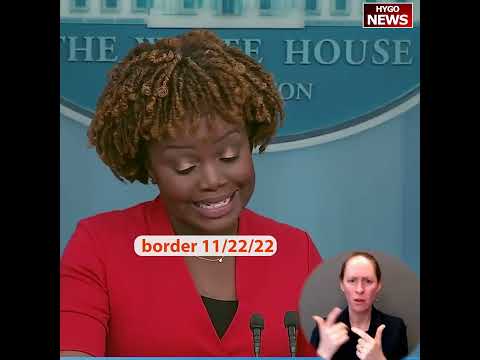
Reporter: “There Actually Hasn’t Been an Official Statement” on Title 42 Appeal — Will White House Appeal the December 21st Court Order?
On 11/22/2022, a reporter pressed White House Press Secretary Karine Jean-Pierre on a fundamental question the administration had been avoiding: would it appeal Judge Sullivan’s order ending Title 42 on December 21? The reporter noted directly: “You were saying the administration has been clear about its plan. There actually hasn’t been an official statement on whether or not the administration will appeal the December 21st court order that would lift Title 42. Will the administration appeal or will it not?” KJP’s response was a masterclass in non-answer. She talked about “preparing for” Title 42’s end, mentioned “accelerating asylum process,” and referred to DHS “proven strategies” — without ever answering whether the administration would appeal.
”There Actually Hasn’t Been an Official Statement”
The reporter’s framing directly contradicted KJP’s prior claims. KJP had been asserting that the administration had been clear about its border plan. The reporter pushed back on that assertion with a specific example: on the most urgent question of the moment — whether the administration would appeal the ruling ending Title 42 on December 21 — no official statement existed.
The distinction between “having a plan” and “communicating the plan clearly” mattered enormously. A plan that existed only in private administration discussions was not equivalent to a plan that had been communicated to Congress, to border officials, to state governments, or to the public. Decision-makers at every level of government needed to know whether Title 42 would end on December 21 or whether an appeal would delay that outcome. The absence of an official statement created operational uncertainty that made planning impossible.
The Concrete Decision
The appeal question had a specific deadline and required a specific decision. Judge Emmet Sullivan had ruled on November 15, 2022, that Title 42 must end on December 21 — giving the administration 35 days to prepare for the policy’s termination. The administration could:
- Accept the ruling and proceed with ending Title 42 on December 21
- Appeal the ruling to seek additional time or reversal
- Ask for a stay to delay implementation pending further legal proceedings
Each option had different consequences. Accepting the ruling meant preparing operational changes by December 21. Appealing meant signaling to courts and the public that the administration disagreed with the decision and wanted Title 42 to continue. Asking for a stay meant preserving the option to appeal while delaying the operational deadline.
”We’ve Been Preparing”
KJP’s response carefully avoided the binary question. “So in many ways we’ve been preparing for — just want to make sure that we’ve been — you aware that I know we get questions about if we’ve been preparing for what to do for — one Title 42 is lifted,” KJP said.
The sentence structure collapsed into incoherence, but the substantive content was clear: KJP wanted to talk about preparation rather than appeal decisions. “We’ve been preparing for this” was offered as evidence that the administration was engaged with the issue without actually answering whether they would fight the court ruling.
The shift from “appeal or not” to “preparation” was a classic deflection technique. The reporter had asked a yes/no question; KJP was answering a different question that she felt more comfortable addressing. The actual answer — the appeal decision — remained hidden.
”Accelerating Asylum Process”
KJP continued with specific but vague language. “We’ve been working to accelerate asylum process as we prepare to transition to the next phase of our work to manage the border — the border — in a safe, orderly, and humane way,” KJP said.
The “accelerate asylum process” phrase was a familiar administration talking point. Throughout 2022, administration officials had spoken about speeding up asylum processing as a solution to border pressures. The idea was that faster processing would reduce the backlog of cases, allow for quicker decisions, and discourage migrants from attempting to enter unlawfully because they would know their cases would be decided promptly.
The reality of asylum processing was different. The immigration court system had a backlog of approximately 2 million cases by late 2022, with wait times averaging multiple years. “Accelerating” this process would require either massive increases in immigration judge staffing (which required congressional funding) or substantial reductions in case complexity (which required policy changes). Neither had occurred.
”Safe, Orderly, and Humane”
The phrase “safe, orderly, and humane way” had become the administration’s standard descriptor for border management. It appeared in virtually every administration statement about the border, regardless of whether actual conditions matched the description.
The phrase was carefully chosen for its rhetorical appeal. Who could oppose safety, order, and humanity? The three words combined to create an image of competent, compassionate governance that transcended political debate.
But the reality at the border in November 2022 did not match any of the three descriptors. The situation was not safe — migrants were dying in record numbers, cartels were exploiting vulnerable people, and fentanyl was flowing across in quantities that were killing Americans. The situation was not orderly — Border Patrol was overwhelmed by encounter numbers, processing facilities were operating at capacity, and migrants were being released into the interior with minimal documentation. The situation was only “humane” in the sense that the administration wasn’t actively cruel — but the chaotic conditions were producing real suffering.
Calling the border situation “safe, orderly, and humane” required redefining those words. KJP was using them as rhetorical framing rather than factual description.
”DHS Will Continue to Double Down”
KJP referenced DHS plans. “The Department of Homeland Security will continue to double down on those proven strategies. And you should expect to hear more from them in the coming weeks on how we’re preparing for this because I know that’s been a question,” KJP said.
The “proven strategies” phrase was interesting. If the strategies were proven, why were border encounters at all-time highs? Proven strategies should produce measurable improvement. The strategies in place had presided over the worst border numbers in American history. Calling them “proven” was another example of language being used rhetorically rather than descriptively.
The “you should expect to hear more in the coming weeks” deferral was also telling. On a question about a decision that needed to be made within days (whether to appeal Judge Sullivan’s ruling), KJP was promising communication “in the coming weeks.” The timeline mismatch suggested the administration hadn’t decided and wasn’t prepared to discuss the decision publicly even as the deadline approached.
”I’m Not Going to Get Into Any Specific”
KJP’s concluding line was the direct non-answer. “Look, I’m not going to get into any specific…” she said, before the transcript cut off.
“Not going to get into any specific” was the direct acknowledgment that the answer to the reporter’s question would not be provided. KJP had been asked a specific, binary question — will the administration appeal? — and her answer was that she wouldn’t address specifics.
This confirmed the reporter’s initial framing: there was no official statement on the appeal decision. The reporter had asked because the statement didn’t exist, and KJP’s response confirmed that it still didn’t exist. Nothing had changed during the briefing. The administration remained without a public position on the most urgent border question of the moment.
Key Takeaways
- A reporter noted that despite KJP claiming the administration had “been clear about its plan,” there was no official statement on whether the White House would appeal Judge Sullivan’s ruling ending Title 42 on December 21.
- KJP’s response talked about “preparing” and “accelerating asylum process” without answering whether the administration would appeal.
- She described the border situation as “safe, orderly, and humane” — a standard phrase that contradicted conditions at the border.
- KJP promised more details “in the coming weeks” — a timeline that didn’t match the imminent December 21 deadline.
- The exchange ended with KJP’s direct acknowledgment that she wasn’t “going to get into any specific.”
Transcript Highlights
The following is transcribed from the video audio (unverified — AI-generated from audio).
- You were saying the administration has been clear about its plan. There actually hasn’t been an official statement on whether or not the administration will appeal.
- Will the administration appeal or will it not?
- In many ways we’ve been preparing for — just want to make sure that we’ve been preparing for what to do for when Title 42 is lifted.
- We’ve been working to accelerate asylum process as we prepare to transition to the next phase.
- The Department of Homeland Security will continue to double down on those proven strategies.
- I’m not going to get into any specific.
Full transcript: 181 words transcribed via Whisper AI.