 HYGO News
 Trump on China Film Ban: 'I've Heard of Worse'; Hegseth Signs Panama Canal Deals; Rubio: 'Re-Ordering the World'
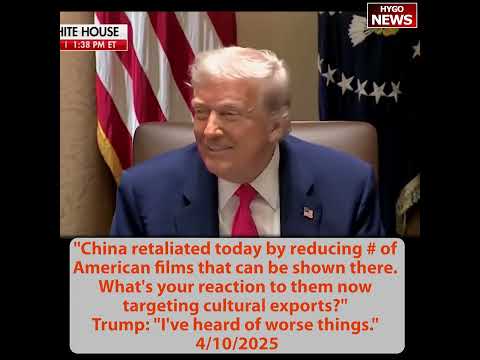
Trump on China Film Ban: “I’ve Heard of Worse”; Hegseth Signs Panama Canal Deals; Rubio: “Re-Ordering the World”
A wide-ranging April 2025 cabinet discussion produced multiple major developments. When told China had retaliated by reducing American film access, Trump shrugged: “I’ve heard of worse things.” Defense Secretary Hegseth reported signing “historic deals” at the Panama Canal — a framework for U.S. vessels to pass “first and free” plus a memorandum for U.S. military presence at Fort Sherman to “push out” Chinese influence. Secretary Rubio called the tariff policy “reordering the world in a proper way” after “31 years” of allowing China “to deindustrialize this country.” He also confirmed direct Iran talks on Saturday and continuing deportation of students who “vandalize libraries and take over campuses."
"I’ve Heard of Worse Things”
The exchange was brief and devastating.
“China retaliated today by reducing the number of American films that can be shown there,” a reporter said. “What’s your reaction to them now targeting cultural exports from the United States?”
Trump’s response: “I think I’ve heard of worse things.”
The dismissal was calculated. China’s decision to restrict American film imports was, in the context of a trade war involving trillions of dollars, a negligible retaliatory measure. The American film industry made money in China, but the amounts were insignificant compared to the hundreds of billions in trade flows at stake. By treating the film restriction as trivial, Trump signaled that China’s retaliatory options were becoming increasingly limited and desperate.
Panama Canal: “Taking It Back”
Hegseth delivered the most significant military-diplomatic announcement of the day.
“Mr. President, we just got back from Panama last night,” Hegseth said. “We were at the Panama Canal with our SOUTHCOM commanders, F-18s, troops, and signed a couple of historic deals.”
He detailed the agreements: “One which is the Panama Canal Authority — a framework for U.S. vessels, first and free through the Panama Canal.”
The second: “And then also a memorandum of understanding with their security minister with the presence of U.S. troops. Fort Sherman is an old U.S. base there, as well as a naval station and air station, jointly with Panama to secure the Panama Canal from Chinese influence.”
Hegseth stated the bottom line: “That’s something you said — we’re taking back the canal. China had too much influence. Obama and others let them creep in. We, along with Panama, are pushing them out, sir.”
He praised the Panamanian leadership: “President Mulino sends his regards, very complimentary of the U.S. He’s a great ally. And I think they want the Communist Chinese out. And with our troops there partnering with their forces, we’ve got a chance to push them all the way out.”
The Panama Canal agreements represented one of the most consequential Western Hemisphere security developments in decades. China had been expanding its influence over the canal through infrastructure investments and port operations. The new framework — U.S. vessels passing “first and free,” American military presence at Fort Sherman, and joint naval and air stations — reasserted American strategic control over the waterway that connected the Atlantic and Pacific oceans.
Rubio: “31 Years” of Deindustrialization
Secretary Rubio placed the tariff policy in its broadest geopolitical context.
“One of the most important things I believe you’ll achieve in your presidency is reordering the world in a proper way,” Rubio said.
He quantified the failure: “For 31 years — more than 31 years now — multiple administrations have allowed the Chinese to deindustrialize this country, to take away jobs and factories and pillars of our national strength.”
Rubio praised the current action: “What you’re doing now is a great service to our country, but ultimately to the world. And I want to congratulate you and your team that’s working on that, because it has extraordinary geopolitical implications — as you see from all these other countries that are now coming here and wanting to join.”
He described the asymmetry: “Basically, we lived in a world where Chinese companies can do whatever they want in America, but our companies cannot do anything over there unless they allow it. And even then they steal our stuff and reverse-engineer it.”
Rubio concluded: “Just reordering all of that has dramatic implications on peace and security of the world.”
The “31 years” traced the timeline to China’s Most Favored Nation status renewal in 1994 — the issue Pelosi had spoken against on the House floor in 1996. In the three decades since, the deindustrialization Rubio described had accelerated through China’s WTO accession in 2001 and the subsequent explosion in Chinese manufacturing exports.
Iran: “Direct Talks on Saturday”
Rubio confirmed the Iran negotiation timeline.
“An important meeting, thanks to you, is going to happen on Saturday for the first time in a long time,” Rubio said. “There will be direct talks between Ambassador Witkoff and a top-level leader in Iran.”
He stated the red line: “You’ve been very clear — Iran is never going to have a nuclear weapon. And I think that’s what led to this meeting.”
Rubio expressed cautious optimism: “We’ll wait for him to come back from it, and we’re hopeful about that.”
The Saturday talks represented the culmination of weeks of diplomatic pressure. The combination of the Houthi campaign (destroying Iran’s most active proxy), secondary tariff threats, and the direct letter Trump had sent to Iranian leadership had created the conditions for face-to-face negotiations.
Student Visa Enforcement
Rubio reiterated the administration’s position on foreign students with characteristic rhetorical flair.
“If you come to this country as a student, we expect you to go to class and study and get a degree,” Rubio said. “If you come here to vandalize a library, take over a campus, and do all kinds of crazy things — we’re going to get rid of these people.”
He used his now-familiar analogy: “A student visa is like me inviting you into my home. If you come into my home and put all kinds of crap on my couch, I’m going to kick you out of my house. And that’s what we’re doing with our country, thanks to the President.”
International Cooperation on Deportations
Rubio reported unprecedented international cooperation on immigration enforcement.
“We are receiving historic cooperation from countries all over the world in taking back their citizens,” he said. “Every country in the world has to take back people that are illegally in another country.”
He noted the consequences for non-compliance: “The ones that are not are paying a price.”
He previewed a visit: “President El Salvador will be here next week. He’s really been a good friend of the United States in that regard.”
Key Takeaways
- Trump dismissed China’s film retaliation: “I’ve heard of worse things.”
- Hegseth signed “historic deals” at the Panama Canal: U.S. vessels “first and free,” military presence at Fort Sherman, and joint operations to “push out” Chinese influence.
- Rubio called the tariffs “reordering the world” after “31 years” of allowing China “to deindustrialize this country, take away jobs, factories, and pillars of national strength.”
- Direct Iran talks confirmed for Saturday between Ambassador Witkoff and a “top-level leader” — with the clear red line that “Iran is never going to have a nuclear weapon.”
- Rubio on student visas: “A student visa is like me inviting you into my home. If you put crap on my couch, I’m going to kick you out.”